
 Philippines
 Vietnam
 Bali, Indonesia
 Malaysia
 Dubai, UAE
 India
India
Zoom's homepage sends Vietnamese searchers to zoom.com/vi, and that URL answers with a 302 redirect to the English homepage unless the request asks for Vietnamese. Google's crawler sends no Accept-Language header, so it gets the redirect. In September 2026 we fetched 50,476 alternate URLs from top homepages to count how often hreflang breaks like this.
How many Southeast Asian sites break hreflang?
Just over half. 1,221 of the 2,300 homepages (53.1%) fail at least one check based on Google's localized versions documentation. 612 sites (26.6%) fail two or more types of check, and 320 fail three or more.
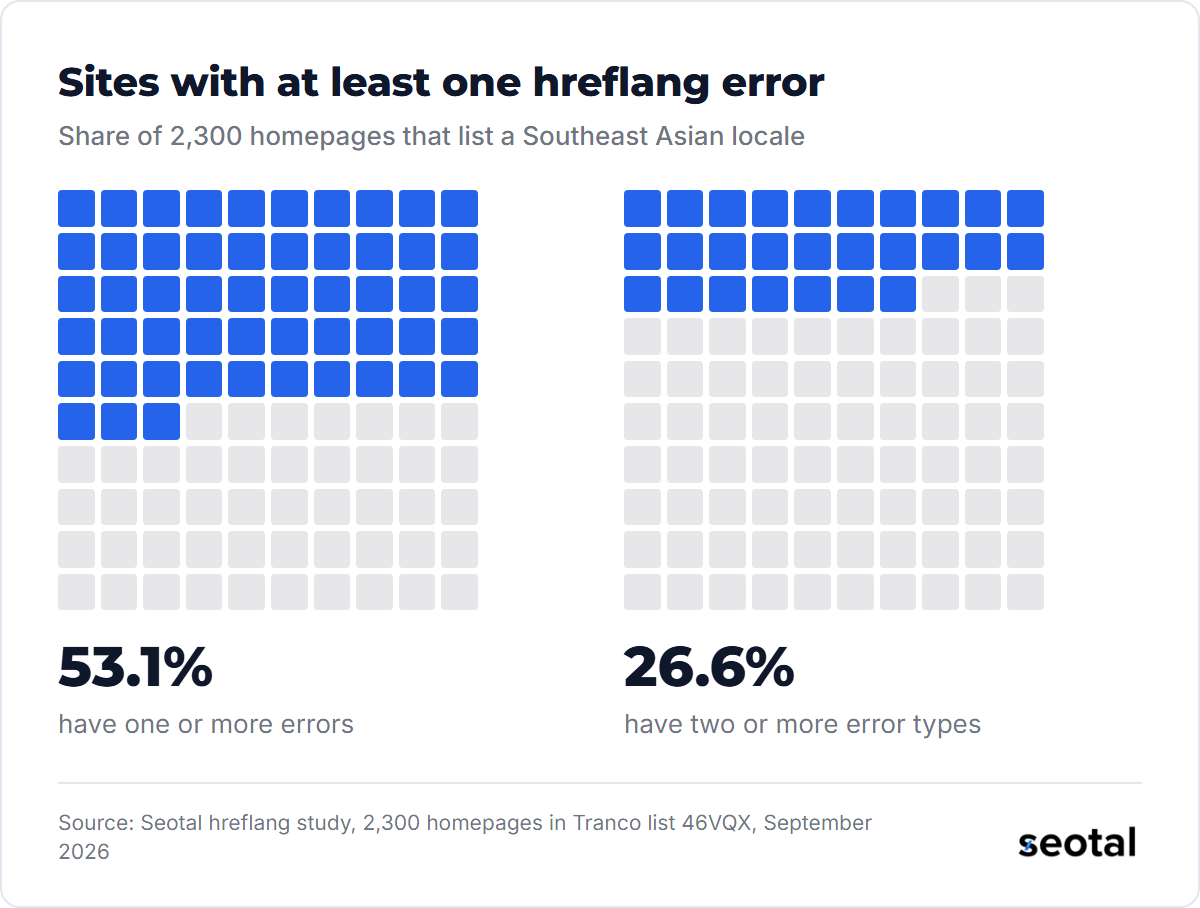
These are large sites. Every domain sits in the Tranco top 83,000, and 78 of them are in the top 1,000. Hreflang is also rarer than many audits assume: 11,106 of the 50,497 homepages we could read (22.0%) carry any hreflang tag, and 2,507 of those list a Southeast Asian language or country.
Which hreflang errors are most common?
Canonical conflicts lead. 477 sites (20.7%) list an alternate page whose own rel="canonical" points to a different URL, or a homepage that canonicalises away from itself. Google's guidance on duplicate URLs asks sites that use hreflang to pick a canonical in the same language.
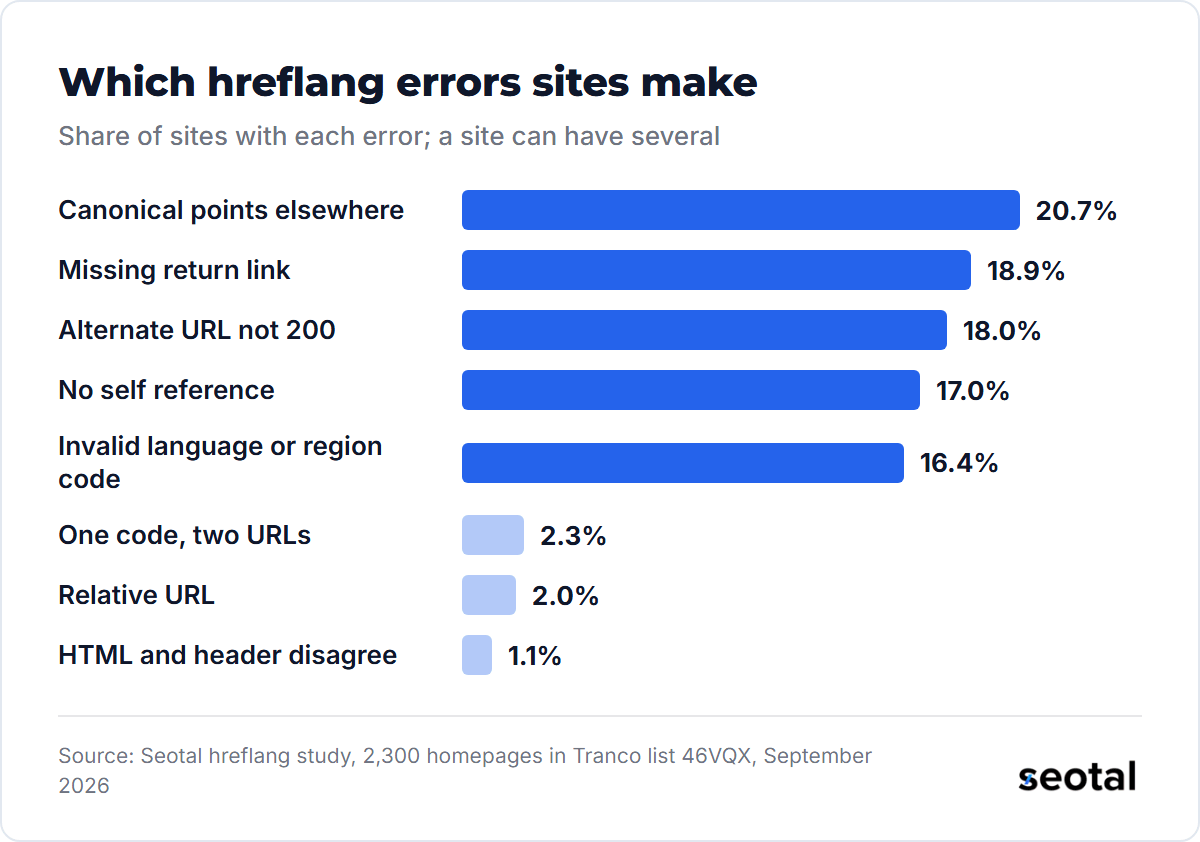
| Check | Sites | Share | Google basis |
|---|---|---|---|
| Canonical points to another URL | 477 | 20.7% | Canonical in the same language, duplicate URLs guide |
| Missing return link | 434 | 18.9% | "If two pages don't both point to each other, the tags will be ignored" |
| Alternate URL not 200 | 415 | 18.0% | Our check: a redirect or error cannot confirm a return link |
| No self reference | 392 | 17.0% | "Each language version must list itself" |
| Invalid language or region code | 377 | 16.4% | ISO 639-1 language, optional ISO 3166-1 alpha-2 region |
| One code, two URLs | 54 | 2.3% | Our check |
| Relative URL | 46 | 2.0% | "Alternate URLs must be fully-qualified" |
| HTML and Link header disagree | 25 of 37 | 1.1% | Our check |
Wacom shows three of these at once. Its India homepage lists hreflang="en-sg" href="https://www.wacom.com/en-sg", and that Singapore page carries no hreflang tags and a canonical pointing to https://www.wacom.com/en-us.
Which Southeast Asian codes do sites get wrong?
The Filipino language code causes most of the damage. 94 sites use fil and 18 use fil-PH, but fil is an ISO 639-2 code, and Google's page states that only ISO 639-1 language codes are supported. The ISO 639-1 code for the language is tl (Tagalog), which 186 sites use.
| Southeast Asian value | Sites |
|---|---|
id | 1,141 |
vi | 906 |
th | 889 |
en-SG | 655 |
ms | 494 |
en-MY | 424 |
en-PH | 390 |
id-ID | 353 |
Language-only codes lead the list, and English with a country code follows. Four other mistakes recur:
- Country first. HP's Poly pages publish
sg-en,my-en,ph-enandvn-vi. The first slot must be a language:sgis the code for Sango, andvnis no language code at all. - Withdrawn codes. 10 sites use
in-ID. ISO replacedinwithidfor Indonesian in 1989. - Underscores. GE HealthCare writes
hreflang="en_sg"; Google's format uses a dash. - Right code, wrong country. iCloud lists
vi-vi, which is Vietnamese for the US Virgin Islands. Six sites usekm-KM(Comoros) and three usems-MS(Montserrat).
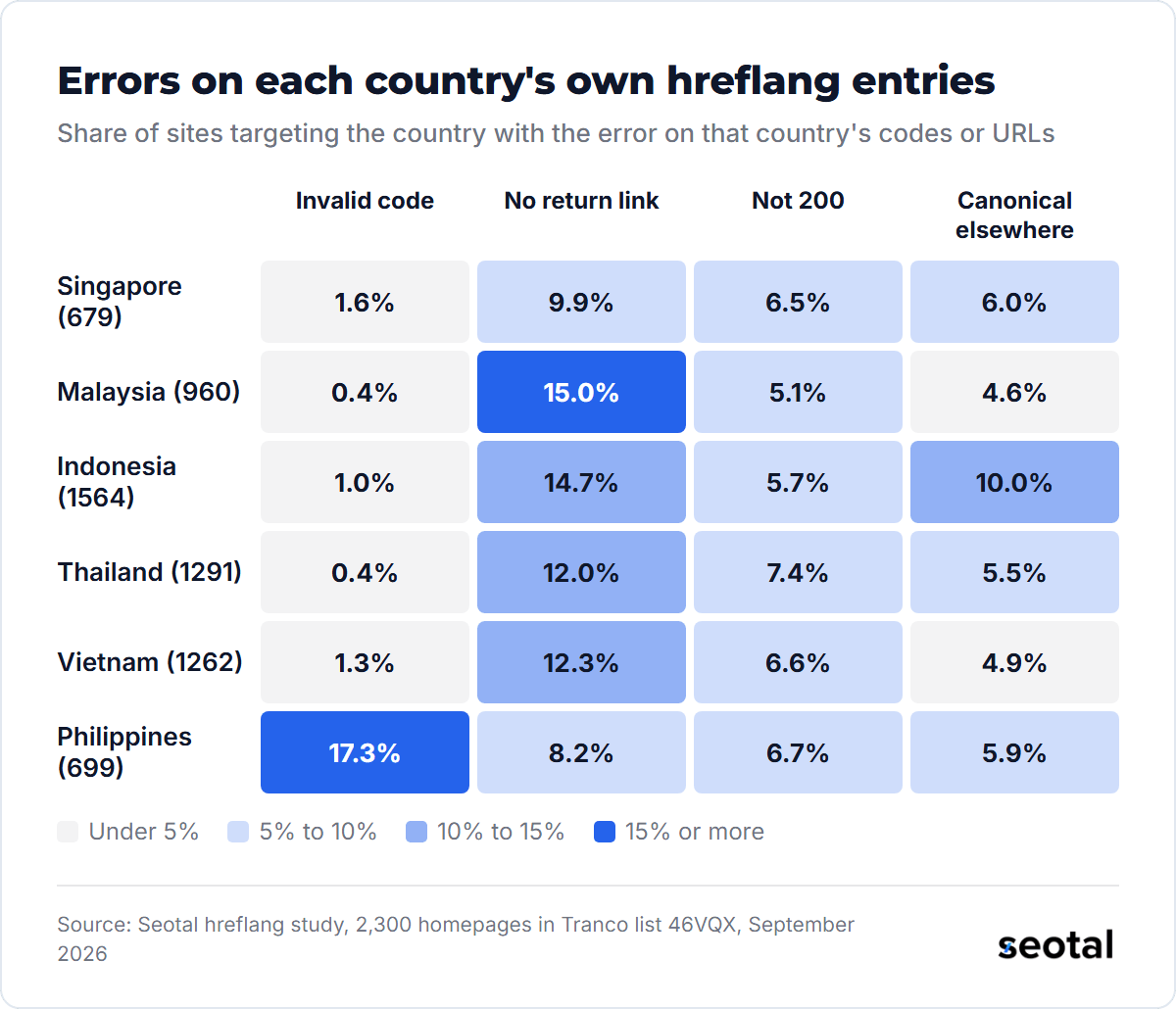
Return links fail most on Malaysian entries (15.0% of sites that target Malaysia) and Indonesian ones (14.7%). Indonesian entries also have the most canonical conflicts, at 10.0%.
How often do return links fail?
13.5% of the time. We fetched 44,546 alternate pages that returned 200 and looked for a link back to the homepage that listed them; 6,007 had none. For Southeast Asian alternates the rate is 14.6%, or 890 of 6,097.
"If two pages don't both point to each other, the tags will be ignored."
That sentence is from Google's localized versions page. A missing return link does not break the whole cluster, since Google processes the pairs that do point to each other. 710 of the failing alternates carried no hreflang tag at all, like the Thai, Vietnamese and Indonesian pages on iie.org.
The failures concentrate on the page we landed on. Between the alternates themselves, we checked 1,340,642 pairs, and only 16,624 (1.2%) lacked a return link. 202 of 1,864 sites (10.8%) had at least one broken pair. I read that as homepage templates drifting from the rest of the site, though our data cannot prove it.
Page A lists page B as its th version, but page B lists no hreflang tags. Does Google still use the A to B annotation?
Do alternate URLs return 200?
88% of Southeast Asian alternates do. We requested each alternate once without following redirects: 44,546 of all 50,476 checked URLs returned 200, 2,631 redirected and 466 returned a 4xx, a 5xx or had no DNS record.
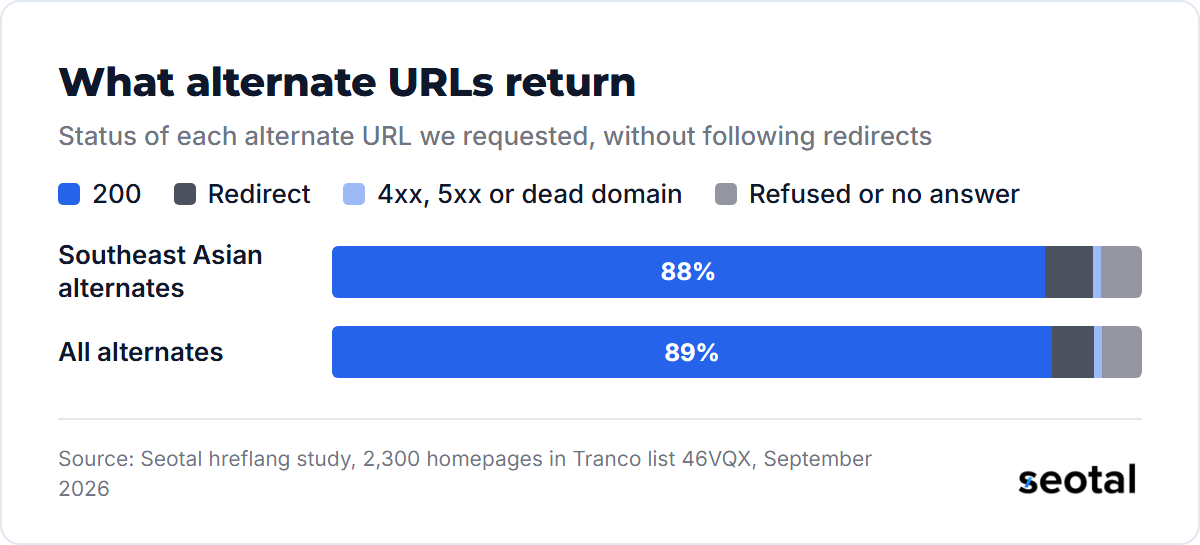
1,158 of the redirects only add or remove a trailing slash. The other 1,473 go somewhere else, often back to a default homepage. Zoom lists <link rel="alternate" href="https://www.zoom.com/vi" hreflang="vi">, and in our re-check that URL returned 302 to https://www.zoom.com/ without an Accept-Language header and 200 with Accept-Language: vi. Google's multi-regional sites guide says Googlebot crawls without that header and asks sites not to redirect by guessed language.
We did not count 60 redirecting URLs that are listed only as x-default. Google suggests x-default for auto-redirecting homepages, so a redirect there follows its advice. A further 1,602 requests were refused with 401, 403 or 429, and 875 got no answer; neither group counts as an error.
Do bigger sites make fewer hreflang mistakes?
No. The top 1,000 sites fail at least one check 56.4% of the time, against 47.8% for sites ranked 50,001 to 83,000. The middle bands split the difference with no trend.
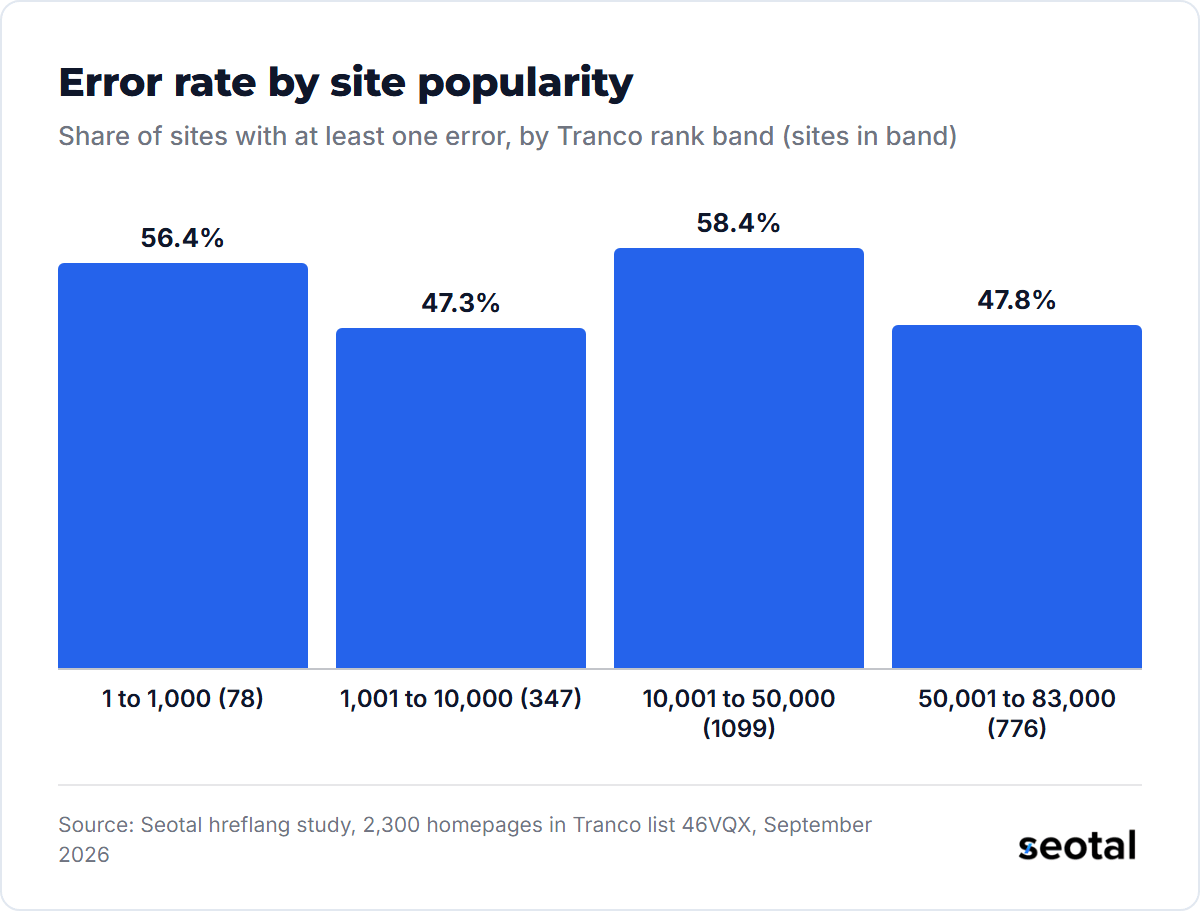
Large sites fail differently. Invalid codes hit 24.4% of top 1,000 sites, against 14.0% in the lowest band, and the invalid values include codes such as fil, ceb and es-419. Missing return links peak in the 10,001 to 50,000 band, at 24.4%.
Do sites use x-default?
Three in four do. 1,719 sites set hreflang="x-default" and 581 (25.3%) do not. We report that as "not used" rather than as an error: Google calls x-default recommended for users whose language settings match no version, and it is not required.
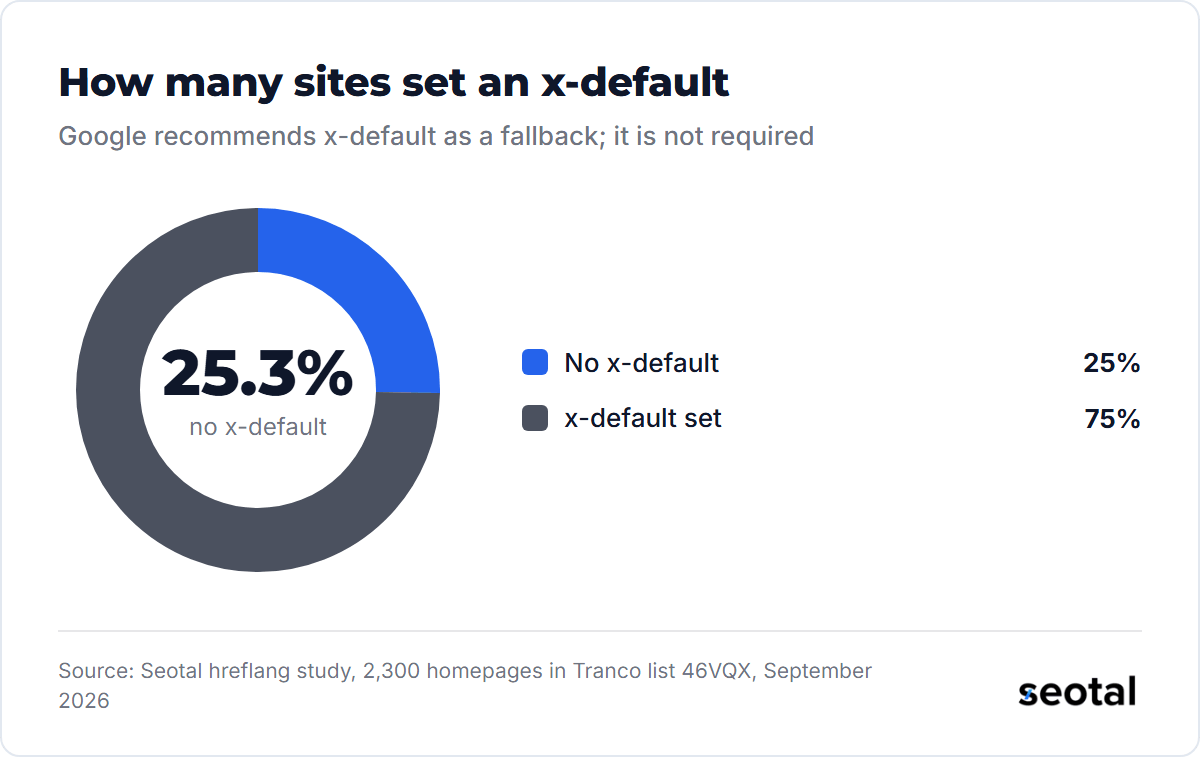
Link headers are rare on homepages. 2,247 sites use HTML tags only, 16 use HTTP Link headers only and 37 use both. We did not read XML sitemaps, which the Vietnamese SEO guide covers as a third way to declare vi-VN pages. Our hreflang guide for Southeast Asia publishes on October 3.
Methodology
Sample. We downloaded Tranco list 46VQX, created on September 12, 2026 from 30 days of CrUX, Farsight, Majestic, Cloudflare Radar and Umbrella data. We planned to fetch the top 100,000 domains and stopped at rank 83,000 when the run hit its time limit; every rank from 1 to 83,000 was fetched.
| Step | Count |
|---|---|
| Domains in ranks 1 to 83,000 | 83,000 |
| No answer (DNS, TLS, timeout, reset) | 15,408 |
| Refused (401, 403, 429) | 12,160 |
| robots.txt disallows us, or returns 5xx | 2,943 |
| Other 4xx, 5xx or errors | 1,992 |
| Homepages read (200) | 50,497 |
| With any hreflang tag or Link header | 11,106 |
| With a Southeast Asian locale | 2,507 |
| Minus domains that land on a homepage already counted | 2,308 |
Minus sites whose only match is es-LA | 2,300 analysed |
A Southeast Asian locale is any value with region SG, MY, ID, TH, VN, PH, KH, MM, LA or BN, or language id, ms, th, vi, fil, tl, km, my or lo. We analysed every qualifying site, so no cap applied.
Fetch. On September 13, 2026, between 15:30 and 19:48 UTC, we requested https://<domain>/ and followed up to 5 redirects, with a 15 second timeout, as SeotalResearch/1.0 (hreflang study; +https://www.seotal.com/). We tried the www host when the apex gave no answer or a 5xx. Before any page request we read the host's robots.txt under RFC 9309 and skipped disallowed URLs.
For each analysed site we requested up to 50 alternate URLs once each, without following redirects: Southeast Asian ones first, then x-default, then the rest. 270 sites listed more than 50. We sent at most one request per second to any host, with 32 homepage and 12 site workers running at a time.
Checks. Language codes were validated against the 183 ISO 639-1 codes, regions against the 249 assigned ISO 3166-1 alpha-2 codes, and scripts against ISO 15924. Google ignores the reserved UK, EU and UN regions, so we count those as invalid. A return link or self reference counts when the tag's URL matches the fetched URL, or the homepage's own canonical when that differs only by a slash or query string.
Manual check. We re-fetched 10 randomly drawn sites with curl, outside our crawler and parser, and compared every flagged error and the visible tags: all 10 sites' verdicts matched. One alternate returned 502 during the study and 301 on the re-check; both count as not 200.
Limitations.
- Homepages only. Deeper templates may be cleaner or worse.
- Tranco bias. The list ranks domains by browsing, DNS and link data, not by audience country, so global brands dominate.
- No sitemaps and no JavaScript. We read raw HTML and Link headers. Tags injected by JavaScript or declared only in XML sitemaps are missed.
- One vantage point. We crawled from India, and 144 sites redirected us to India pages.
- One snapshot. Sites can fix or break hreflang the day after.
The per-site results are in hreflang-errors-southeast-asia.csv, and the totals in the summary JSON.
Get your hreflang fixed by a technical SEO specialist
Most of the errors above are template fixes: a canonical tag, a missing return link, a code written backwards. Seotal matches you with vetted freelance SEO specialists, including technical SEO specialists who work on hreflang for international sites.
You get 3 to 5 vetted profiles within 72 hours of your brief. Hourly work costs $15 to $30 with no minimum, and a part-time retainer costs $1,000 to $2,000 a month for 60 to 80 hours, with a 3-month minimum and a 30-day replacement guarantee (see pricing). Hire an SEO expert, browse technical SEO specialists in Vietnam, or read our technical SEO experts to hire, SEO and AEO for front-end developers and Southeast Asia SEO statistics.
hreflang errors: frequently asked questions
Is en-UK a valid hreflang code?
No. The ISO 3166-1 code for the United Kingdom is GB, so use en-GB. Google says it ignores the UK part of an annotation.
Should hreflang URLs include the protocol?
Yes. Google requires fully-qualified URLs such as https://example.com/foo, not //example.com/foo or /foo.
Does Google use hreflang to detect a page's language?
No. Google uses the visible content of the page to determine its language. Hreflang only tells Google which URLs are versions of each other.

 Which Southeast Asian Websites Block AI Crawlers? A robots.txt Study of Top Domains (2026)
  Vietnamese SEO: Cốc Cốc, Diacritics and Keyword Research
  Is Outsourcing Local SEO Worth It? Cost and ROI in 2026