
 Philippines
 Vietnam
 Bali, Indonesia
 Malaysia
 Dubai, UAE
 India
India
None of the 11 Shopee and Lazada homepages in the sample send structured data or Open Graph tags in their HTML. Google's six country domains redirect to google.com, which declares a single Microdata WebPage. We fetched the homepages of the top 500 .sg, .my, .id, .th, .vn and .ph domains and read the markup they served before any JavaScript ran.
How many top Southeast Asian homepages carry structured data?
JSON-LD accounts for most of it. 876 of the 969 homepages with markup include at least one JSON-LD block, and 757 use nothing else. Microdata appears on 191 homepages, 9.6% of those we could analyse, and 22 homepages use RDFa typeof attributes.
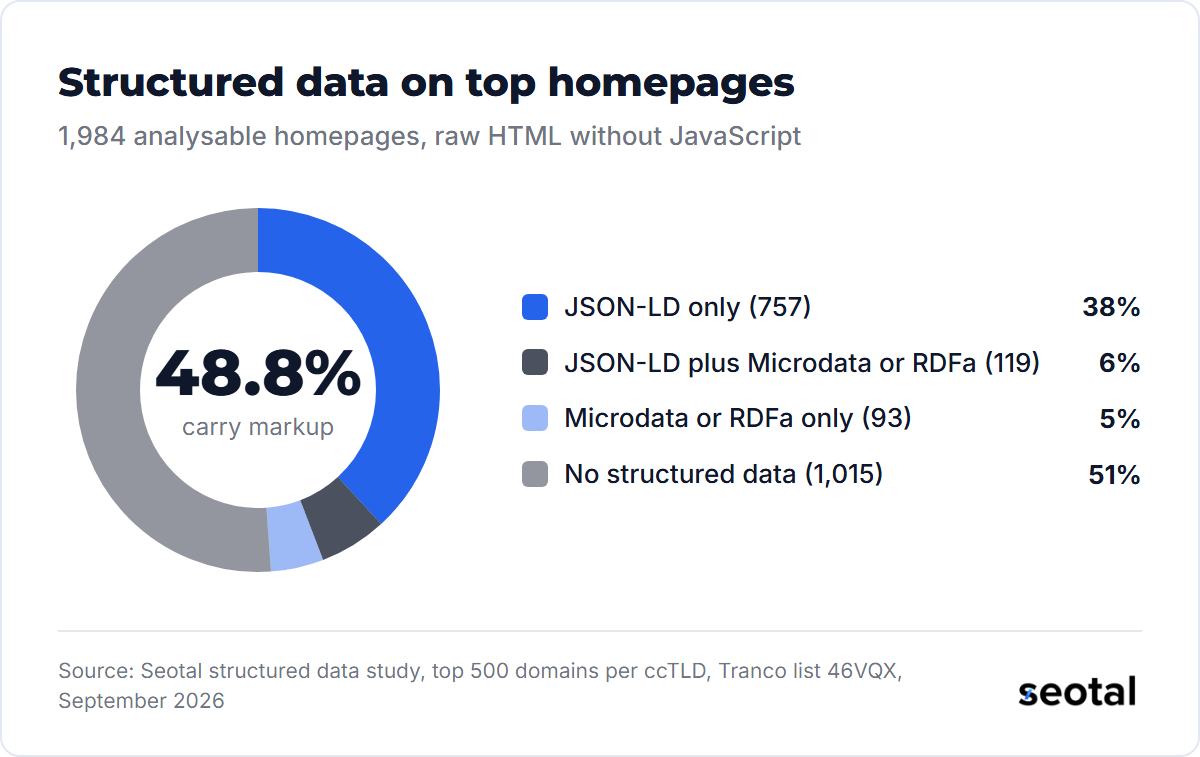
Open Graph is more common than any structured data format. 68.9% of analysable homepages carry og: tags and 47.8% carry Twitter card tags. 486 homepages have Open Graph but no structured data at all, so they describe themselves to Facebook and LinkedIn previews but not to a schema.org parser.
Popularity inside the sample does not change the picture. Within each country, 48.6% of the top 100 domains carry markup, 50.0% of those ranked 101 to 250 and 48.3% of those ranked 251 to 500.
Which schema.org types do the homepages declare?
SPH Media's Singapore titles, among them The Business Times, Lianhe Zaobao, Berita Harian and Tamil Murasu, share one template. Each homepage declares a NewsMediaOrganization with a logo, sameAs links and a memberOf ProgramMembership that names SPH Media, plus a WebSite with a SearchAction.
Across the sample, Organization and its subtypes lead, followed by WebSite. We counted a type once per homepage, wherever it sat in the markup, including nested nodes such as a publisher or a potentialAction.
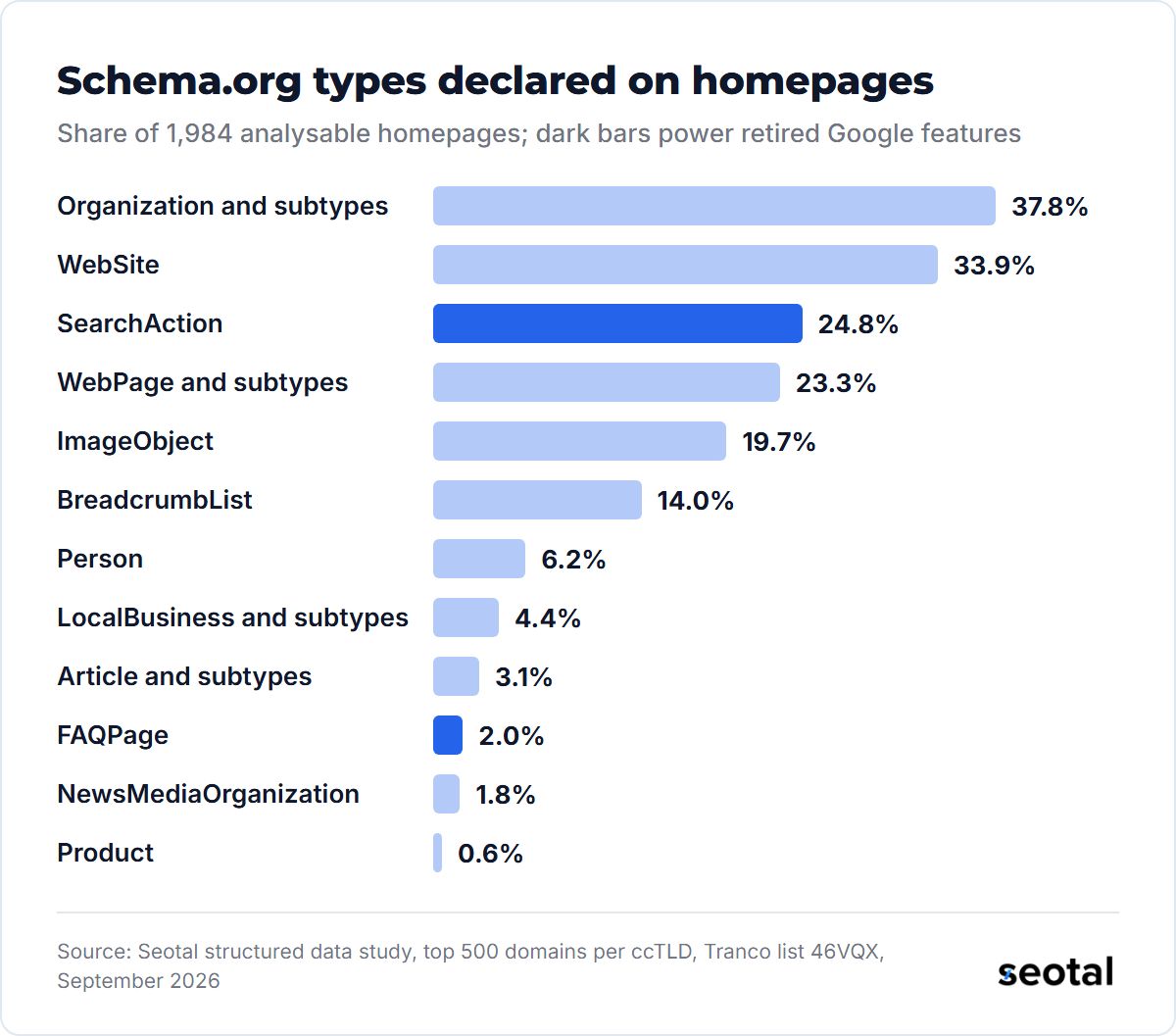
LocalBusiness and its subtypes appear on 88 homepages, 4.4%. Banks use BankOrCreditUnion (bpi.com.ph, cimb.com.my), Toyota Malaysia uses AutoDealer and the Vietnamese medical group Medlatec uses Hospital. Vietnam has the highest share, at 7.5%. The guide to schema and Business Profiles for AI search covers the markup local businesses need on inner pages.
Product (12 homepages) and Article types (62) are rare, since a homepage seldom describes a single product or story.
Some type names do not match schema.org. 11 homepages spell the type Website, including kayak.sg, foody.vn and malaysiaairports.com.my, while the vocabulary defines WebSite with a capital S. We counted those as WebSite, and 23 homepages had at least one type written in the wrong case.
Which country marks up its homepages most?
Vietnam is the only country where more than half of analysable homepages use JSON-LD, at 54.7%. Singapore comes second on JSON-LD at 49.7%, and trails Vietnam on any markup, at 54.0% against 56.1%.
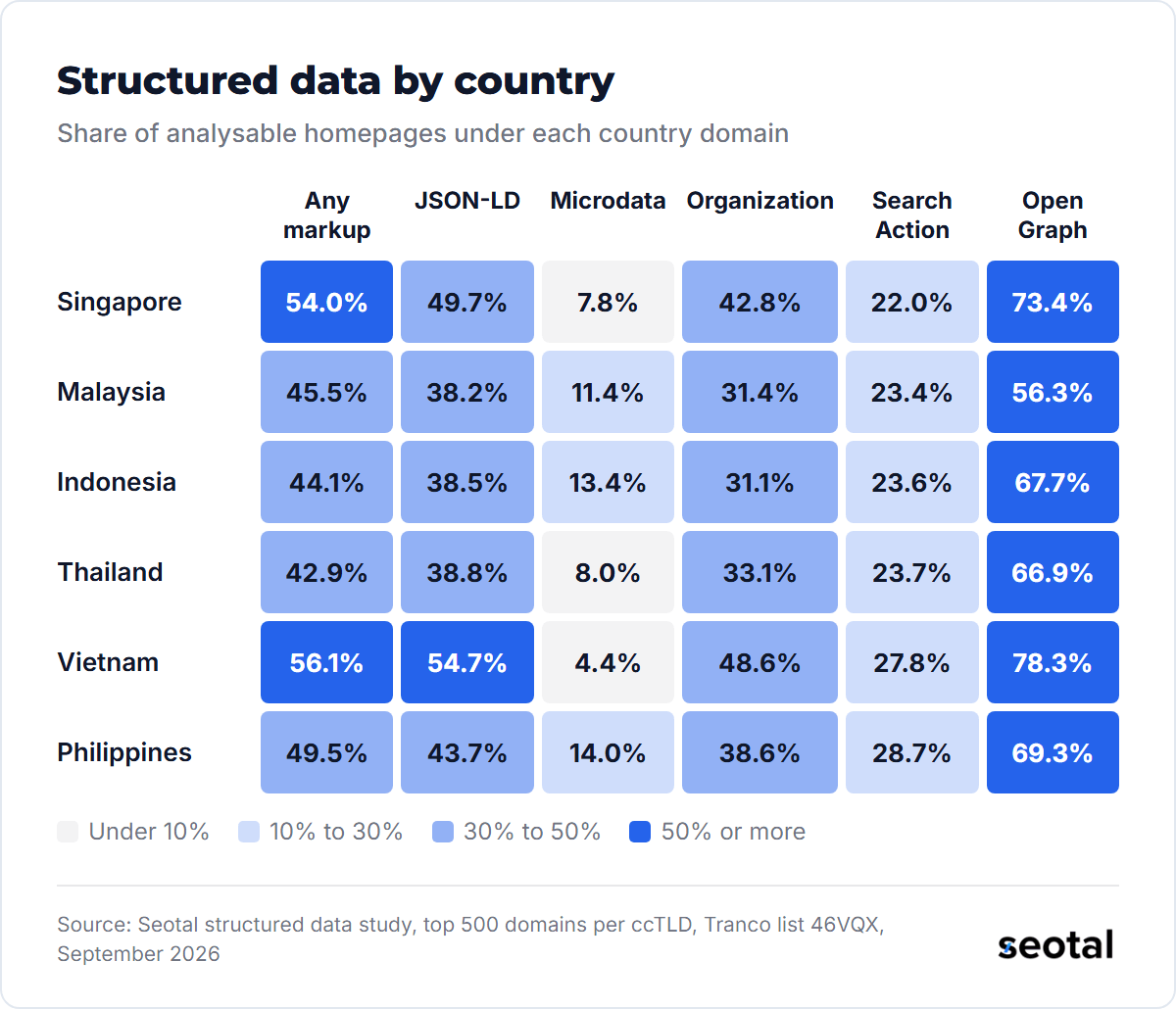
Microdata splits the region the other way. The Philippines (14.0%) and Indonesia (13.4%) use it most, and Vietnam least. WordPress themes add some of it: 63 homepages mark up a WPHeader element, and 58 of them run WordPress.
Vietnamese homepages also declare Person far more often than the rest, at 15.8% against 3.2% to 4.8% elsewhere. Malaysia has the lowest Open Graph share, at 56.3%.
How much of the markup still earns a Google search feature?
Yoast SEO wrote the SearchAction on 180 of the 492 homepages that declare one, and Rank Math wrote it on 51. Both are WordPress SEO plugins, and the sitelinks search box that SearchAction once powered has left Google's results.
- Aug 2023FAQ rich results limited to authoritative government and health sites; How-to limited to desktop
- Sep 2023How-to rich results removed from desktop too
- Nov 2024Sitelinks search box removed from results
- Jun 2025Seven features announced for phase-out, including Claim Review and Special Announcement
- May 2026FAQ rich results stop appearing on May 7
The Star (thestar.com.my) shows the usual pattern, a WebSite node with a SearchAction inside it:
{
  "@type": "WebSite",
  "@id": "https://www.thestar.com.my/#website",
  "url": "https://www.thestar.com.my/",
  "name": "The Star",
  "potentialAction": {
    "@type": "SearchAction",
    "target": "https://www.thestar.com.my/search?q={search_term_string}",
    "query-input": "required name=search_term_string"
  }
}
Google's farewell post for the sitelinks search box says the markup can stay: "Unsupported structured data like this won't cause issues in Search." It adds that site names use a variation of WebSite structured data, which Google still supports.
Google announced the HowTo and FAQ changes in August 2023, and it named the seven features it would phase out in June 2025.
FAQPage is the newer casualty. Google's Search Central changelog says FAQ rich results no longer appear from May 7, 2026, and the documentation came down in June. The 39 homepages that still declare FAQPage include the Indonesian rail operator KAI (kai.id), the Singapore telco M1 and the carmaker Perodua. Four homepages still declare HowTo.
A homepage's WebSite node carries a SearchAction. Should you delete the whole WebSite block?
Most homepages still declare something Google uses. 816 homepages, 41.1%, carry at least one type behind a feature in Google's structured data search gallery, led by Organization and BreadcrumbList. 39 declare only retired types.
Do Organization entities include a logo and sameAs links?
The Philippines has the widest gap: 82.3% of its 113 homepages with Organization markup include a logo, but 54.0% list sameAs links. Singapore has the narrowest, at 90.5% and 79.1%.
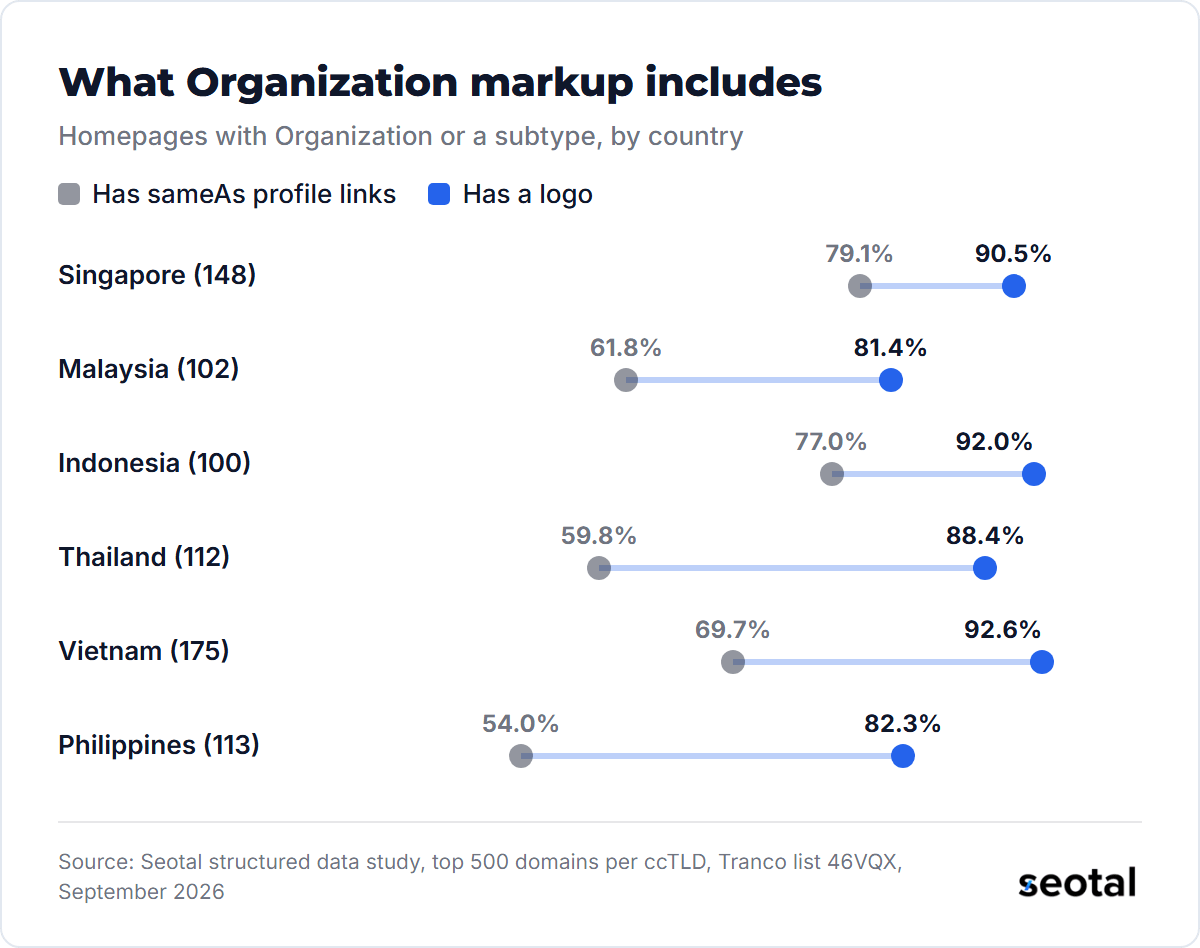
Google's Organization structured data documentation says the logo property can help it pick the logo shown in Search results and knowledge panels. It defines sameAs as the URL of a page on another website with more information about the organization.
48 homepages declare an Organization with neither property. Thairath, Chulalongkorn University (chula.ac.th) and the Vietnamese news sites CafeF and Kenh14 include a logo but no sameAs. Lianhe Zaobao lists six profiles, from Facebook and YouTube to Telegram and Weibo.
In an audit of a homepage that already has Organization markup, I check sameAs first. The logo is present on close to nine in ten of these homepages, while sameAs is missing on one in three.
Do government and university homepages use structured data?
Singapore's government homepages lead the region: 41 of the 72 we could analyse carry structured data, 56.9%. In Thailand the figure is 6 of 32, and in Indonesia 8 of 41.
The difference traces to one platform. Isomer, which describes itself as a "website builder engineered for agencies", runs 28 of the 29 Singapore government homepages that declare GovernmentOrganization, including the Ministry of Health and the Ministry of Foreign Affairs. Singapore accounts for 29 of the 36 GovernmentOrganization declarations in the sample.
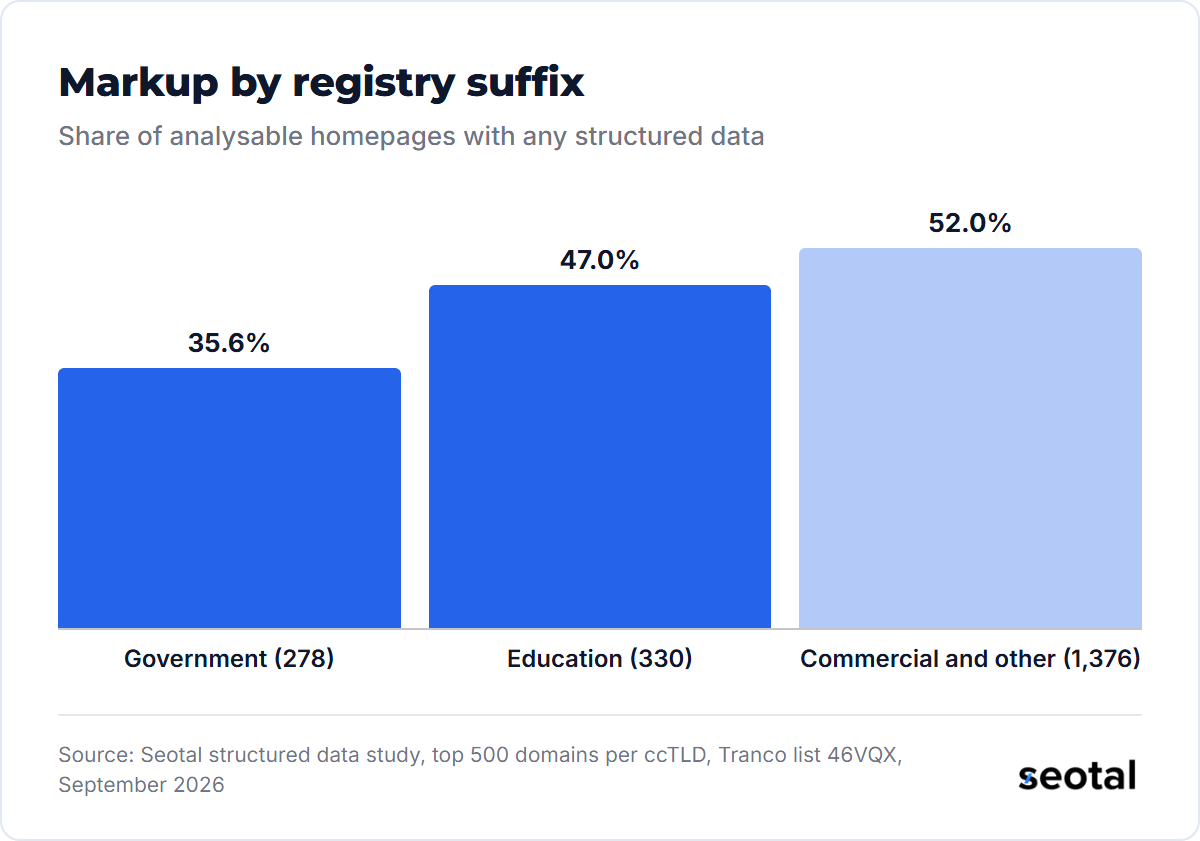
We sorted domains by registry suffix, as in the robots.txt study: gov, go, mil and mi count as government; edu, ac and sch as education. Malaysian agencies such as the tax board (hasil.gov.my) and the road transport department (jpj.gov.my) run WordPress and carry a SearchAction written by Yoast SEO and All in One SEO.
Government domains were also the hardest to read. Of 488 in the sample, 78 served a bot wall and 92 gave no answer, so only 278 reached the analysis.
Which site platforms ship structured data by default?
45 of the 47 Shopify homepages carry structured data, 95.7%, the highest share of any platform we detected. WordPress follows at 78.8% of 430 homepages.
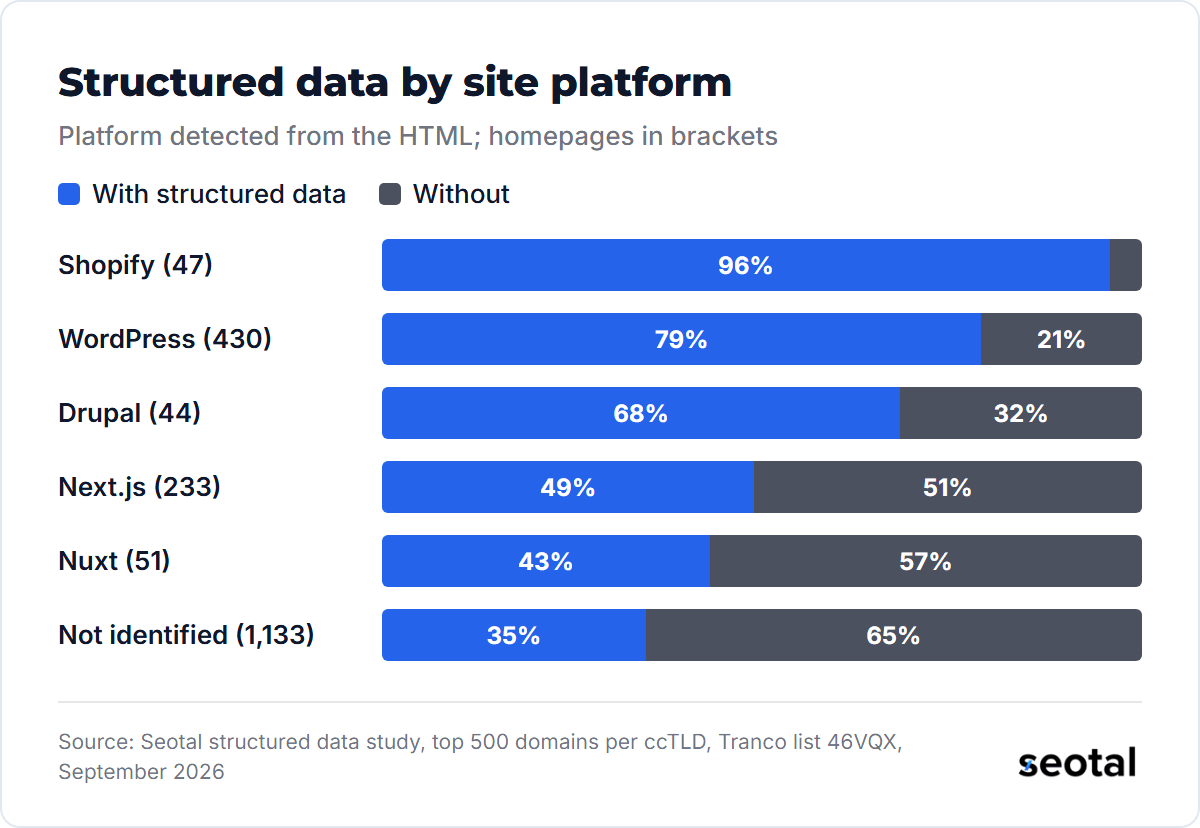
On WordPress, SEO plugins do most of the work. 83.8% of the 315 WordPress homepages with JSON-LD carry a plugin's class name on the script tag: Yoast SEO on 182, Rank Math on 51 and All in One SEO on 31.
JavaScript frameworks sit near the middle. Next.js homepages carry markup in 48.9% of cases and Nuxt homepages in 43.1%. A framework site that injects JSON-LD in the browser shows up here as having none, so the Shopee and Lazada results need care. The guide to SEO and AEO for front-end developers covers server rendering choices like these.
How often is the JSON-LD broken?
Thairath (thairath.co.th), the highest-ranked Thai news domain in the sample, serves a WebSite block that JSON parsers reject. It closes one brace too many:
      "potentialAction":
        {
            "@type":"SearchAction",
            "target":"https://www.thairath.co.th/search/{search_term_string}",
            "query-input":"required name=search_term_string"
        }
    }
  }
Broken blocks are rare across the sample.
16 of the 25 failures are syntax errors like Thairath's. Five contain raw control characters, such as line breaks, inside strings, which the JSON standard, RFC 8259, requires writers to escape. Four end a list with a trailing comma, among them the Singapore Food Agency (sfa.gov.sg).
Vietnam (9) and Thailand (6) account for most of the broken homepages, and the Philippines has none. posb.com.sg and royalgrandpalace.th are among the eight homepages where no block parses at all, so a parser gets no types from them.
Methodology
Sample. We reused the sample from our robots.txt study of AI crawler blocking: the 500 highest-ranked domains ending in .sg, .my, .id, .th, .vn and .ph in Tranco list 46VQX, generated on September 12, 2026, second-level forms such as .com.sg included.
| Country | n | Tranco rank range | robots.txt disallows homepage | No answer | Bot wall | Other HTTP error | Empty or not HTML | Analysable |
|---|---|---|---|---|---|---|---|---|
| Singapore | 500 | 3,209 to 518,641 | 10 | 55 | 53 | 36 | 0 | 346 |
| Malaysia | 500 | 3,872 to 324,060 | 6 | 72 | 58 | 39 | 0 | 325 |
| Indonesia | 500 | 745 to 128,989 | 8 | 58 | 86 | 23 | 3 | 322 |
| Thailand | 500 | 3,401 to 581,762 | 6 | 61 | 74 | 20 | 1 | 338 |
| Vietnam | 500 | 1,424 to 177,853 | 5 | 65 | 48 | 20 | 2 | 360 |
| Philippines | 500 | 1,031 to 376,823 | 15 | 49 | 97 | 45 | 1 | 293 |
| Total | 3,000 | 745 to 581,762 | 50 | 360 | 416 | 183 | 7 | 1,984 |
"No answer" covers DNS failures, timeouts, refused connections and robots.txt files that returned a 5xx, which RFC 9309 treats as a full disallow. Cloudflare served 342 of the 416 bot walls and Imperva 41. Most "other HTTP errors" were plain 403 responses (132).
Fetch. On September 13, 2026, between 16:28 and 17:35 UTC, we requested https://<domain>/, then https://www.<domain>/ when the apex gave no response or a 5xx. Requests followed up to five redirects, timed out after 20 seconds and identified as SeotalResearch/1.0 (structured data study; +https://www.seotal.com/). We fetched domains with no answer again, and tried those that timed out or dropped the connection a third time.
We checked each request, redirect hops included, against the robots.txt rules for that user agent and *. We reused the robots.txt files from the earlier study where they covered the same host, and fetched fresh files for other hosts. At most 8 domains were in progress at once, with at least 1.1 seconds between requests to one host.
Extraction. We parsed the HTML with parse5 and did not run JavaScript. JSON-LD blocks count as invalid when JSON.parse fails after trimming a wrapping comment or CDATA marker; invalid blocks add no types. Microdata types come from itemtype on elements with itemscope, and RDFa types from typeof, which we resolved against vocab and prefix attributes on the element and its ancestors.
We normalised type names across @graph, arrays, nested nodes, http and https IRIs and the schema: prefix, then checked against the schema.org type list. Subtypes such as BankOrCreditUnion count toward their parents. Platforms and Isomer come from signatures in the HTML, such as wp-content paths, Shopify CDN URLs, Next.js build files and Isomer asset hosts. We detected bot walls from Cloudflare, Akamai, Imperva, DataDome, AWS WAF, F5 and other challenge page signatures.
Checks. We compared the extractor with an independent regex reading of the raw source for 15 random homepages and 5 notable ones (Thairath, pavietnam.vn, The Star, google.com.sg and utem.edu.my). Block counts, formats and Open Graph matched on all 20. Two type differences led to fixes: a protocol-relative //schema.org/Blog itemtype, and the Website spelling now reported as a case error.
Limitations.
- Homepages only. Product, Article, BreadcrumbList and FAQPage markup sits on inner pages more often than on homepages.
- No JavaScript rendering. JSON-LD injected in the browser, by a framework or Google Tag Manager, is missed.
- Detection, not validation. We did not check required properties against Google's feature rules.
- Redirects leave the ccTLD. 123 analysable homepages ended on a host outside their sample domain, among them the six Google domains.
- 599 domains answered with a bot wall or an HTTP error. Browsers may get a different page.
- One snapshot. Templates can change the day after we read them.
The per-domain results are in structured-data-southeast-asia.csv, one row per domain with formats, types and Open Graph flags, and the totals are in the summary JSON.
Get your structured data checked by a technical SEO specialist
More than half the homepages with markup in this study carry a SearchAction Google no longer uses, and one in three Organization blocks has no sameAs. Seotal matches you with vetted freelance SEO experts whose work covers technical SEO audits and schema markup.
You get 3 to 5 vetted profiles within 72 hours of your brief. Hourly work costs $15 to $30 with no minimum, and a part-time retainer costs $1,000 to $2,000 a month for 60 to 80 hours, with a 3-month minimum and a 30-day replacement guarantee (see pricing).
Compare profiles in top technical SEO experts to hire, and see hreflang errors on the same sites or Southeast Asia SEO statistics. For local markup, start with Google AI Overviews for local businesses.
Structured data: frequently asked questions
Does structured data help a page appear in Google's AI Overviews?
Google says sites need no special markup. Its guide to optimizing for generative AI features says "Structured data isn't required for generative AI search, and there's no special schema.org markup you need to add." It recommends keeping structured data for rich result eligibility.
Can Google read JSON-LD that JavaScript adds after the page loads?
Yes, Google documents generating structured data with JavaScript, through Google Tag Manager or custom code. For Product markup it warns that markup generated this way can make Shopping crawls less frequent and less reliable.
Which format does Google recommend?
JSON-LD, in most cases. Google's introduction to structured data calls JSON-LD the recommended format and says all three formats work for Google when the markup is valid and follows the feature documentation.

 Top 10 SEO & AEO Principles Every Front-End Developer Should Know
  How Many Websites Targeting Southeast Asia Get hreflang Wrong? (2026 Study)
  Which Southeast Asian Websites Block AI Crawlers? A robots.txt Study of Top Domains (2026)