
 Philippines
 Vietnam
 Bali, Indonesia
 Malaysia
 Dubai, UAE
 India
India
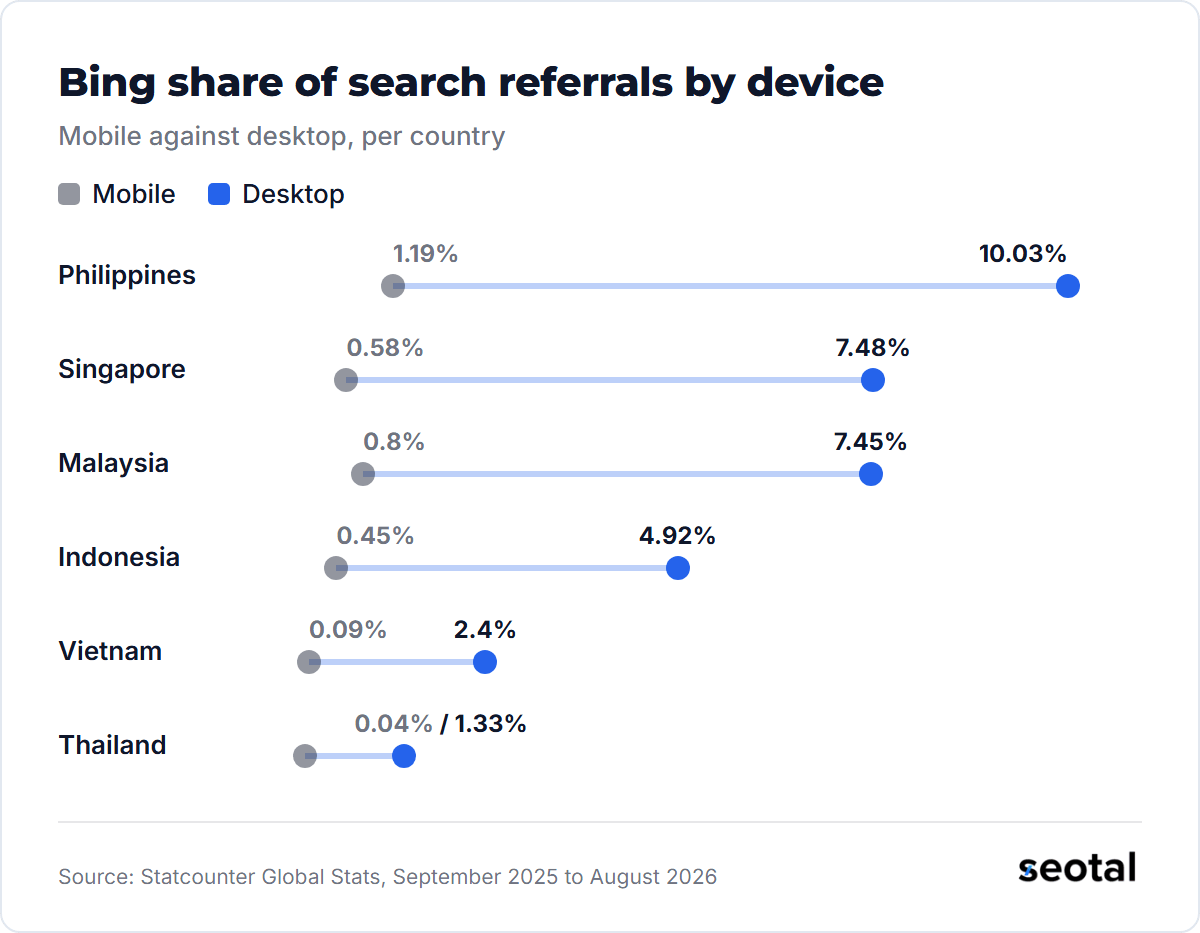
Bing sends 10.03% of desktop search clicks in the Philippines, almost level with its 9.94% desktop share worldwide. On phones in the same country it sends 1.19%. Thailand went the other way: Bing's share across all devices fell from 1.67% to 0.43% in a year, leaving Google almost alone.
Which search engines do people use in Southeast Asia?
Thailand leads the region: 99.47% of search engine referrals came from Google between September 2025 and August 2026, on Statcounter's Thailand search engine data. A year earlier the figure was 97.18%. Google's worldwide share over the same twelve months was 90.41%, so five of the six markets sit above the global line. The Philippines, at 90.25%, sits below it.
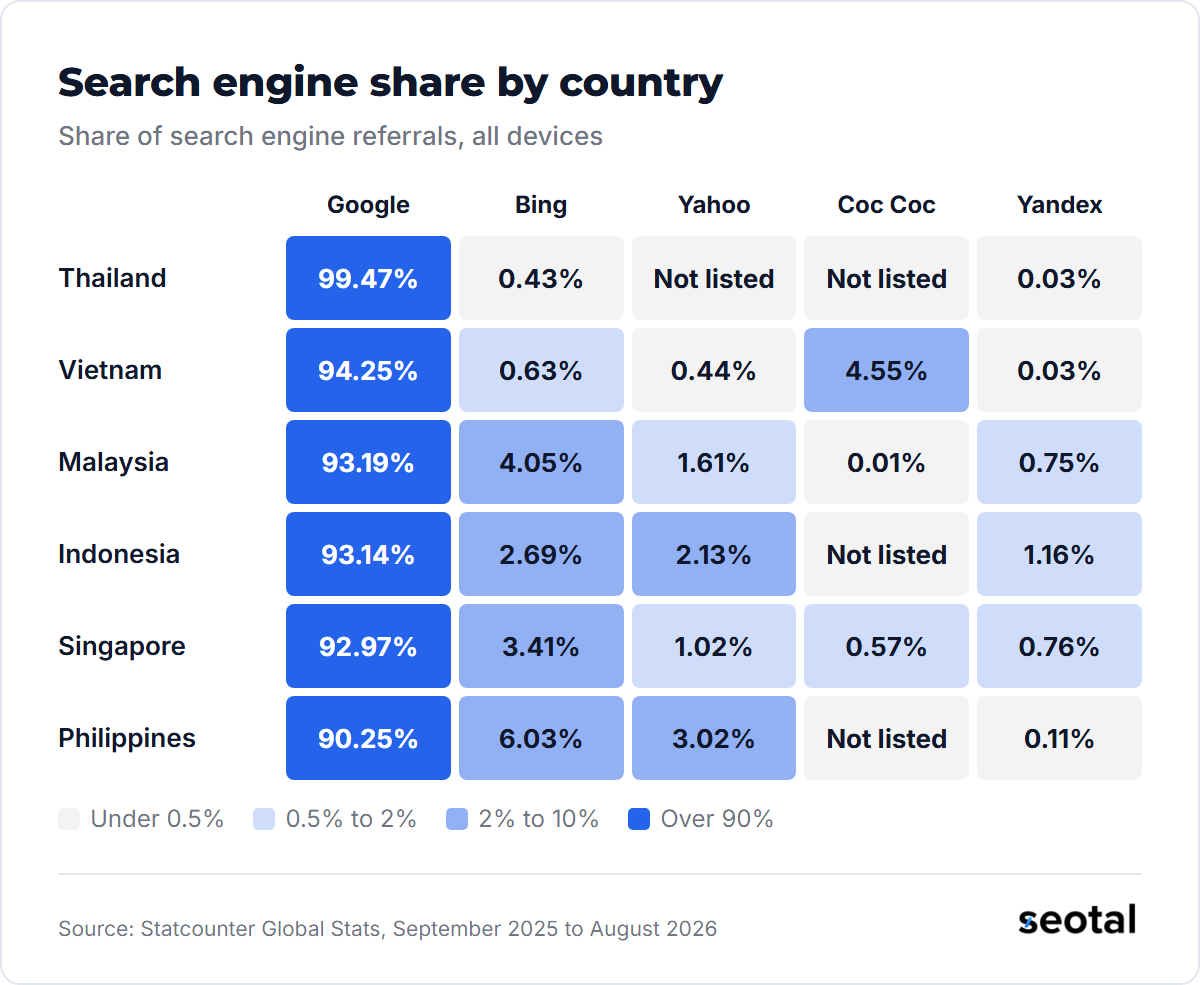
The second engine changes by country:
- Philippines: Bing 6.03% and Yahoo 3.02%, the highest combined non-Google share in the region.
- Malaysia: Bing 4.05%, Yahoo 1.61%.
- Singapore: Bing 3.41%, plus 0.19% for Baidu and 0.08% for Naver.
- Indonesia: Bing 2.69%, Yahoo 2.13% and Yandex 1.16%, the highest Yandex share of the six.
- Vietnam: Cốc Cốc 4.55%, with Bing at 0.63%.
How much search traffic does Bing send on desktop?
Bing's share in Southeast Asia lives on desktop. In the Philippines it sends 10.03% of desktop referrals, in Singapore 7.48% and in Malaysia 7.45%. On mobile, no country gives it more than 1.19%.
Yahoo follows the same pattern. It holds 5.31% of desktop referrals in the Philippines, 4.04% in Indonesia and 3.09% in Malaysia, and under 0.3% of mobile referrals in all three.
The gap is also a trend. Bing's share of Philippine desktop referrals was 12.09% in the previous twelve months, so it is shrinking there even as its all-device share rose from 5.41% to 6.03%. I would still not skip Bing Webmaster Tools for a site aimed at desktop users in the Philippines or Malaysia.
In which of the six countries does Bing have the largest desktop share?
Does Cốc Cốc still matter for SEO in Vietnam?
It matters most on desktop, where Cốc Cốc sent 7.41% of desktop search referrals in Vietnam over the twelve months to August 2026, against 3.66% on mobile. It is the only engine built in Southeast Asia that shows up in the top five of any of the six countries.
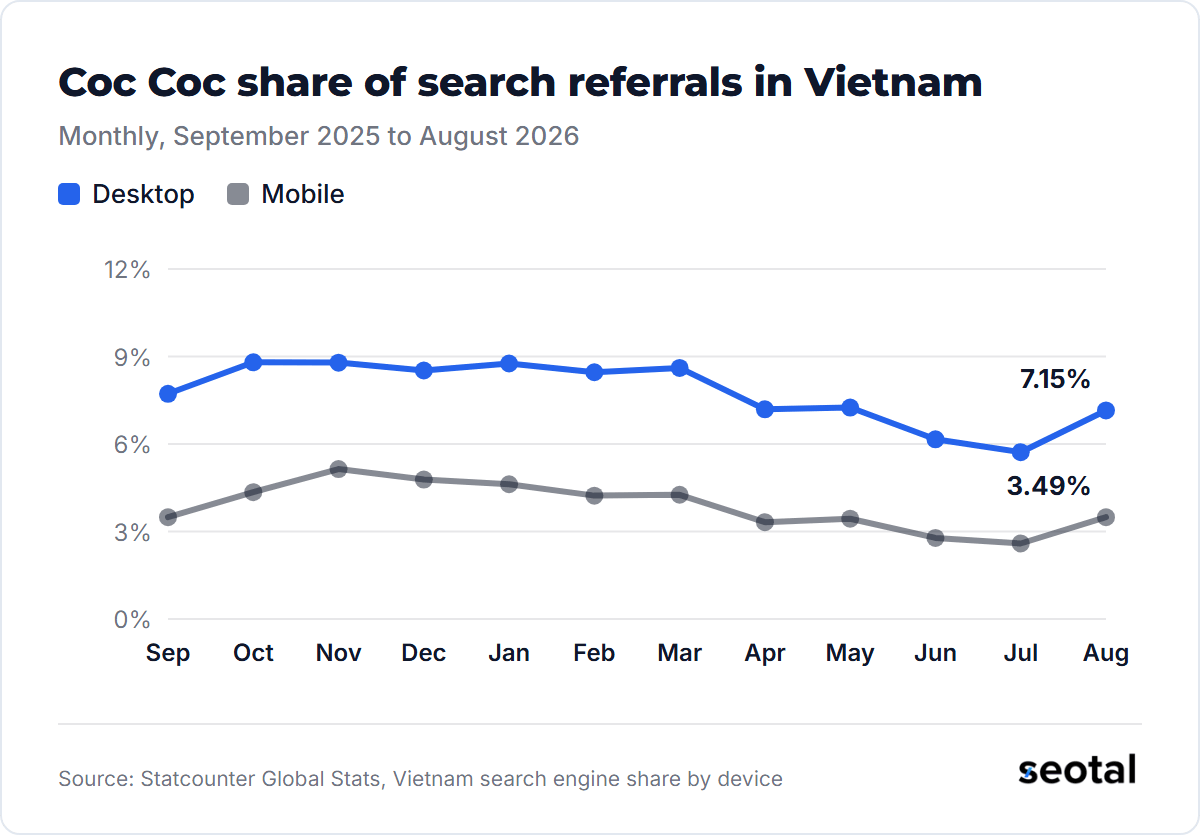
Its desktop share is shrinking, though. In the previous twelve months, September 2024 to August 2025, Cốc Cốc held 9.57% of desktop referrals in Vietnam. Its mobile share moved the other way, from 3.1% to 3.66%, and its share across all devices rose from 3.8% to 4.55%.
Cốc Cốc also appeared in Singapore's data in 2026. Its share there sat at 0.03% in each month from September to December 2025, then reached 1.22% in April 2026 and 1.59% in July, per Statcounter's Singapore search engine data. Statcounter does not say who those users are.
For local context on the Vietnamese market, see our Vietnam digital marketing statistics and the Vietnam talent hub.
How fast is mobile internet in Southeast Asia?
Indonesia is the only one of the six countries where the typical phone connection beats the typical home line. Ookla's figures in DataReportal's Digital 2026 Indonesia report put the median mobile download speed at 45.01 Mbps and the median fixed speed at 39.88 Mbps. Both are the lowest in the group.
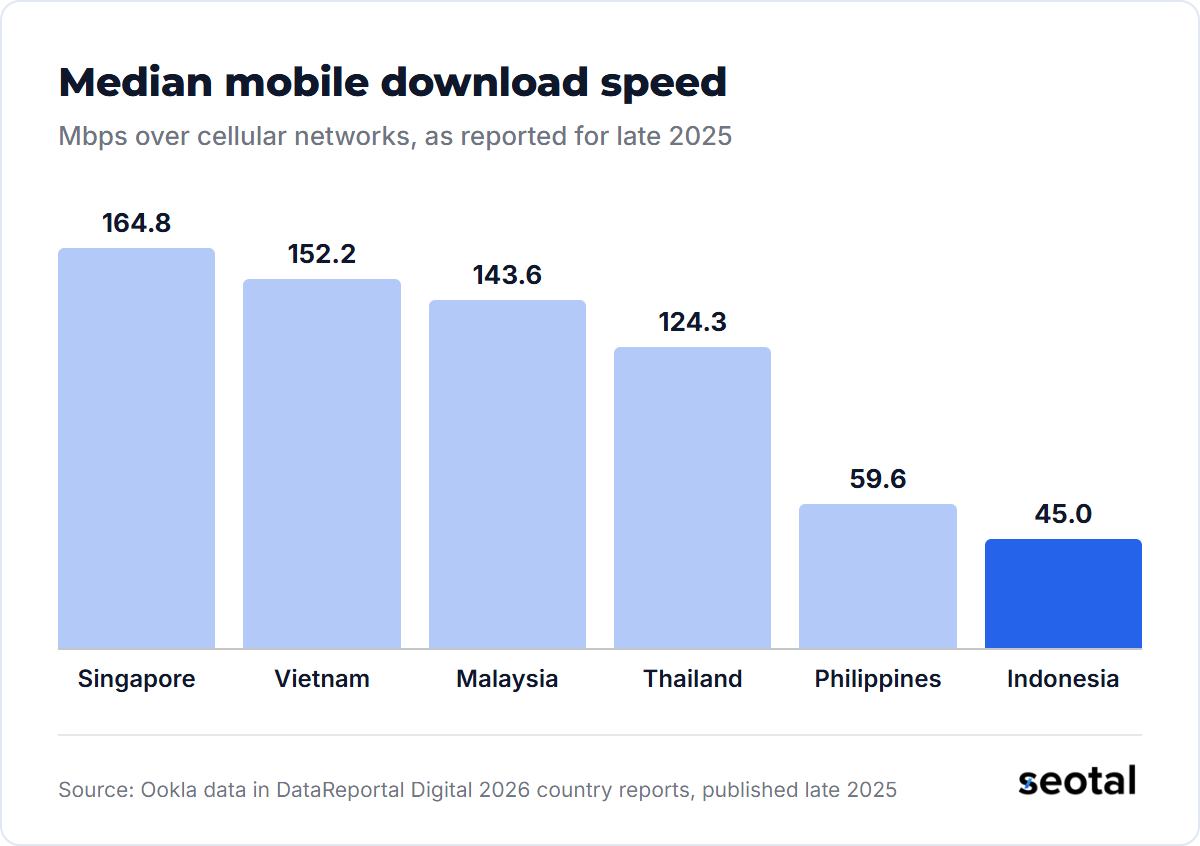
Vietnam posted the biggest gain. Its median mobile speed rose 95.22 Mbps (+167%) in the twelve months to August 2025, reaching 152.17 Mbps. Thailand's rose 127% to 124.33 Mbps. The Philippines, at 59.64 Mbps, gained 77.2%.
Fixed broadband puts Singapore further ahead:
- Singapore: 394.30 Mbps fixed, 164.75 Mbps mobile.
- Thailand: 262.42 Mbps fixed, 124.33 Mbps mobile.
- Vietnam: 261.80 Mbps fixed, 152.17 Mbps mobile.
- Malaysia: 154.03 Mbps fixed, 143.56 Mbps mobile.
- Philippines: 105.17 Mbps fixed, 59.64 Mbps mobile.
Mobile connections outnumber people in all six countries. GSMA Intelligence data in the same reports shows 9.79 million cellular connections in Singapore at the end of 2025, equal to 166% of its population. Thailand's 96.6 million equal 135%, Vietnam's 137 million equal 134%, Malaysia's 44.0 million equal 122% and the Philippines' 137 million equal 117%.
Indonesia's count went the other way: connections fell by 18 million (-5.2%) to 331 million, still 116% of the population. DataReportal notes that some connections carry only voice and SMS, so connections are not a count of mobile internet users.
For SEO, the speed gap sets the budget for page weight. Google's guidance on Largest Contentful Paint treats 2.5 seconds or less as a good score, and that target is harder to hit on a 45 Mbps median connection than on a 165 Mbps one.
How many people in Southeast Asia are online?
Indonesia had 230 million internet users in October 2025, more than twice the Philippines' 98.0 million, according to DataReportal's Digital 2026 Indonesia report. It also has the most room to grow: 55.8 million Indonesians, 19.5% of the population, did not use the internet at the end of 2025.
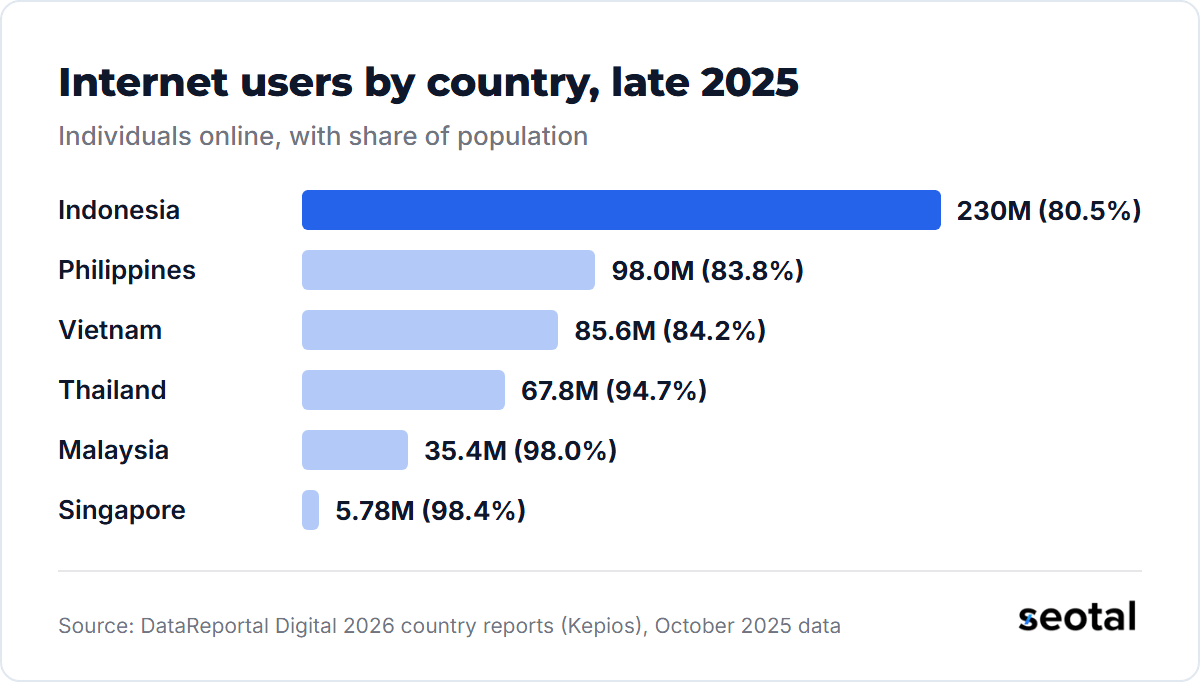
Growth rates split the region in two. Indonesia added 18 million users (+8.7%) and Thailand 2.4 million (+3.7%) between October 2024 and October 2025. Vietnam added 508 thousand (+0.6%) and the Philippines 789 thousand (+0.8%). Malaysia and Singapore are close to saturation, at 98.0% and 98.4% of the population online.
The table draws on DataReportal's reports for the Philippines, Vietnam, Thailand, Malaysia and Singapore, all using October 2025 data.
| Country | Internet users (Oct 2025) | Share of population online | People offline |
|---|---|---|---|
| Indonesia | 230 million | 80.5% | 55.8 million |
| Philippines | 98.0 million | 83.8% | 19.0 million |
| Vietnam | 85.6 million | 84.2% | 16.1 million |
| Thailand | 67.8 million | 94.7% | 3.78 million |
| Malaysia | 35.4 million | 98.0% | 714 thousand |
| Singapore | 5.78 million | 98.4% | 96.9 thousand |
Language splits the region further. The e-Conomy SEA 2025 report by Google, Temasek and Bain counts more than 1,200 living languages across the ten ASEAN countries, more than 700 of them in Indonesia alone.
When did AI Overviews and AI Mode reach Southeast Asian languages?
Indonesian was one of six languages Google named for AI Overviews when it took the feature to more than 100 countries in October 2024. Thai, Vietnamese and Filipino followed later. Google's AI Overviews help page, read on September 13, 2026, lists Burmese, Cebuano, Filipino, Indonesian, Khmer, Lao, Malay, Thai and Vietnamese, and names all six countries as available locations.
- Oct 28, 2024AI Overviews reach more than 100 countries, with Indonesian among the six languages named.
- May 20, 2025AI Overviews reach 200+ countries and 40+ languages, with Malay named among the additions.
- Aug 21, 2025AI Mode opens in English in 180+ new countries and territories.
- Sep 8, 2025AI Mode adds Indonesian, one of five new languages.
- Oct 7, 2025AI Mode adds 35+ languages and 40+ countries; Google Thailand confirms Thai the next day.
Google's May 2025 expansion post named Malay but not Thai or Vietnamese. The October 2025 AI Mode post gave a count, not a list. Google Thailand's announcement confirmed Thai the next day, and says people ask AI Mode questions almost three times the length of traditional searches.
The e-Conomy SEA 2025 report points the same way with Google internal data. Users are asking queries 2 to 3 times the length of traditional searches (May 2025), and visual search is growing 70% a year (July 2025).
Our guides explain how AI Overviews choose local businesses, how AI search finds local businesses and the schema and Business Profile signals these systems read.
Which AI assistants send traffic in Southeast Asia?
ChatGPT sends most AI chatbot referrals in all six countries, but Gemini is closing in on it in Thailand and Vietnam. In August 2026, Gemini took 24.5% of AI chatbot referrals in Thailand and 21.39% in Vietnam, on Statcounter's AI chatbot data. Its worldwide share that month was 10.93%.
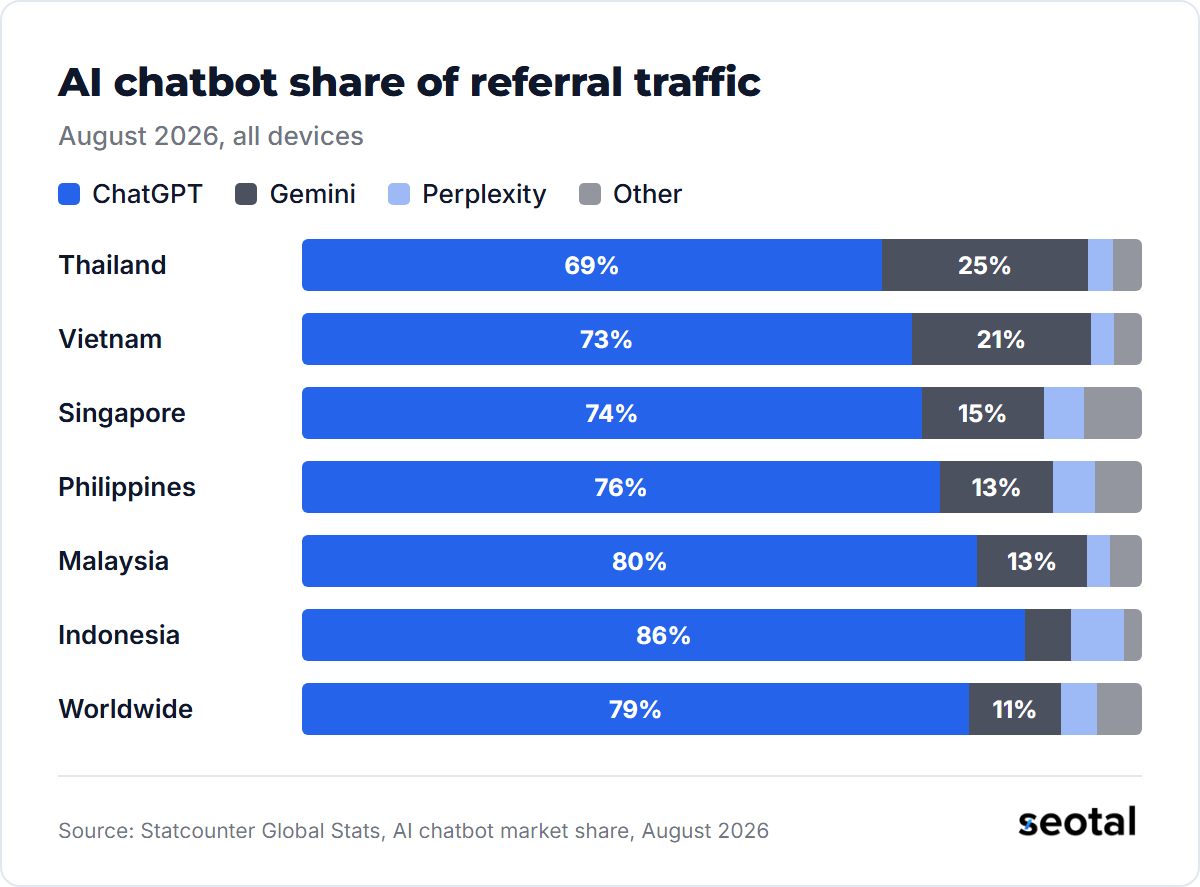
Indonesia runs the other way. ChatGPT sent 86.13% of referrals there in August 2026, and Perplexity took 11.57% over the full twelve months, more than Gemini's 3.33%. This data maps which assistant sends clicks, which is narrower than which assistant people ask.
AI use in the region is among the highest in the world. GWI's Q4 2025 survey, reported in DataReportal's Digital 2026 Mid-Year Global Update, found 93.6% of online adults in Indonesia used an AI tool in the past month, third of 54 markets.
The Southeast Asia regional figure was 91.8%, against 81.2% worldwide, and 79.3% of online adults worldwide used a search engine.
Google and Milieu surveyed 7,200 consumers across the ten ASEAN countries in September 2025 for e-Conomy SEA 2025. 75% said AI chatbots, translators and image search helped them discover content. 33% said they prefer services that narrow the choice to the best 2 or 3 options.
Where do Southeast Asian shoppers start product searches?
Most start on a marketplace. In a report published in July 2026 by impact.com, Cube Asia and dentsu, based on 2,400 consumers across the six markets, 71% said they discover new products on online marketplaces and 57% through search engines, as ITBrief Asia reported. 67% had bought a product on a creator's recommendation.
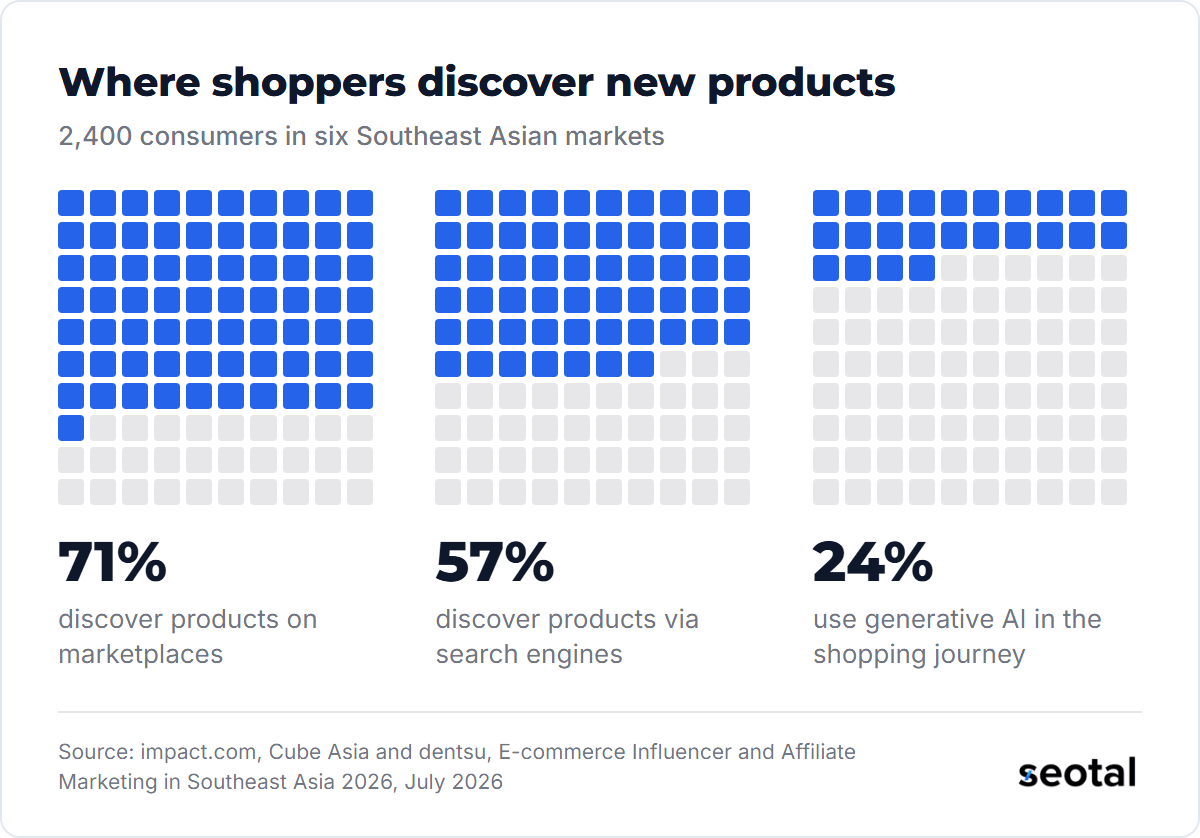
Generative AI use splits by country. Marketing in Asia's summary of the same study puts it at 34% in Vietnam and 31% in Indonesia, against 14% in Singapore. The published summaries do not give figures for Thailand, Malaysia or the Philippines.
Video is taking a larger slice of the checkout too. e-Conomy SEA 2025 estimates video commerce at about 25% of the region's ecommerce GMV in 2025, up from under 5% in 2022. In the Google and Milieu survey, 62% of consumers said AI features such as personalised recommendations influenced a purchase.
Hire an SEO specialist who knows these markets
A Philippine desktop site that skips Bing, or a Vietnamese store with no Cốc Cốc check, leaves clicks behind. Seotal matches you with vetted freelance SEO experts in the Philippines, Vietnam, Indonesia and Malaysia, including writers in Tagalog, Vietnamese, Bahasa Indonesia and Bahasa Malaysia. Compare the best countries for SEO specialists, freelancer rates and the Philippines digital marketing statistics.
I lead SEO and GEO at Seotal, and we send a shortlist of 3 to 5 screened profiles within 72 hours of your brief. A part-time retainer costs $1,000 to $2,000 a month for 60 to 80 hours, with a 3-month minimum (see pricing). Hire an SEO expert for the market you are entering.
Southeast Asia search: frequently asked questions
Do Baidu or Naver matter for SEO in Southeast Asia?
Only in Singapore, and only a little. Baidu sent 0.19% and Naver 0.08% of Singapore's search referrals from September 2025 to August 2026, per Statcounter. Neither reaches 0.05% in Malaysia, the Philippines or Indonesia.
Is DuckDuckGo growing in Indonesia?
On mobile, its share rose from 1.34% in September 2025 to 2.81% in August 2026, per Statcounter. That put DuckDuckGo second on Indonesian mobile that month, ahead of Yandex at 0.88% and Bing at 0.59%.
Where does Yandex have the most share in the region?
Indonesia is the Yandex market of the region. Yandex took 1.16% of all search referrals and 1.91% of mobile referrals there over the twelve months to August 2026. In Thailand and Vietnam it sat at 0.03%.

 Philippines Digital Marketing Statistics 2026
  Vietnam Digital Marketing Statistics 2026
 ![How to Hire an SEO Specialist from Asia [2026]](/assets/blog/how-to-hire-an-seo-specialists-cover.png) How to Hire an SEO Specialist from Asia [2026]
How to Hire an SEO Specialist from Asia [2026]