
 Philippines
 Vietnam
 Bali, Indonesia
 Malaysia
 Dubai, UAE
 India
hreflang="my" does not target Malaysia. In the IANA Language Subtag Registry, my is Burmese, sg is Sango, bn is Bengali and la is Latin. Four Southeast Asian country codes, typed on their own, name a different language.
Which hreflang codes should each Southeast Asian market use?
Each tag starts with a lowercase language subtag and can add an uppercase region subtag. Google's localized versions guide supports only ISO 639-1 language codes and ISO 3166-1 Alpha 2 region codes. It warns that a country code alone does not work, because Google does not derive a language from a country.
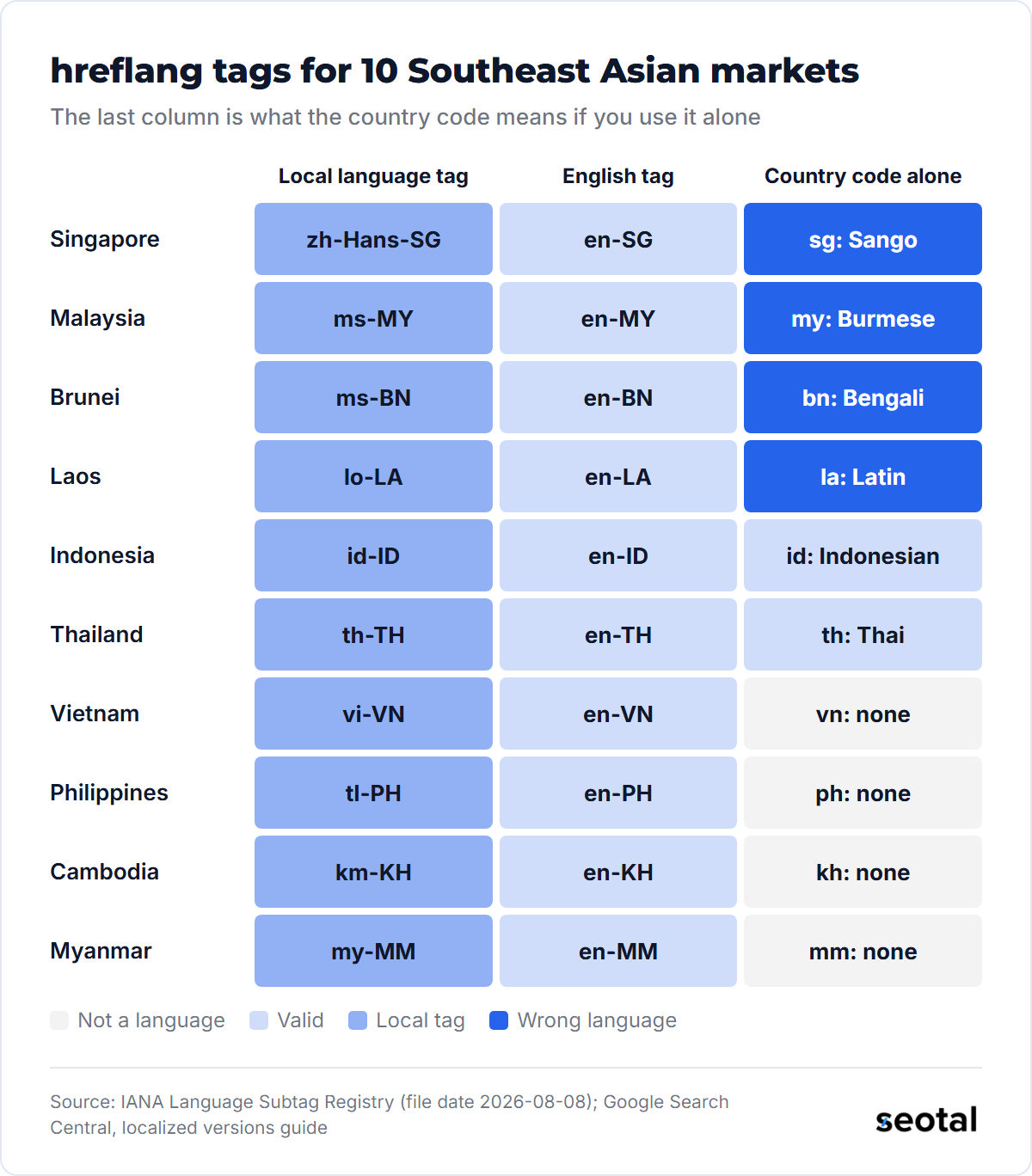
The IANA registry is the public list of these subtags, and the current file carries the date August 8, 2026. RFC 5646, the standard behind it, says two-letter language subtags come from ISO 639-1. The same RFC treats tags as case insensitive, so en-sg and en-SG are the same tag.
Singapore: English first, then Chinese, Malay and Tamil
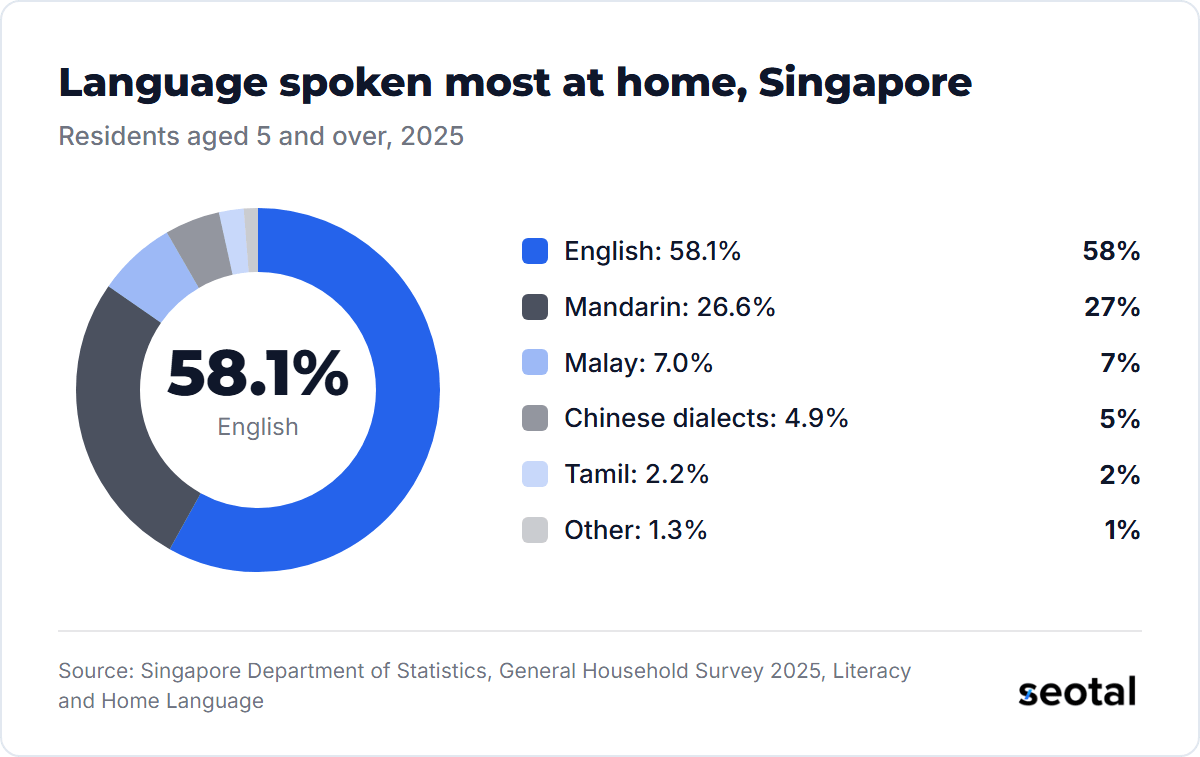
English is the main home language in Singapore, so the en-SG page comes first. The General Household Survey 2025 from the Singapore Department of Statistics found Mandarin in second place at home, at 26.6%.
For Chinese pages, Google says it derives the script from the region, and its only example is zh-TW for Traditional Chinese. It also accepts the script written out with ISO 15924, as in zh-Hans-US. For simplified Chinese aimed at Singapore, zh-Hans-SG leaves nothing to derive. Malay and Tamil pages take ms-SG and ta-SG.
Malaysia and Brunei: ms, with region when prices or rules differ
Malay pages use ms-MY in Malaysia and ms-BN in Brunei. The registry lists ms as a macrolanguage, and it files Indonesian (id) under it. Google's guide says nothing about macrolanguages, so tag Indonesian pages id and do not expect an ms page to stand in for them.
English and Chinese pages follow the same pattern: en-MY, zh-Hans-MY, en-BN.
Indonesia: id, never in
Indonesian is id, and id-ID targets Indonesia. The IANA registry has marked the older code in deprecated since 1989, with id as the preferred value.
Philippines: tl for Filipino, en-PH for English
Filipino and Tagalog pages take tl or tl-PH. The registry lists fil (Filipino) as a three-letter code and tl (Tagalog) as the two-letter one. Google's Ads API language table maps "Filipino" to tl, criterion 1042.
fil is still a valid BCP 47 tag for the HTML lang attribute. It sits outside the codes Google's hreflang guide supports, so keep it out of hreflang. English pages for the Philippines use en-PH.
Thailand, Vietnam, Cambodia, Myanmar and Laos
- Thailand:
th-TH. The language code and the country code happen to match. - Vietnam:
vi-VN, orvifor Vietnamese in any country, as our Vietnamese SEO guide sets out.vnis not a language code. - Cambodia:
km-KHfor Khmer. - Myanmar:
my-MMfor Burmese. The old region code BU (Burma) has been deprecated since 1989 in favour of MM. - Laos:
lo-LAfor Lao. Google's multi-regional sites guide lists .la among the country domains it treats as generic, so a Lao site on .la needs hreflang to state its target.
When should you use ms instead of ms-MY, and when x-default?
Use the language code alone when one page serves all speakers of that language. Add a region only when the pages differ by country: currency, delivery, tax or legal text. Google's guide lists de for German "independent of region" and en-GB for English aimed at the UK.
- ms: Malay speakers anywhere
- One page for Malaysia, Brunei and Singapore
- Nothing to add for unlisted countries
- Fewer URLs to keep in sync
- ms-MY: Malay speakers in Malaysia
- Separate pages for MYR, BND or SGD prices
- Add a plain ms page as the catch-all
- More return links to maintain
Google recommends that catch-all when you run several regional pages in one language. Its example gives Ireland, Canada and Australia their own English pages, then a generic en page for English speakers in all other places. The catch-all can be one of the regional pages.
x-default is a different fallback. It catches users whose language settings match none of your tags, and Google says it was designed for language selector pages. A Singapore company with English, Malay and Chinese pages might point x-default at its English home page or at a country picker.
Google ignores regions reserved for something else. Its guide names EU, UN and UK as codes with no effect in hreflang. The United Kingdom's region code is GB.
How do you implement hreflang with tags, headers or a sitemap?
Google calls the three methods equivalent and says using all three brings no benefit in Search. Pick one per page type, then build the whole cluster in it.
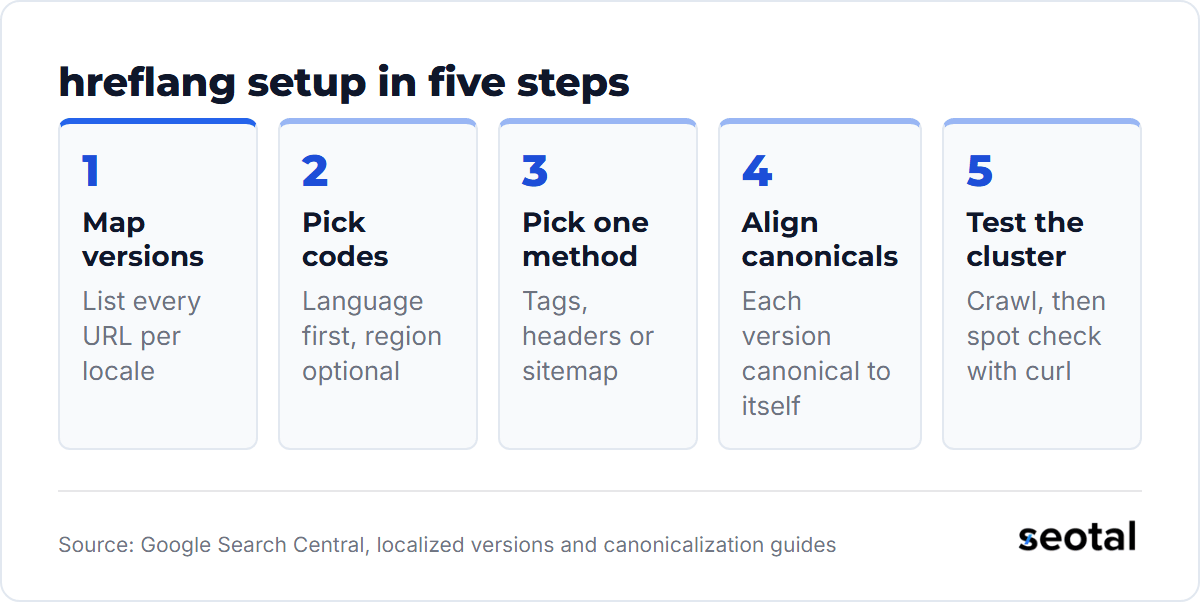
The examples below use one common Southeast Asian pattern: a single English page for Singapore, Malaysia and the Philippines, plus Indonesian and Vietnamese versions. The English page takes plain en and doubles as x-default.
HTML link tags
Put the same block in the <head> of all three pages:
<link rel="alternate" hreflang="en" href="https://example.com/en/pricing/" />
<link rel="alternate" hreflang="id-ID" href="https://example.com/id-id/harga/" />
<link rel="alternate" hreflang="vi-VN" href="https://example.com/vi-vn/bang-gia/" />
<link rel="alternate" hreflang="x-default" href="https://example.com/en/pricing/" />
Every href is a full URL with https. Google's guide requires fully qualified URLs, so /id-id/harga and //example.com/id-id/harga/ do not count.
Most frameworks can generate the block: Next.js takes an alternates.languages object in its metadata API and turns relative paths into full URLs through metadataBase. Our comparison of Nuxt.js, Next.js and Astro for SEO covers head management in each.
HTTP Link headers
Headers suit files with no <head>, such as a rate card PDF. The header lists all versions, including the file the server is sending, and it is identical on all three:
Link: <https://example.com/en/rate-card.pdf>; rel="alternate"; hreflang="en", <https://example.com/id-id/rate-card.pdf>; rel="alternate"; hreflang="id-ID", <https://example.com/vi-vn/rate-card.pdf>; rel="alternate"; hreflang="vi-VN"XML sitemap
A sitemap moves the whole cluster out of the page. Each <url> entry repeats the full set of xhtml:link children, itself included, and the file declares the xhtml namespace:
<?xml version="1.0" encoding="UTF-8"?>
<urlset xmlns="http://www.sitemaps.org/schemas/sitemap/0.9"
  xmlns:xhtml="http://www.w3.org/1999/xhtml">
  <url>
    <loc>https://example.com/en/pricing/</loc>
    <xhtml:link rel="alternate" hreflang="en" href="https://example.com/en/pricing/"/>
    <xhtml:link rel="alternate" hreflang="id-ID" href="https://example.com/id-id/harga/"/>
    <xhtml:link rel="alternate" hreflang="vi-VN" href="https://example.com/vi-vn/bang-gia/"/>
    <xhtml:link rel="alternate" hreflang="x-default" href="https://example.com/en/pricing/"/>
  </url>
  <url>
    <loc>https://example.com/id-id/harga/</loc>
    <xhtml:link rel="alternate" hreflang="en" href="https://example.com/en/pricing/"/>
    <xhtml:link rel="alternate" hreflang="id-ID" href="https://example.com/id-id/harga/"/>
    <xhtml:link rel="alternate" hreflang="vi-VN" href="https://example.com/vi-vn/bang-gia/"/>
    <xhtml:link rel="alternate" hreflang="x-default" href="https://example.com/en/pricing/"/>
  </url>
  <url>
    <loc>https://example.com/vi-vn/bang-gia/</loc>
    <xhtml:link rel="alternate" hreflang="en" href="https://example.com/en/pricing/"/>
    <xhtml:link rel="alternate" hreflang="id-ID" href="https://example.com/id-id/harga/"/>
    <xhtml:link rel="alternate" hreflang="vi-VN" href="https://example.com/vi-vn/bang-gia/"/>
    <xhtml:link rel="alternate" hreflang="x-default" href="https://example.com/en/pricing/"/>
  </url>
</urlset>
Google notes that a sitemap can only hold URLs below its own folder, so a file at /vi-vn/sitemap.xml cannot list /id-id pages as entries.
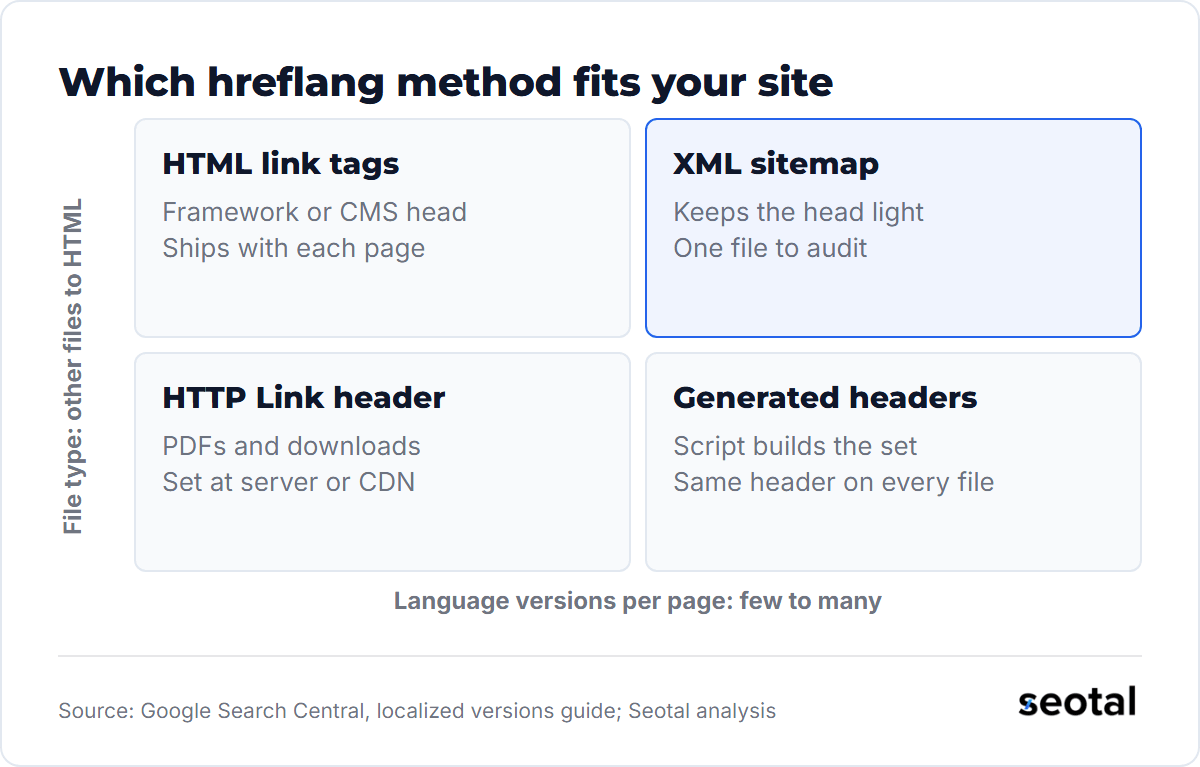
My rule of thumb: once a template carries more than four or five versions, the sitemap is easier to audit than the head of every page. For a site with a single regional template and two languages, link tags are the simpler build.
How do return links, self-references and canonicals fit together?
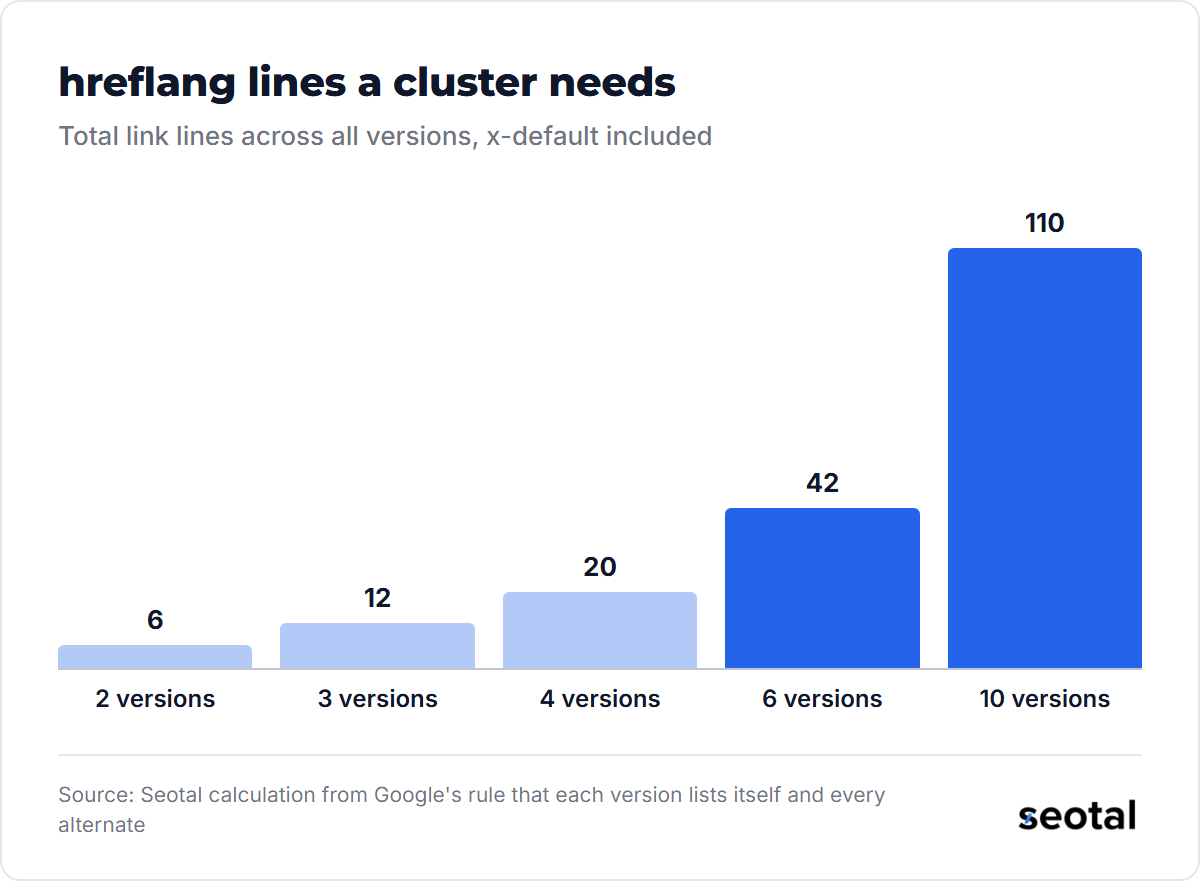
Each version must list itself and every other version. That rule makes the line count grow much faster than the version count. Six versions, one each for en-SG, ms-MY, id-ID, th-TH, vi-VN and tl-PH, need 42 lines once you add x-default.
Google allows one shortcut when a full set is hard to maintain. You can leave some languages off some pages, and Google still processes the pairs that link both ways. Its guide asks you to link new language pages both ways to the original, dominant version first.
Canonicals must agree with the cluster. Google's canonicalization guide asks you to specify a canonical page in the same language, or the best substitute language when none exists. A /vi-vn/bang-gia page that canonicalizes to the English page tells Google the English URL is the one to index.
Three more rules from the same guide:
- Google ignores a
rel="canonical"link that carries an hreflang, lang, media or type attribute. - For choosing canonicals, Google prefers URLs that are part of an hreflang cluster over similar URLs that are not.
- Listing the HTTP version of a page in hreflang, instead of the HTTPS one, can lead Google to pick the HTTP page as canonical.
Regional English pages are where this gets hard in Southeast Asia. Google's multi-regional guide says similar content in one language on different URLs should get a preferred version, marked with rel="canonical" and hreflang.
I would keep en-SG and en-MY as separate, self-canonical URLs only when they differ in something a buyer sees, such as SGD and MYR prices. Otherwise, one en page is less to maintain.
What does hreflang not do?
hreflang does not tell Google what language a page is in. Google's guide says it uses neither hreflang nor the HTML lang attribute to detect language. It uses algorithms on the visible content instead. A Bahasa Indonesia page with an English menu and footer still sends mixed signals, whatever its tags say.
hreflang does not make Google find versions it cannot crawl. Google's multi-regional guide says Googlebot usually crawls from the USA and sends no Accept-Language header. A site that redirects Vietnamese IP addresses to /vi-vn may only ever show Google the default version. Google advises against both IP-based adaptation and automatic language redirects.
The guide describes what hreflang does as helping Google "point users to the most appropriate version". It makes no promise about rankings. Google also ignores location meta tags such as geo.position.
Bing is less explicit. Its Webmaster Guidelines, read in September 2026, do not mention hreflang, the lang attribute or a content-language meta tag. A December 2025 post on the Bing Webmaster Blog tells site owners to use hreflang to define language and regional targeting. The same post warns that near-identical regional pages in one language count as duplicates.
Set <html lang> anyway, for browsers and screen readers. The WHATWG HTML standard calls the http-equiv="content-language" meta tag non-conforming and tells authors to use the lang attribute instead.
How do you test hreflang on a live site?
Start with a crawler. Google's deprecation notice for the International Targeting report says Google still supports and uses hreflang tags, but country targeting in Search Console is gone.
A crawl checks the whole cluster at once. Screaming Frog's hreflang audit guide lists the filters its crawler reports, including:
- missing return links and inconsistent language return links
- non-canonical and noindex return links
- incorrect language and region codes
- multiple entries for one code, which also catches tags set in both HTML and headers
Then spot check what the server sends, with curl:
curl -s https://example.com/id-id/harga/ | grep -i 'hreflang'
curl -sI https://example.com/id-id/rate-card.pdf | grep -i '^link:'
curl -s https://example.com/sitemap.xml | grep -c 'hreflang='
curl reads the HTML before any JavaScript runs. Empty output on a page that shows tags in the browser points to a script adding them, so compare the two before you trust either.
Search Console's URL Inspection tool covers the canonical side. Inspect the indexed version of each page and read the Google-selected canonical field. Google notes that the live test cannot predict which URL it will choose as canonical.
What are the most common hreflang errors on Southeast Asian sites?
Google's guide names three mistakes as the most common: missing return links, wrong language codes and wrong region codes. On Southeast Asian sites the code errors take local forms. For how often each one turns up, see our hreflang errors study for Southeast Asia.
The code errors to search your templates for:
- Country code as language:
myfor Malaysia,sgfor Singapore,bnfor Brunei,lafor Laos. - Region alone:
vn,ph,khormm, which match no language subtag. - Deprecated codes:
infor Indonesian andBUfor Myanmar. - Three-letter language codes:
fil-PH, outside Google's supported list. - Reserved regions:
en-UKinstead ofen-GB. Google ignores the UK part.
Which tag targets Burmese speakers living in Malaysia?
my-MY. Position sets the meaning: the first subtag is the language, so my is Burmese, and the second is the region, so MY is Malaysia.The cluster errors are harder to spot by eye. A page tagged id-ID that canonicalizes to the English page, a noindex Thai page inside a cluster, and an old HTTP URL in the sitemap can each break a working set. Our guide to SEO and AEO principles for front-end developers covers keeping canonical and hreflang tags correct on each route.
Get hreflang built and audited by a Seotal technical SEO specialist
I lead SEO and GEO at Seotal. We match businesses with vetted freelance technical SEO specialists, and our FAQ lists hreflang for international sites among their specialisms. You can hire technical SEO specialists in Vietnam or in Malaysia, or compare profiles in our list of technical SEO experts to hire.
A one-off hreflang audit fits the hourly plan, at $15 to $30 an hour with no minimum. Ongoing work runs on a part-time retainer of $1,000 to $2,000 a month for 60 to 80 hours, with a 3-month minimum.
For a full-time hire, our pricing page puts mid-level SEO experts at $1,000 to $2,200 a month in Vietnam and $1,800 to $3,500 in Malaysia. Send a brief through hire an SEO expert and get screened profiles within 72 hours.
hreflang in Southeast Asia: frequently asked questions
Can hreflang link pages on different domains, such as .co.id and .vn sites?
Yes. Google's localized versions guide says alternate URLs do not need to be on the same domain. The return link rule still applies across both sites.
Do hreflang entries count toward the sitemap URL limit?
No. Google says the child xhtml:link elements do not count toward the limit. Its sitemap guide caps one sitemap at 50,000 URLs or 50MB uncompressed.
Where can I find search data for these markets?
Our Southeast Asia SEO statistics compare Google, Bing and Cốc Cốc shares, mobile speeds and AI search use across the region.
 How Many Websites Targeting Southeast Asia Get hreflang Wrong? (2026 Study)
 English Proficiency in Southeast Asia and India: 2026 Data for Content and SEO Hiring
 How Much of the Web Is in Southeast Asian Languages? Common Crawl and Wikipedia Data (2026)