
 Philippines
 Vietnam
 Bali, Indonesia
 Malaysia
 Dubai, UAE
 India
India
Delhi's test takers averaged 407 in EF's 2025 city table, 170 points below Kochi and 60 below Bangkok. Country averages hide gaps that wide. Exam data from IELTS and TOEFL candidates reorders several of the same countries again.
How do Southeast Asia and India rank on English proficiency?
Malaysia moved ahead of the Philippines in the 2025 edition, 581 to 569, after trailing it in each edition from 2018 to 2024. Malaysia now ranks 24th of 123 countries and first of 25 in Asia on the EF English Proficiency Index 2025. Cambodia ranks last of all 123.
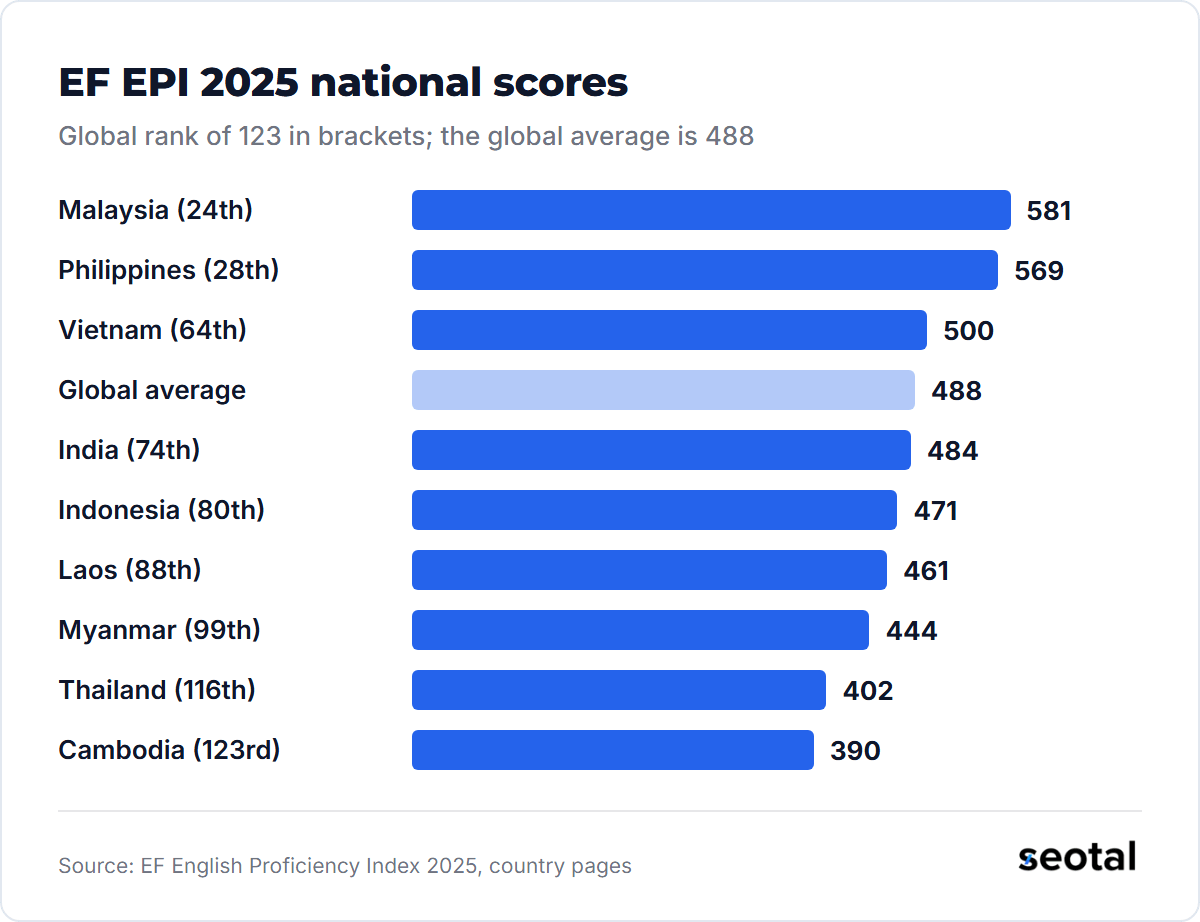
Rank within Asia, from the country pages:
- Malaysia: 1st of 25, high band.
- Philippines: 2nd, high band.
- Vietnam: 7th, moderate band, 12 points over the global average of 488.
- India: 10th, low band.
- Indonesia: 12th, low band.
- Laos: 14th, low band.
- Myanmar: 19th, very low band.
- Thailand: 24th, very low band.
- Cambodia: 25th, very low band.
Singapore has no country page in the 2025 edition. The 2024 edition ranked it 3rd of 116 with 609, and EF's 2025 pages give no reason for the gap.
For the two biggest markets side by side, with rates and time zones, see our Philippines vs India SEO outsourcing comparison.
Which countries gained or lost ground since 2020?
Malaysia gained 34 points between the 2020 and 2025 editions, and Myanmar 33. Cambodia fell from 435 to 390 over the same span, and Thailand from 419 to 402.
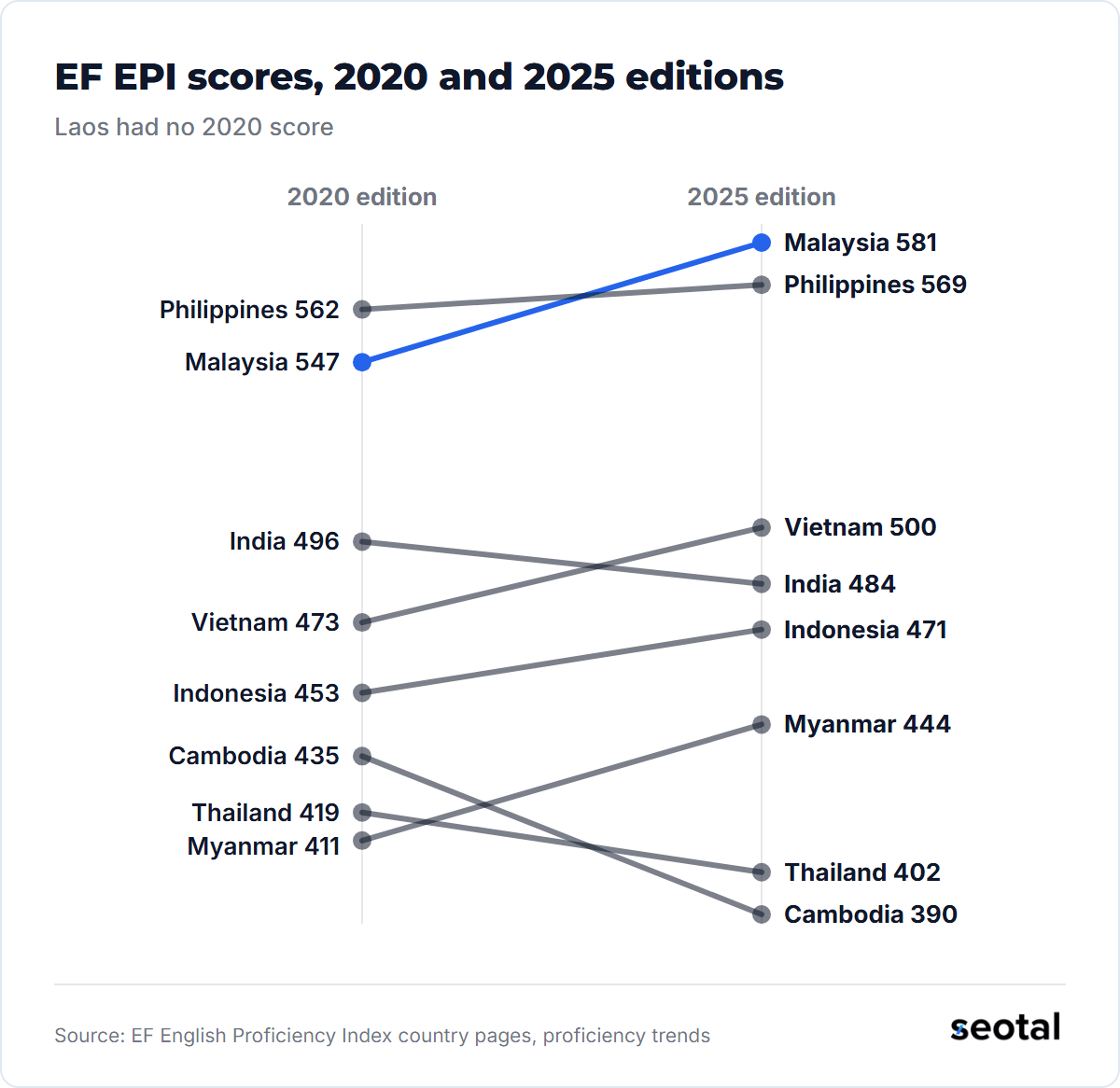
The latest single edition moved some countries more than others. Cambodia dropped 18 points from 2024, Thailand 13 and India 6. Malaysia added 15, the largest one-year gain here.
The longer series tells a different story for some markets:
- India peaked at 553 in 2015. Its 2025 score of 484 is its lowest since the first edition in 2011.
- Vietnam started at 440 in the first edition, 2011, and has held between 473 and 514 since 2013.
- Laos scored 364 in 2022 and 461 in 2025. EF's page for Laos shows no score for 2018 to 2021 or for 2023 and 2024, so the jump covers a gap in the data.
- Cambodia entered in 2014 at 370, rose to 435 by 2020, and has fallen in four of the five editions since.
Because each national score averages three years, a one-year swing reflects two older years as well as the newest one.
How much do scores vary between cities and regions?
India's city scores span 249 points, from 577 in Kochi to 328 in Thiruvarur, the widest spread of the seven countries with several cities listed. Malaysia has the highest floor: its lowest city entry, Terengganu, still scored 553.
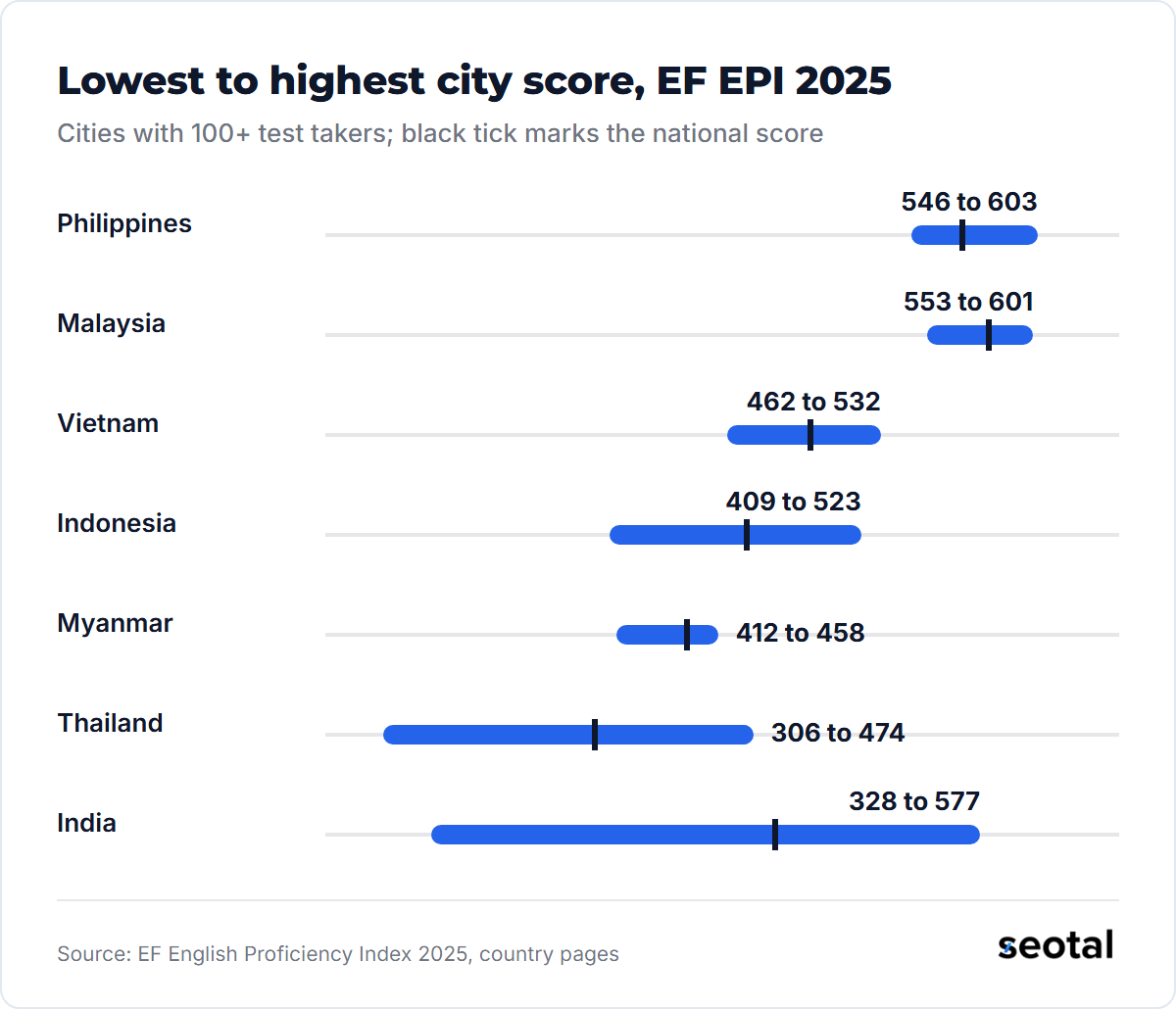
Capitals and business hubs lead in some countries and not in others:
- Vietnam: Hanoi scored 532, Nha Trang 517 and Ho Chi Minh City 508.
- Thailand: Pattaya (474) edged Bangkok (467).
- Malaysia: Kuantan (601) and Shah Alam (600) topped Kuala Lumpur (588).
- Indonesia: Jakarta led at 523, with Surabaya at 519.
- Cambodia and Laos: EF lists one city each. Phnom Penh scored 472 and Vientiane 486, both above their national scores.
EF also scores regions and states. The Cordillera Administrative Region scored 606, the highest in the Philippines, and Ilocos 533. In India, Telangana led at 548 and Uttar Pradesh trailed at 418. Vietnam's Red River Delta scored 526 against 464 for the Mekong River Delta, and Indonesia's Java 493 against 416 for Maluku.
EF lists a city once it has 100 test takers, so a small city's score rests on far fewer tests than a national one.
How do age and gender change the scores?
India is the one country here where test takers over 40 outscore all four younger groups: 528, against 458 for those aged 18 to 20. In four of the other six, scores peak in the 26 to 30 group.
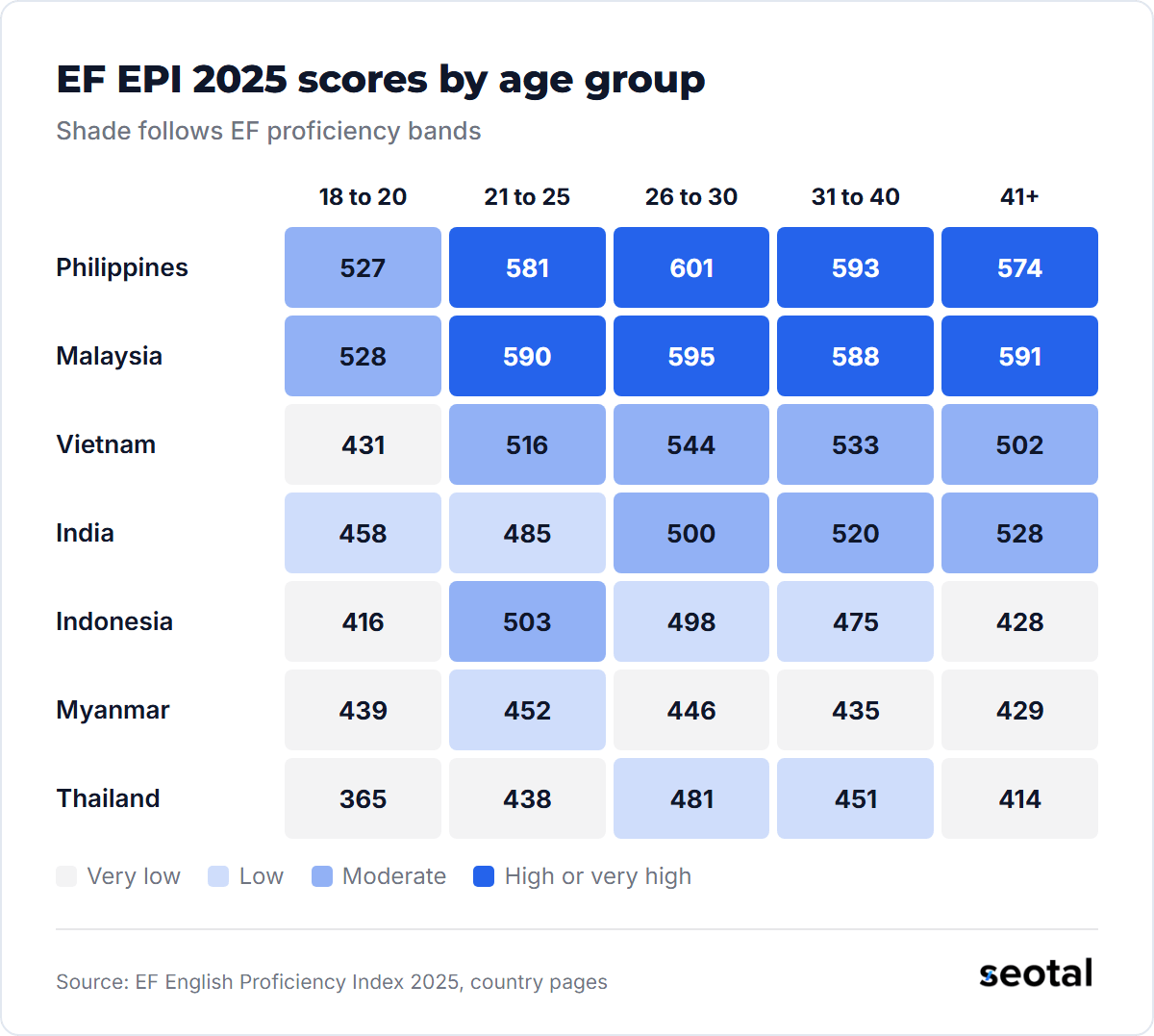
The youngest adults score lowest in six of the seven countries with age data. Indonesia's 18 to 20 group scored 416 and Thailand's 365. EF's report notes that proficiency among the youngest adults remains lower than before the pandemic worldwide. EF publishes no age breakdown for Cambodia or Laos.
Gender gaps run in both directions:
- Laos: women 474, men 448, the largest gap in favour of women here.
- India: men 495, women 474.
- Cambodia: men 401, women 379.
- Myanmar: men 454, women 435.
- Philippines: women 571, men 567.
- Malaysia: men 583, women 580.
EF's worldwide averages are 491 for men and 486 for women.
What do EF's writing and marketing scores show?
Philippine test takers averaged 603 on EF's writing section, the one writing score in the very high band among these ten countries. EF published skill scores for the first time in 2025, next to its scores by job function.
| Country | Writing | Speaking | Marketing staff |
|---|---|---|---|
| Philippines | 603 | 539 | 600 |
| Malaysia | 584 | 534 | 580 |
| Vietnam | 508 | 461 | 511 |
| India | 504 | 500 | 463 |
| Myanmar | 484 | 433 | 450 |
| Indonesia | 479 | 447 | 513 |
| Laos | 463 | 419 | n/a |
| Cambodia | 394 | 386 | n/a |
| Thailand | 363 | 377 | 459 |
India and Indonesia swap places on the marketing column. Indonesian marketing staff scored 513, above the national 471, while Indian marketing staff scored 463, below India's national 484. India's writing score, 504, sits in the moderate band even though the country's overall score is low.
Writing is the strongest of the four skills in Myanmar, at 484 against 421 for listening. EF's report groups Myanmar with Bangladesh, Bhutan and Nepal and links the pattern to education systems or workplaces that value written English. Thailand shows the reverse: writing, at 363, is its weakest skill.
For scale, EF's report places "write professional emails on familiar subjects" among the sample tasks for its moderate band (500 to 549). The high band (550 to 599) adds tasks such as reading a newspaper.
How do IELTS and TOEFL candidates from these countries score?
Indonesian IELTS Academic candidates averaged 6.68 in 2024 to 2025, above India's 6.58, the reverse of EF's order.
| Country | IELTS Academic, overall | IELTS Academic, writing | TOEFL iBT, total | TOEFL iBT, writing |
|---|---|---|---|---|
| Singapore | n/a | n/a | 97 | 24 |
| Malaysia | 7.06 | 6.46 | 91 | 23 |
| Philippines | 6.81 | 6.30 | 86 | 22 |
| Indonesia | 6.68 | 6.16 | 84 | 21 |
| India | 6.58 | 6.24 | 94 | 23 |
| Myanmar | 6.55 | 6.10 | 83 | 21 |
| Vietnam | 6.20 | 6.06 | 74 | 20 |
| Thailand | 6.20 | 5.81 | 83 | 20 |
| Cambodia | 6.03 | 5.82 | 79 | 20 |
| Laos | n/a | n/a | 58 | 16 |
The IELTS columns come from the IELTS test taker performance data for 2024 to 2025, which lists the top nationalities by candidature; Singapore and Laos are not among them. Writing is the lowest of the four IELTS skills for six of the eight nationalities listed here. The two exceptions are Vietnam, where speaking is lower, and Cambodia, where listening is.
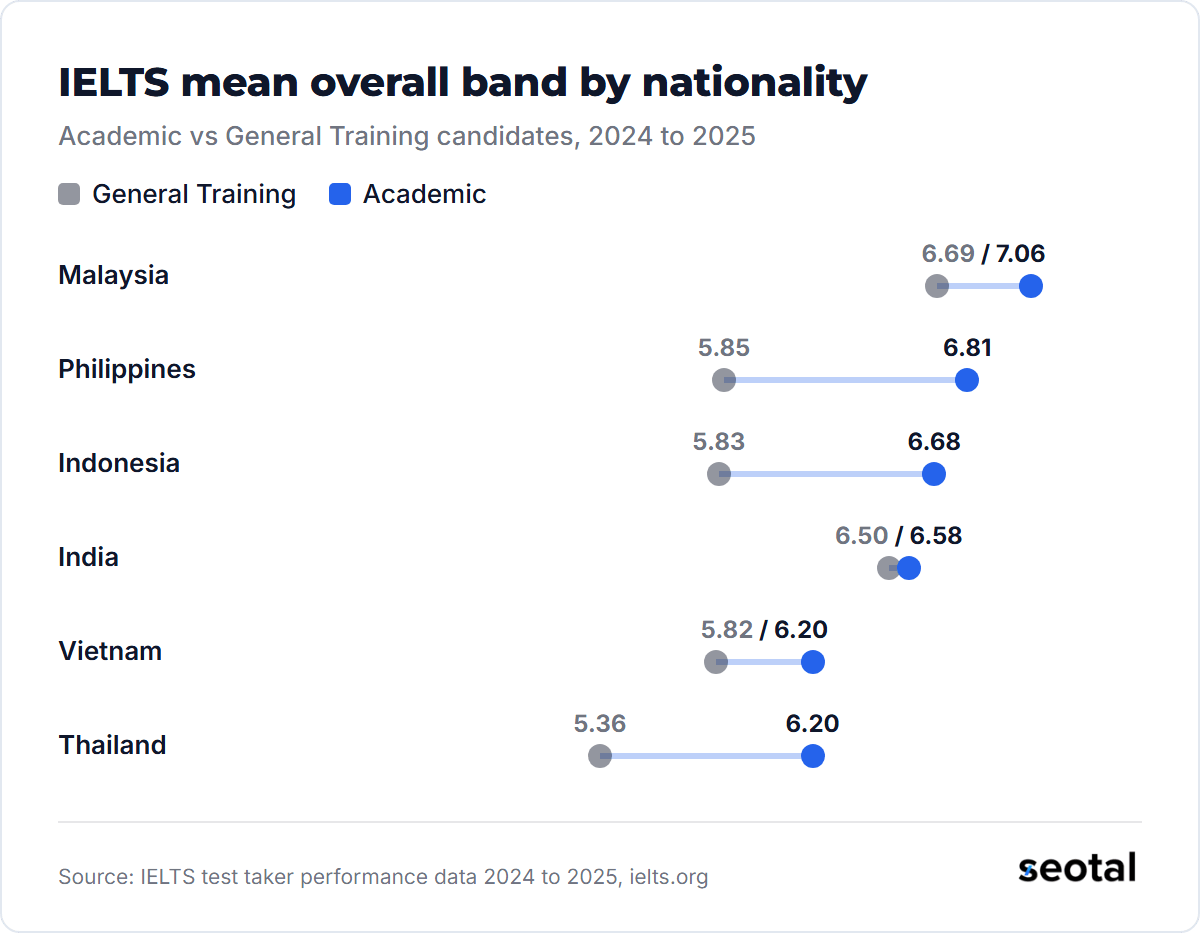
In some countries the test version matters as much as the nationality. IELTS reports Academic and General Training candidates in separate tables. In India the two groups sit 0.08 of a band apart, while in the Philippines the gap is 0.96.
The TOEFL columns come from Table 16 of the TOEFL iBT Test and Score Data Summary 2024, grouped by native country for tests taken from January to December 2024. ETS does not report means for groups under 30 test takers. It also warns against ranking countries on these means, saying the test "is not appropriate for comparing countries."
EF reports that its 2025 national scores correlate with TOEFL iBT 2023 scores at r=0.74 and with IELTS Academic 2024 scores at r=0.61. Correlations at that level still leave room for the reorderings in the table above.
Where does Singapore fit?
English is the language most Singapore residents speak at home: 58.1% of residents aged 5 and over in 2025, up from 48.3% in 2020, according to the SingStat General Household Survey 2025 press release of June 30, 2026.
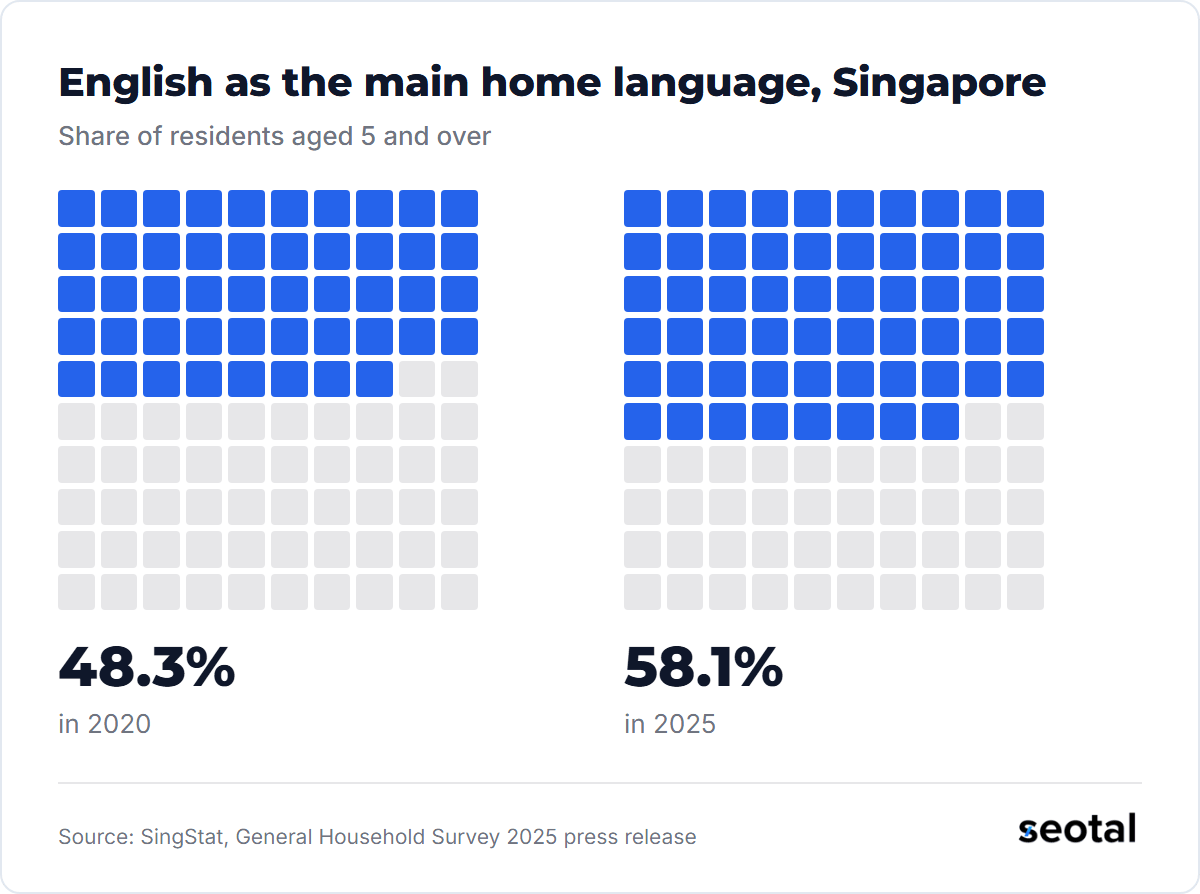
The same release says 80.5% of those English-speaking residents also speak a vernacular language as a second home language. The survey measures self-reported home use, not tested skill, so it answers a different question from EF, IELTS or TOEFL.
On tested skill, Singapore's TOEFL iBT test takers averaged 97 in 2024, and EF's 2024 edition put the country in its very high band.
What do proficiency scores leave out for SEO and content work?
EF, IELTS and TOEFL all test general or academic English. None of them scores a search brief, a meta description, keyword placement or edits to a style guide, so a strong national score says little about one writer's SEO work.
The data can narrow a search. It can show where scores run high, such as Manila (603) or Kochi (577), and flag a skill gap before interviews, such as speaking scores well below writing scores. It cannot tell a fluent generalist from a writer who understands search intent.
Which measure in this post counts English speakers instead of testing them?
A paid sample task tests the part the indexes miss. Our guide on how to hire an SEO specialist covers test tasks, and the SEO freelancer rates by country set the budget side. For daily video calls, internet speeds for remote work in Asia is the other constraint to check.
Hire English-language content and SEO talent through Seotal
We match companies with vetted freelance content and SEO specialists in markets including the Philippines, India, Vietnam and Malaysia. Vetting includes a written and spoken English assessment alongside a written SEO test, and most clients receive 3 to 5 vetted profiles within 72 hours of the brief, per how it works.
A mid-level content strategist costs $1,100 to $2,200 a month in the Philippines, $1,000 to $2,100 in India, $900 to $1,900 in Vietnam and $1,600 to $3,200 in Malaysia on our pricing page. A part-time retainer runs $1,000 to $2,000 a month for 60 to 80 hours, with a 3-month minimum.
Role pages cover a content strategist in the Philippines and a content manager in India, and you can hire a content manager in the other markets we cover. If I were weighing two countries for written English, I would read the writing column before the national rank.
English proficiency data: frequently asked questions
Can an EF EPI score be converted to an IELTS band?
No. EF publishes no conversion table. Its correlations with TOEFL iBT and IELTS Academic compare national averages, and they say nothing about what one person's EF score equals on either exam.
Why do Cambodia and Laos have fewer breakdowns?
EF's pages for both list one city each, with no age, region or job function scores. EF lists a city only once it reaches 100 test takers, and a country at 400, but the report does not state a threshold for the other breakdowns.

![How to Hire an SEO Specialist from Asia [2026]](/assets/blog/how-to-hire-an-seo-specialists-cover.png) How to Hire an SEO Specialist from Asia [2026]
How to Hire an SEO Specialist from Asia [2026]  Internet Speeds for Remote Work in Asia: Philippines, Vietnam, Indonesia, Malaysia and India (2026)
  Philippines vs India for SEO Outsourcing: Cost, English and Time Zones (2026)