
 Philippines
 Vietnam
 Bali, Indonesia
 Malaysia
 Dubai, UAE
 India
India
Cebuano Wikipedia has 6,115,735 articles, more than any edition except English. Common Crawl's language detector found 33,782 Cebuano pages in its entire August 2026 crawl. We analysed Common Crawl's language table across 38 crawls, the Wikipedia editions for eight Southeast Asian languages, and census counts for each language's home country.
How much of the web is in each Southeast Asian language?
Indonesian and Vietnamese sit between Czech (1.1458%) and Korean (0.8500%) in Common Crawl's August 2026 table. Common Crawl's language statistics record the primary language of each HTML page in a crawl. The August crawl, CC-MAIN-2026-34, put 2.14 billion pages through the detector.
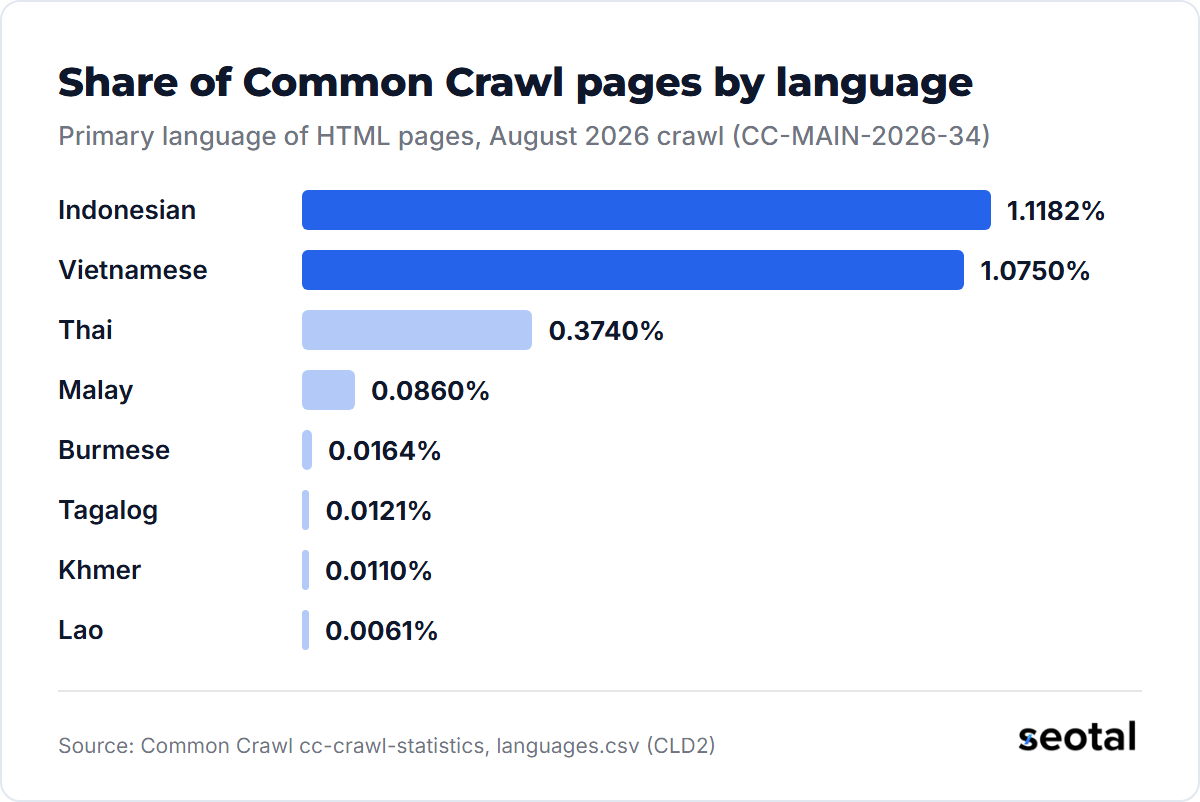
Thai ranks 27th and Malay 41st. After Malay the shares drop by a factor of five: Burmese is 60th, Tagalog 65th, Khmer 69th and Lao 79th. Our ranks leave out the 3.2480% of pages the detector could not assign.
In page counts, the August crawl holds:
- Indonesian: 23,924,783 pages
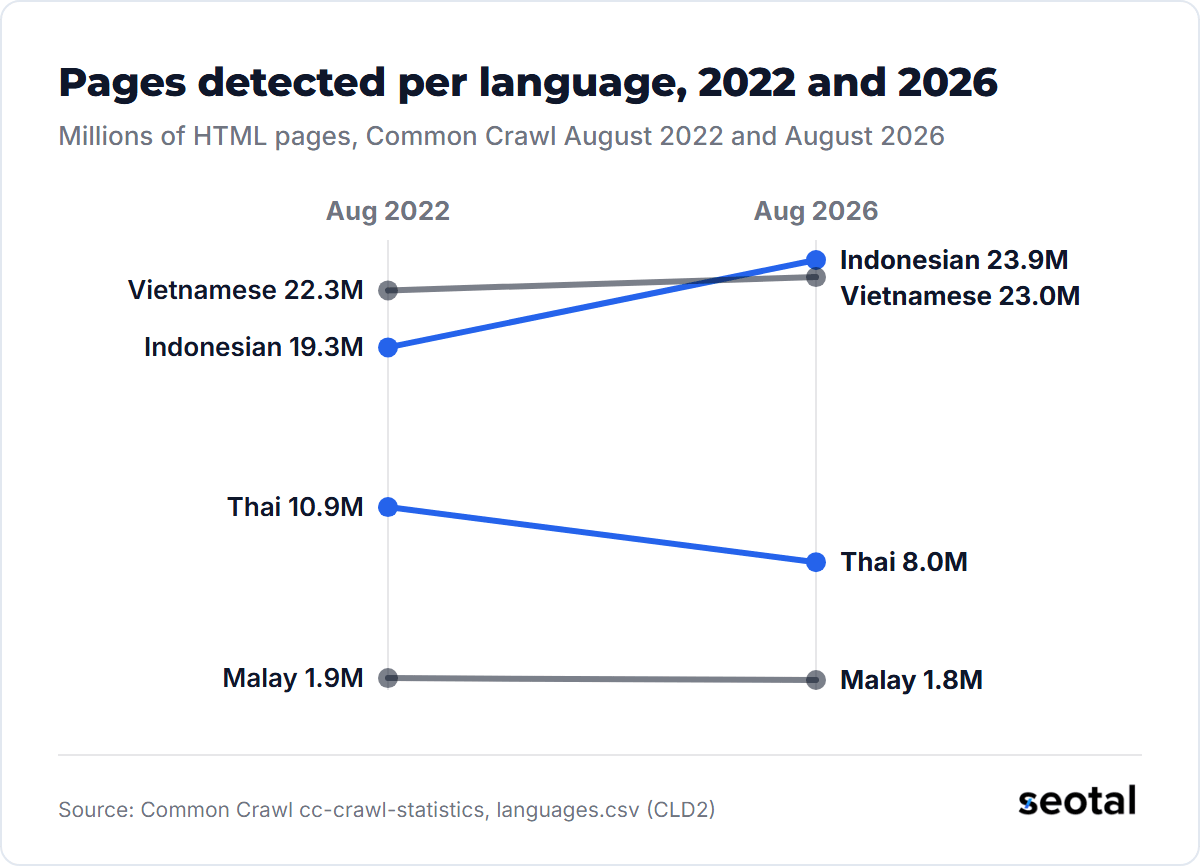
- Vietnamese: 23,000,895 pages
- Thai: 8,002,604 pages
- Malay: 1,840,421 pages
- Burmese, Tagalog, Khmer and Lao: 976,803 pages combined
English accounts for 40.4526% of the same crawl and Chinese for 4.3829%, which ranks 7th.
Has the Southeast Asian share of Common Crawl grown since 2022?
The eight languages grew from 2.13% of pages in August 2022 to 2.70% in August 2026, summing Common Crawl's published shares. The high point came in April 2026 (CC-MAIN-2026-17), at 2.87%.
The two largest languages traded places along the way. Indonesian passed Vietnamese in the August 2024 crawl and led in 18 of the 25 crawls from then to August 2026.
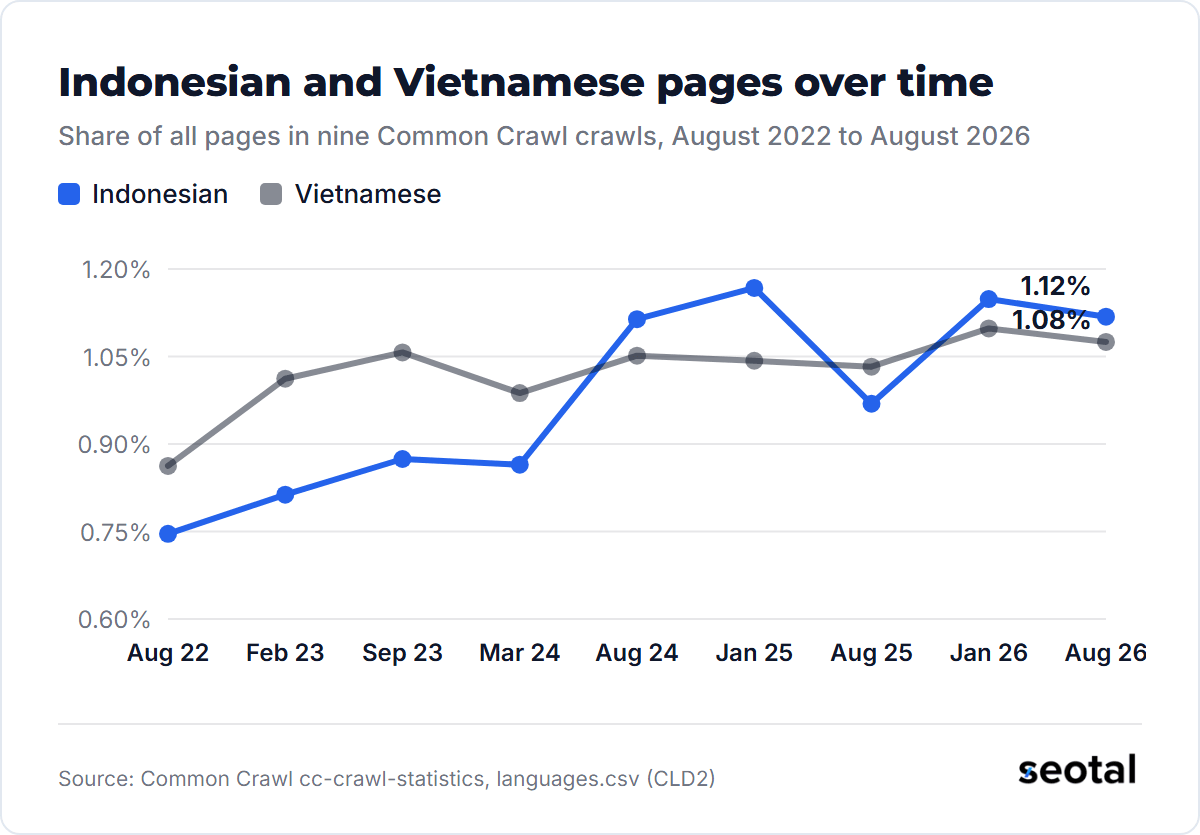
Vietnamese led again in five crawls in a row, from August to December 2025. Indonesian moved more between crawls: its share fell from 1.1676% in January 2025 to 0.9690% in August 2025, then rose to 1.1485% in January 2026.
Which languages gained and lost pages?
Thai lost the most. The August 2022 crawl held 10,888,547 Thai pages and the August 2026 crawl 8,002,604, a fall of 26.5%, while the whole crawl shrank 17.3%. Thai's share peaked at 0.5037% in February 2025 and stayed between 0.3697% and 0.3944% in the 13 crawls since August 2025.
The CLD2 documentation says scripts such as Thai "map one-to-one to detected languages." A page counts as Thai when Thai script makes up most of its text, so a mix-up with a neighbouring language would not explain the fall.
Indonesian added the most pages despite the smaller crawl: up 23.9%, from 19,315,087 to 23,924,783. Malay lost 2.5% of its pages and its share still rose 18.0%, in a crawl that shrank 17.3%.
How much content exists in Burmese, Khmer, Lao and Tagalog?
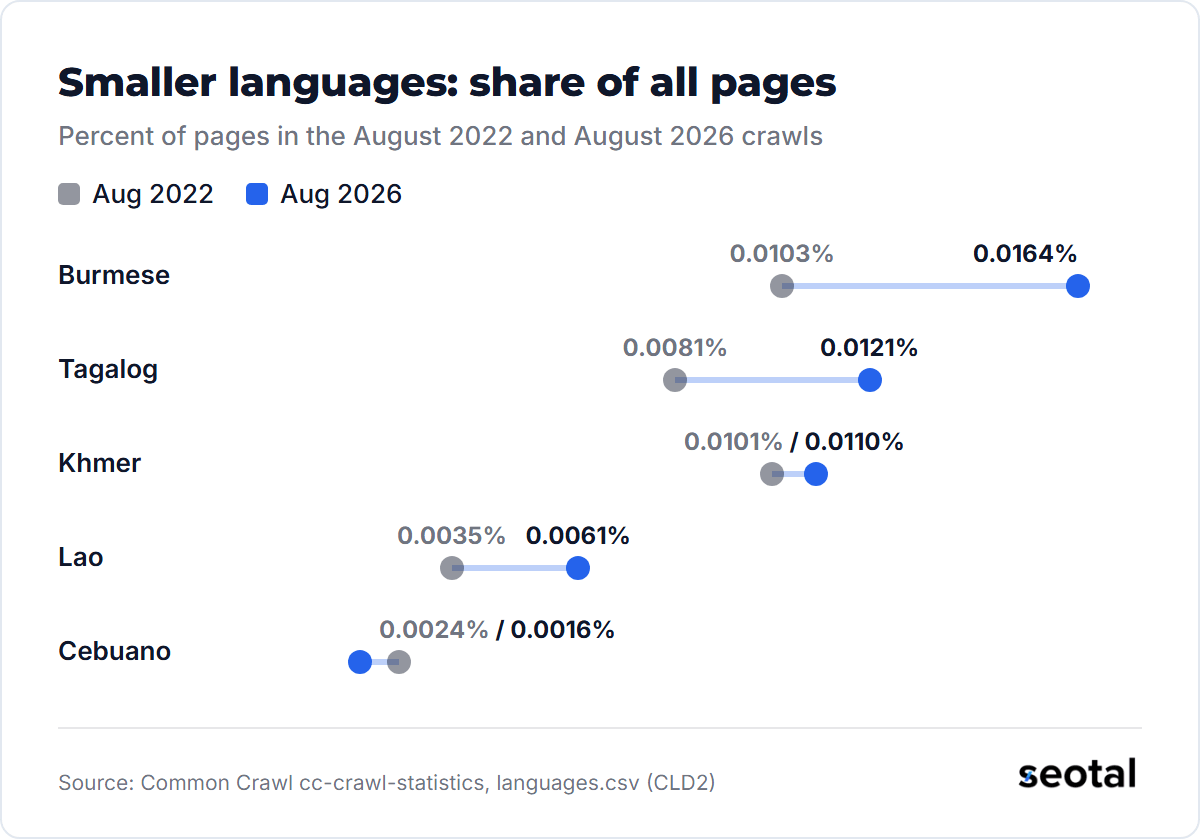
Each has fewer than 400,000 pages in the August 2026 crawl. Burmese leads with 351,096, then Tagalog with 258,643, Khmer with 236,411 and Lao with 130,653.
All four grew their share since August 2022: Burmese by 59.2%, Tagalog by 49.4% and Khmer by 8.9%. Khmer still lost pages, down 9.4%.
Tagalog has the second largest home population of the eight languages and the sixth largest web share. The Philippines counted 109,035,343 people in its 2020 census, more than Vietnam's 96,208,984 in 2019. Vietnamese still has 89 times as many pages as Tagalog in the crawl.
The detector's rules explain part of the gap. Common Crawl counts only the first language CLD2 returns for a page, so a Philippine news site written in English adds to the English count. The supported list in its documentation names Tagalog and has no separate entry for Filipino.
Cebuano, also spoken in the Philippines, went the other way. Its page count fell 44.6%, from 60,973 to 33,782.
Which had more pages in Common Crawl's August 2026 crawl, Burmese or Tagalog?
How do web pages compare with population and Wikipedia?
Wikipedia puts these languages in a different order from the web. Malay Wikipedia has 443,726 articles for a home country of 32.4 million, while Thai Wikipedia has 187,672 for Thailand's 70.3 million. On the web, Thai has more than four times as many pages as Malay.
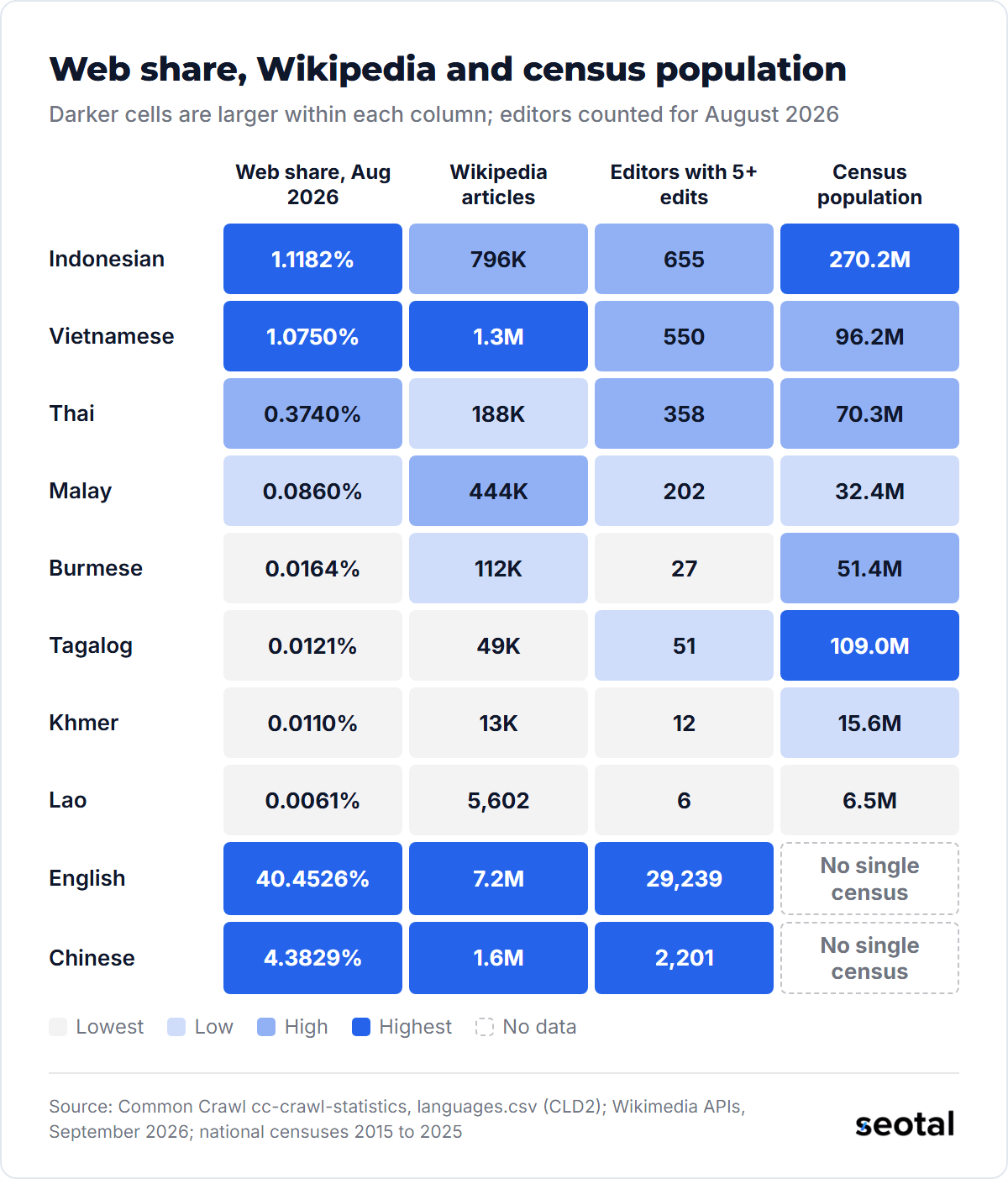
We read the article counts from each edition's siteinfo statistics on September 13, 2026. Editor counts come from the Wikimedia editors API: registered users with five or more content edits in August 2026.
English and Chinese have no single home census, so their population cells stay empty.
What does Wikipedia show that Common Crawl does not?
Among the eight languages, Vietnamese has the largest Wikipedia, even though Indonesian leads on the web. Vietnamese Wikipedia holds 1,304,256 articles and 394 million words of article text, against 795,821 articles and 294 million words in Indonesian.
Editor counts put the editions in another order. In August 2026, Indonesian Wikipedia had 655 editors with five or more edits, Vietnamese 550 and Thai 358. Indonesian lost 311 of these editors since August 2022, while Thai gained 42 and Tagalog went from 27 to 51.
Article counts can mislead. The English Wikipedia page on Lsjbot says the bot created most Cebuano articles, and Waray Wikipedia holds 1,266,965 articles with 11 editors making five or more edits in August 2026.
- 6,115,735 articles
- 50 editors with 5+ edits
- Second largest edition
- 33,782 pages
- 0.0016% of all pages
- Page count down 44.6% since 2022
Why do Common Crawl page counts matter for AI search?
Common Crawl is a documented source for some large language models. OpenAI's GPT-3 paper lists filtered Common Crawl at 410 billion tokens and 60% of the training mix, with Wikipedia at 3%.
Google's mT5 paper built its mC4 corpus from Common Crawl. It kept pages with at least three lines of 200 or more characters, and included a language only when it had 10,000 or more pages. Both papers date from 2020, and neither says what newer models use.
Site owners control part of this. Common Crawl's CCBot page tells sites to disallow CCBot in robots.txt to stay out of its crawls. In our robots.txt study of top Southeast Asian domains, 12.8% of readable domains blocked CCBot.
I read page counts as a measure of competition. Lao has 130,653 pages in the August crawl, so a site that publishes 500 well-structured Lao pages adds about 0.4% to that pool. The same 500 pages in English would be a rounding error.
For Lao, Khmer or Tagalog audiences, I would budget for original pages in the local language before translated English pages in a GEO plan.
For the search side of that plan, see how AI search finds local businesses, AI search use in Southeast Asia and the Vietnamese SEO guide. Sites that serve several of these languages need working language tags, covered in the hreflang guide for Southeast Asia.
Methodology
Common Crawl. We downloaded languages.csv from the cc-crawl-statistics project on September 13, 2026. It lists pages and the percentage of pages per crawl for each ISO 639-3 code. We took the percentages as published and used the crawl dates from Common Crawl's index collection list.
- Latest crawl: CC-MAIN-2026-34, fetched August 7 to 20, 2026.
- Earlier crawl: CC-MAIN-2022-33, fetched August 7 to 20, 2022.
- Trend: all 38 crawls from CC-MAIN-2022-33 to CC-MAIN-2026-34; the line chart shows nine of them.
- Our calculations: the eight-language total, ranks, and percentage changes, each within Common Crawl's table.
Detection. Common Crawl runs CLD2 on HTML pages and counts the first language it returns. CLD2's documentation gives web pages of at least 200 characters as its design target.
The same documentation says the detector scores distinctive words to separate close pairs such as Malay and Indonesian, so some pages in those two languages can land in the wrong column.
Wikipedia. Article counts, article word counts and 30-day active users came from each edition's siteinfo API. Editor counts sum the three Wikimedia activity levels from five edits up, for registered users and content pages.
Census populations.
| Language | Home country census | Year |
|---|---|---|
| Indonesian | BPS Sensus Penduduk 2020 | 2020 |
| Vietnamese | 2019 census results, GSO and UNFPA | 2019 |
| Thai | NSO census early results | 2025 |
| Malay | DOSM Census 2020 key findings | 2020 |
| Burmese | Department of Population census highlights | 2024 |
| Tagalog | Proclamation No. 1179 on the 2020 census | 2020 |
| Khmer | NIS General Population Census | 2019 |
| Lao | Lao Statistics Bureau figures via KPL | 2015 |
Myanmar's 51.4 million includes 19.2 million people the Department of Population estimated for areas it could not count. Thailand and Malaysia publish rounded totals, and we use them as published.
Limitations.
- Common Crawl is a sample. Each crawl covers the pages its crawler reached, and sites that block CCBot are missing.
- Pages are not volume. A short product page and a long article count as one page each.
- Detection makes errors, most of all on short text and between Malay and Indonesian.
- Crawl size changes. Shares move when the rest of the crawl grows or shrinks, so we report page counts next to them.
- Wikipedia is a proxy. Bot-created articles inflate some editions, as Cebuano and Waray show.
The full table is in southeast-asian-languages-on-the-web.csv, and the trend series are in the summary JSON.
Hire native-language SEO specialists for Southeast Asian markets
A Vietnamese or Indonesian page competes in a pool of about 23 million crawled pages, and a Khmer page in one of about 236,000. Seotal matches you with vetted freelance SEO specialists based in Vietnam, Indonesia, Malaysia, the Philippines, India and Dubai, UAE.
For content in the local language, we can match freelancers who write in Vietnamese, Bahasa Indonesia, Bahasa Malaysia, Tagalog or Khmer.
You get 3 to 5 vetted profiles within 72 hours of your brief. Hourly work costs $15 to $30 with no minimum, and a part-time retainer costs $1,000 to $2,000 a month for 60 to 80 hours, with a 3-month minimum and a 30-day replacement guarantee (see pricing).
Hire an SEO expert, compare the best countries for SEO specialists, or start with talent in Vietnam, Indonesia or Malaysia.
Southeast Asian languages on the web: frequently asked questions
Why is Common Crawl's share of English falling?
Common Crawl's table shows English at 46.7774% of pages in August 2022 and 40.4526% in August 2026, and the table gives no reason for the fall. The same table shows English pages falling 28.5% while the crawl shrank 17.3%.
How often does Common Crawl publish new language statistics?
About once a month in 2026. Common Crawl's index list shows eight crawls from January to August 2026, and the statistics page listed CC-MAIN-2026-34 as its latest crawl when we read it.

 Top 10 SEO Tools for Vietnamese, Indonesian and Thai Keywords (2026)
  hreflang for Southeast Asia: en-SG, ms-MY, id-ID, th-TH, vi-VN and tl-PH Setup Guide (2026)
  Top 10 SEO & AEO Principles Every Front-End Developer Should Know