 Philippines
 Vietnam
 Bali, Indonesia
 Malaysia
 Dubai, UAE
 India
On launch day, Citeme ran the claim flow and found the "service" button greyed out, and that is the option a software vendor, agency or consultancy would pick. Only "Online store" led to a profile. "Physical location" put the user on a waitlist. So the first useful thing a startup can learn from Business Hub is which of those three buttons it is.
What is ChatGPT Business Hub?
ChatGPT Business Hub is the place where a business claims the profile ChatGPT keeps about it, keeps that profile's details current and reads first-party numbers on how ChatGPT users find it. OpenAI announced it as Businesses in ChatGPT on November 10, 2026, in beta. The profile works like the business listings Google and other search engines already show.
The audience is large. OpenAI told IT Brief Asia that 1.2 billion people use ChatGPT each week. That is a 50% rise from the 800 million Sam Altman gave at DevDay in October 2025, per TechCrunch.
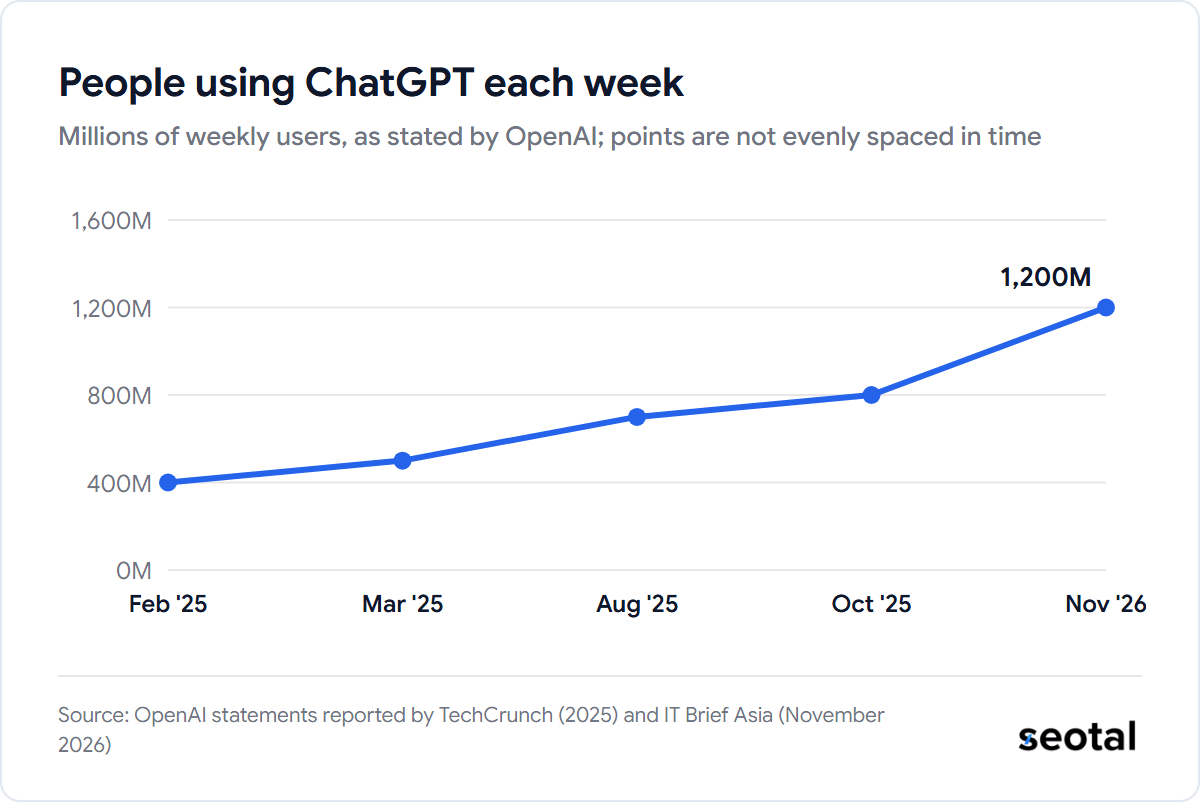
Those earlier points come from TechCrunch's March 2025 report of 400 million and its August 2025 report of close to 700 million, up from 500 million at the end of March. Each one is OpenAI's own count of people who use ChatGPT in a week.
Business Hub has three parts:
- Profile. About, location, contact, hours and photos, plus a product feed with prices and stock for stores.
- Insights. Mentions, profile views, website clicks and the topics of conversations that cite you.
- Business Agent. A labelled chat inside ChatGPT that answers questions from the product and policy data you supply.
Can a startup claim its business in ChatGPT?
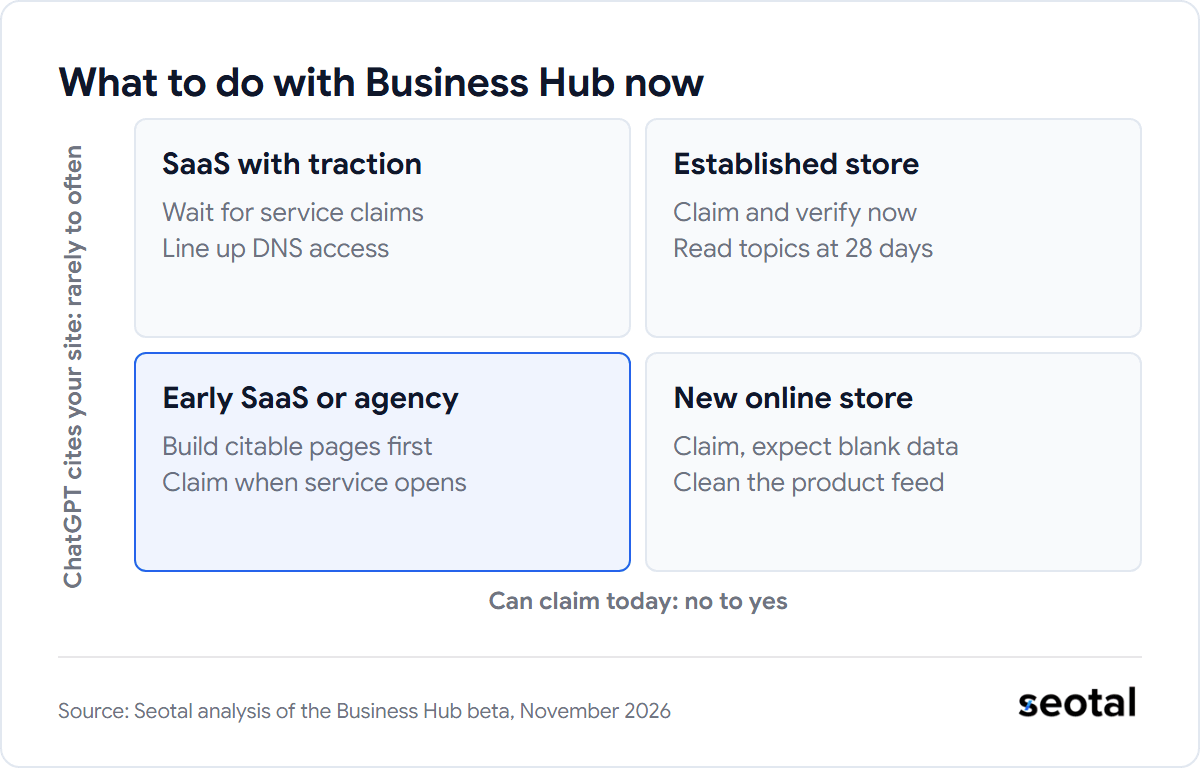
An online store can. A SaaS or service startup cannot yet.
In the flow Citeme tested on November 10, the three business types behaved like this: "Online store" reached profile creation, "Service" showed a greyed-out "Coming soon" label, and "Physical location" led to a waitlist. Citeme's walkthrough answers "Can a SaaS or a service business claim its profile?" with "Not yet."
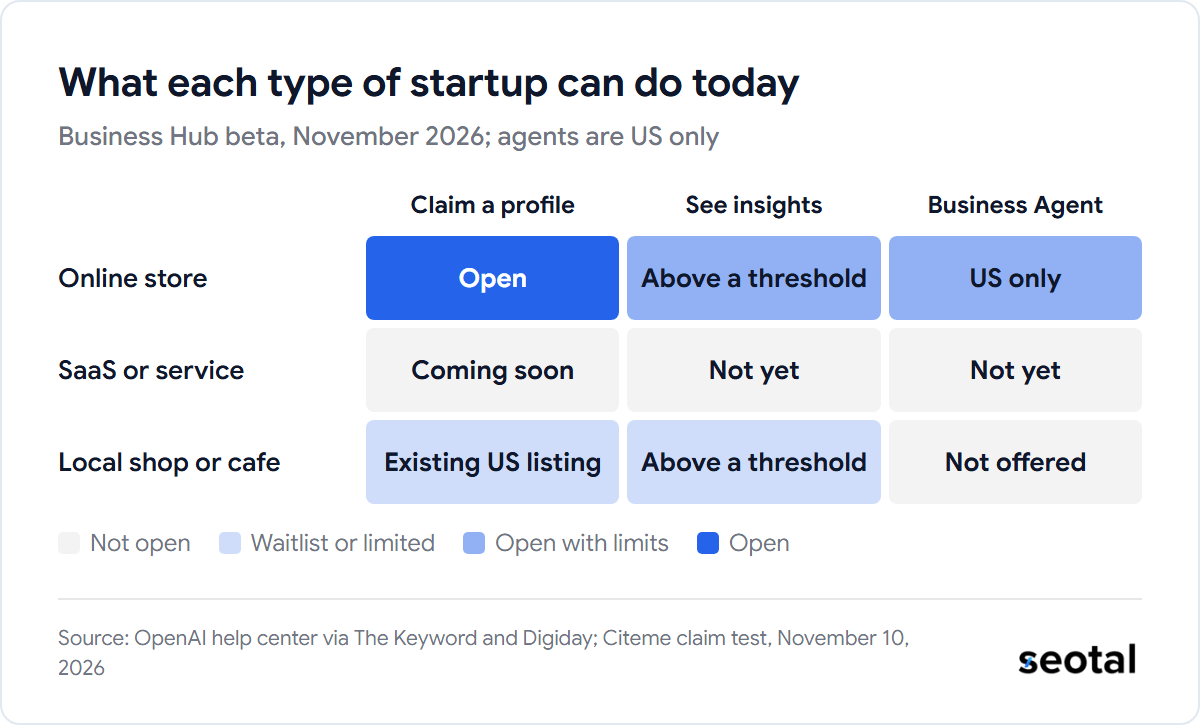
OpenAI's own wording is broader. Its announcement says eligible businesses wherever ChatGPT is available can claim. The setup guide in OpenAI's help center narrows that for local businesses: a store or restaurant can only claim an existing US listing for now, per The Keyword's summary. A company claims and manages each brand on its own, with no parent account across brands or locations.
Which bucket is a software startup in?
Citeme puts software vendors, agencies and consulting firms under "Service", which is the closed option. A startup that sells a physical product through Shopify is an online store. A startup that sells a subscription app is a service. A marketplace with a storefront sits in between, and Citeme did not test pushing a software product through the store path.
How do you claim and verify a profile?
You open Business Hub from the ChatGPT sidebar or at chatgpt.com/business-hub, search for your business, pick the match and prove you control it. OpenAI lists four proofs: a business phone, a business email, a TXT record on your website's domain or a connected Shopify store. A website is required to start.
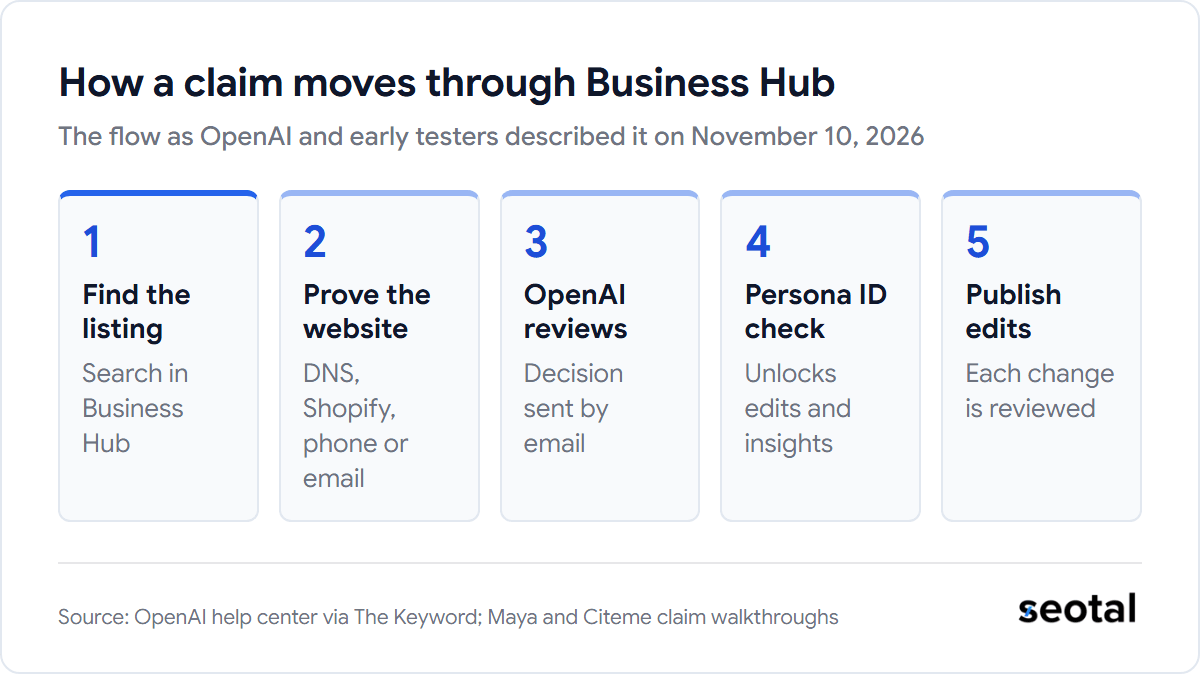
Two checks follow the claim. OpenAI reviews the claim and emails a decision, and it has not published a review time, per Maya's walkthrough. Then comes an identity check through Persona, which may ask for a government ID, business registration details and proof that you can act for the company.
The blue check appears once Persona approves you, and that step gates almost everything. You cannot publish edits, view insights or build an agent until it clears. Edits are not live when you press save either: OpenAI reviews each change before it appears.
What startups get stuck on
- DNS access. The TXT route needs someone who can edit the domain's DNS records. At an early startup that is often one founder's registrar login.
- Who passes Persona. The person verifying needs ID and authority to represent the company. A contractor or agency cannot stand in.
- Shopify only for some flows. Citeme's online store test offered only Shopify sign-in or a DNS record, not phone or email.
At the end of the flow, OpenAI offered Citeme $500 in ChatGPT Ads credit and an upgrade to the ChatGPT Business plan. Neither is required to claim. The Keyword confirms a claim needs no Ads account and no Enterprise agreement.
What do the insights show, and why might yours be blank?
Insights show four counts over a 7 or 28 day window: mentions, profile views, website clicks and discovery topics. Discovery topics list the top five themes in conversations where ChatGPT cited your site. Until this beta, no tool had OpenAI's own counts.
OpenAI does not show individual prompts or chats, and share of voice against competitors is not part of the beta.
The definitions are tighter than the names suggest. Digiday reports that for an online business a mention counts only when ChatGPT references its website, and naming the brand alone "doesn't count." A website click is a click on a link from a ChatGPT surface, not a completed visit or a sale.
ChatGPT names your startup in an answer but links to a review site instead of yours. Does Business Hub count a mention?
The threshold problem
OpenAI hides low counts for privacy. A blank metric can mean activity has not reached the reporting threshold, not that it is zero. Citeme's draft profile showed "No data is available for this timeframe", and its write-up says "A small brand with few citations may therefore see an empty dashboard." For a seed-stage startup, blank is the likely first result.
What it replaces, and what it does not
Until now, brands estimated ChatGPT visibility by running prompts through third-party trackers. "The fact that OpenAI will now share insights itself will take some of the power away from the third-party companies," Sonata Insights founder Debra Aho Williamson told Digiday. Accuracast's Farhad Divecha said those tools "are all using approximations."
One marketer on Hacker News welcomed it, writing that "so far only Bing Webmaster Tools has offered anything of value" on first-party data.
Business Hub covers one engine, though. Citeme, which sells a cross-engine tracker, reports that across seven brands it tracks and close to 2,000 queries, the engines cited those brands 13% of the time. The rate ran from 17% on Claude to 11% on Perplexity, and the best engine was not the same for every brand.
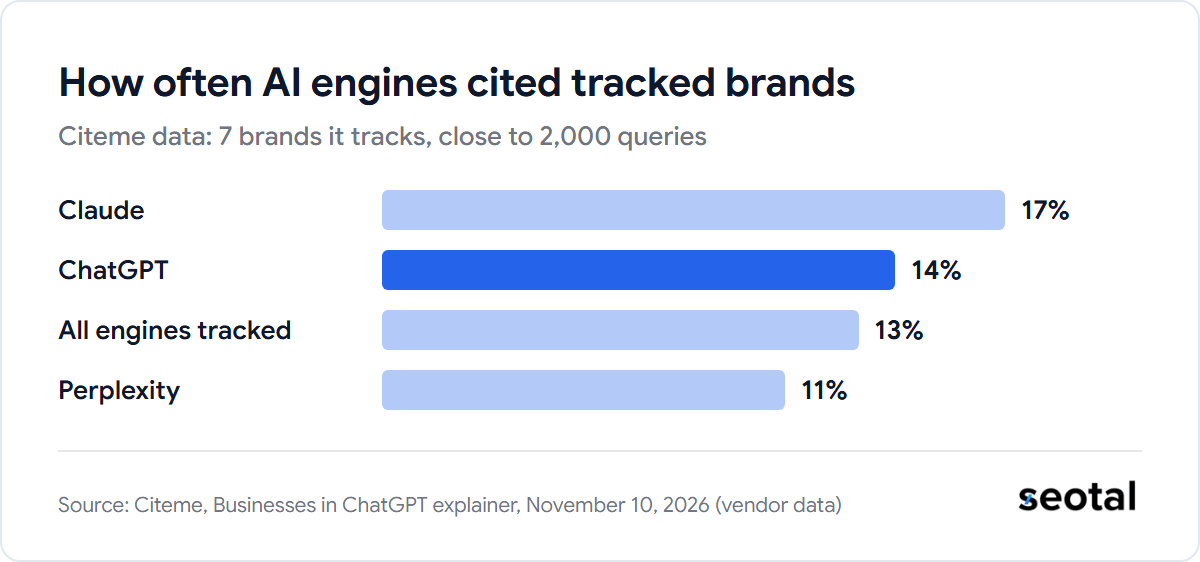
Treat that as vendor data with no published method. It still makes the point: a ChatGPT dashboard says nothing about Claude, Perplexity or Google's AI Overviews. Our list of companies that get brands cited in AI search covers the tools and teams that measure the rest.
What can a Business Agent do?
A Business Agent is a chat assistant that ChatGPT runs for your business, built from the product feed, policies and instructions you supply. Users open it in a labelled conversation separate from ChatGPT's own answers. It can answer questions, compare your products and link out to your website.
It stops short of the sale. The Keyword reports the agent "cannot complete purchases, take bookings or check an order." When a shopper is ready to pay, the agent sends them to your site, because "it's up to the business on how they want to close the transaction," OpenAI's Benji Shomair told Digiday.
You also cannot plug in your own agent: "We aren't allowing folks to bring their own agents."
Agents are open to ecommerce and online service businesses in the United States, and passing verification does not by itself make a business eligible. OpenAI still checks the category and intended use.
How the agent ties into ChatGPT ads
The free agent and the paid ad share one engine. "Think of the business agent as the organic experience," Shomair said. "The sponsored agent is the paid experience, but the agent that sits behind it should be the same." OpenAI began testing sponsored agents as a click-to-chat ad with selected US advertisers in September.
- March 2026OpenAI retires its in-chat checkout cart
- September 2026Sponsored agents tested as ads with selected US advertisers
- November 10, 2026Business Hub beta opens claims, insights and Business Agents
The March date matters for anyone planning around the agent. OpenAI's checkout cart "failed to gain traction and was retired in March," per AI Insider. Business Hub sends the transaction back to your own site instead.
Does claiming help you rank in ChatGPT?
No. OpenAI says claiming does not guarantee higher placement, and Shomair told Digiday that the core product has to "maintain objectivity." A business "should not have an impact on how frequently it appears," he said.
ChatGPT's recommendations stay independent of the profile and of ads. Accurate business information can help ChatGPT show you "in more relevant conversations," which is a matching benefit, not a ranking one.
- Your hours, contact details and photos
- Product prices and stock in the feed
- What your Business Agent says
- Pages that answer the question asked
- Third-party reviews and comparisons
- Being cited across the open web
ChatGPT still decides whom to recommend from what it finds about you outside the profile. A startup with few ChatGPT citations will claim a profile with nothing in the insights. The work that changes that is on your own site and in the places that write about you.
In our study of the 100 largest YC startups, 41% publish competitor comparison pages and 52% a pricing page. Both page types answer the questions buyers bring to ChatGPT, such as "X vs Y" or "how much does X cost." If ChatGPT is going to cite a startup's site, these are the pages it can cite.
Is Business Hub free?
It is free in the beta. Digiday reports that Business Hub and Business Agents cost nothing in the beta, and Shomair "didn't rule out a paid model in the future." OpenAI also declined to give a timeline for opening agents to more businesses. It says access will widen over time to more markets and business categories.
Business Hub is a listing tool, so a startup looking for OpenAI credits needs a different programme. In Australia, for example, it raised the API credit cap to USD 50,000 per company in March 2026, with 10 free ChatGPT Business seats.
Get your startup cited in ChatGPT with Seotal
Business Hub shows whether ChatGPT cites you. Getting cited takes the pages, structured data and third-party coverage that ChatGPT draws on, and Seotal matches startups with vetted specialists who build them.
You can hire an AI SEO specialist by the hour at $15 to $30, or on a part-time retainer of $1,000 to $2,000 a month for 60 to 80 hours (see pricing). Our breakdown of what AI SEO costs a small business has the full budget.
Frequently asked questions
Do I need a ChatGPT Business subscription to use Business Hub?
No. Business Hub is free and works from a regular ChatGPT account, and the claim needs no Ads account or Enterprise agreement. ChatGPT Business is a separate paid workspace plan for your team.
Can a startup outside the US claim its profile?
OpenAI says eligible businesses wherever ChatGPT is available can claim. Local businesses are limited to existing US listings for now, and Business Agents are US only. Rules vary by market, since OpenAI uses different verification methods by country and business type.
How long does verification take?
OpenAI has not published a review time. OpenAI reviews the claim first and emails its decision, and the Persona identity check follows. OpenAI then reviews each profile edit before it goes live.
Can an agency claim the profile for a client?
The person who verifies through Persona must be authorized to represent the business, with ID and proof of authority. An agency can prepare the copy and product feed, but the client's own representative has to pass the identity check.
 How to Show Up in Google AI Overviews for Local Searches (2026)
 How the Top 100 YC Startups Do SEO: 2026 Study
 How to Get SEO Projects Online: 8 Channels That Work in 2026