
 Philippines
 Vietnam
 Bali, Indonesia
 Malaysia
 Dubai, UAE
 India
India
Apollo.io's sitemap lists 171 competitor comparison and alternatives pages, while 50 of the 85 companies whose sitemaps we could read list none. On October 13, 2026 we crawled the websites of the 100 largest YC companies by team size and checked more than 25 SEO signals on each.
Which YC companies did we study?
We took the YC company directory, read through the yc-oss/api mirror updated on October 13, 2026, and kept companies marked Active or Public that are not nonprofits. We ranked them by the team size YC lists and took the top 100. The smallest company in the sample lists 300 people.
That rule picks established startups, not seed-stage ones. 42 of the 100 carry YC's Top Company badge, 13 are public, and 60 are headquartered in the US. By YC's industry label, 49 are B2B, 17 consumer, 15 fintech and 10 healthcare. We excluded acquired companies because their old domains now belong to the buyer's site.
We read 93 of the 100 homepages. Five refused our requests or showed a bot check (Breadfast, DoorDash, Zepto, Helloverify and SkydropX), Airbnb handed our visit off to its Indian domain, and MarketForce's listed domain now shows a parked page.
What SEO basics do the top YC startups have in place?
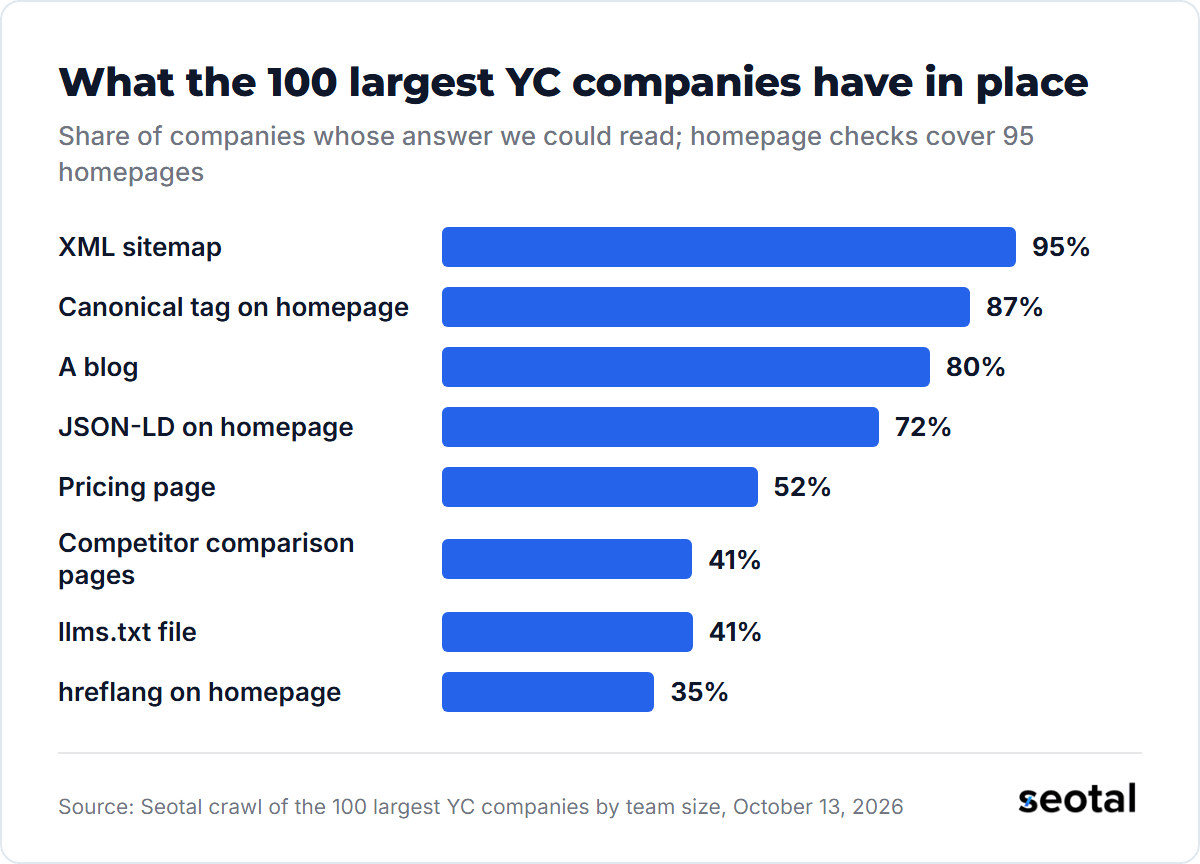
Almost all of them have the plumbing. 88 of the 93 sites we could check publish an XML sitemap declared in robots.txt or at /sitemap.xml or /sitemap_index.xml, and 81 of 93 homepages carry a canonical tag.
The sitemaps vary in size. The median sitemap we read lists 1,218 URLs. 17 list more than 10,000, from marketplaces with a page per store or product, such as Rappi, Meesho and DoorDash, to B2B platforms such as Zapier and Webflow. 10 list fewer than 100.
The five without one are GOAT Group, Calii, Ginkgo Bioworks, Pair Team and Instacart. Instacart is the largest of them: it declares no sitemap in robots.txt and returns a 404 at /sitemap.xml, so a sitemap elsewhere would only reach Google through Search Console.
Do the biggest YC startups have a blog?
Yes, most of them. 74 of the 92 companies whose homepage or blog we could read link a blog from their homepage or list blog posts in their sitemap. The 18 without one include marketplaces such as Meesho and Chaldal, the rocket makers Relativity Space and Stoke Space, and Gusto, whose homepage links guides and resources but no blog.
The blogs are active. We could date the newest post on 51 of them, from an RSS or Atom feed (23 blogs) or from the dates printed on the blog index (28). The median newest post was 7 days old on October 13, 2026.
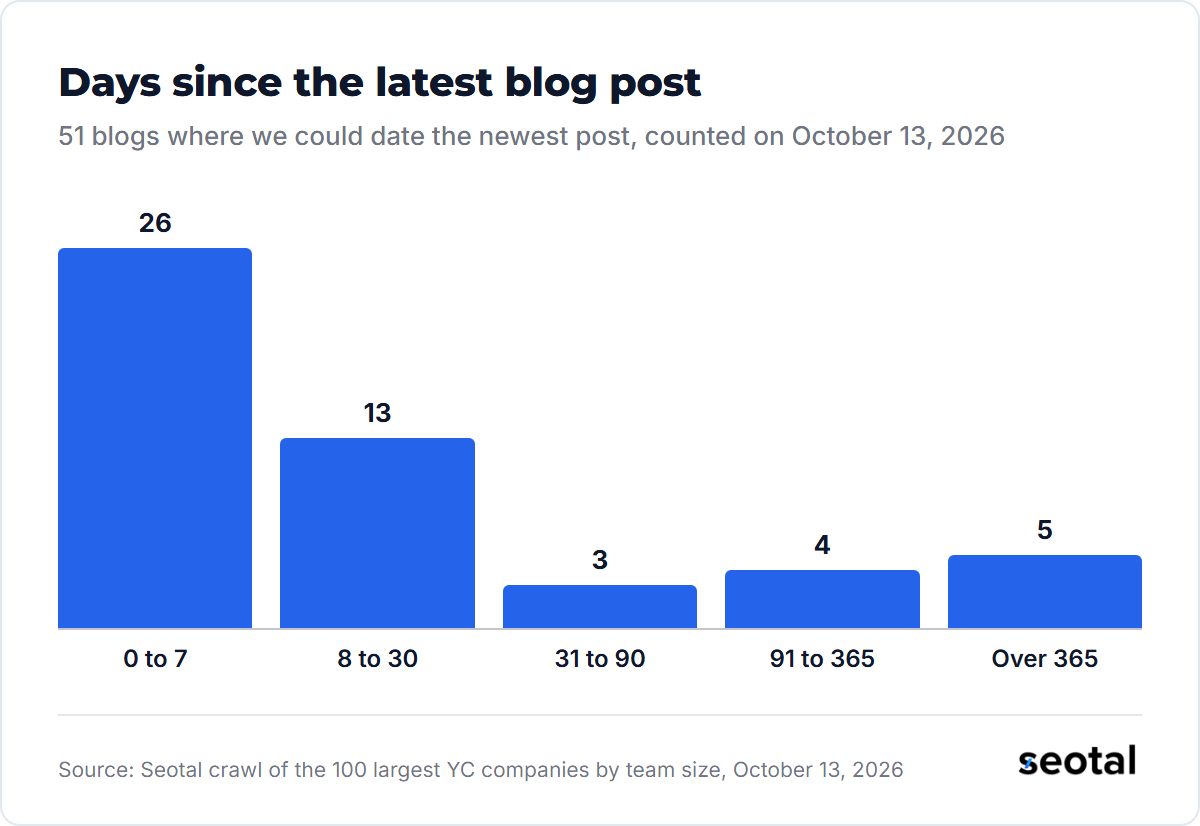
39 of the 51 dated blogs published in the last 30 days. Nine had gone quiet for more than 90 days, including Wave (last post January 2023), Magic (May 2023) and Go1 (March 2025).
Volume varies more than freshness. Among the 15 blogs whose feed reaches back 90 days, Deel published 47 posts in that window, TRM Labs 45, Plivo 33 and Amplitude 30. Four of the 15 published none.
How many YC startups build comparison and alternatives pages?
35 of the 85 companies whose sitemaps we could read publish at least one competitor comparison page. We counted a page when it sits in a comparison directory (/compare/, /vs/, /alternatives/), names the company next to "vs" or "alternatives", or is a short "X alternatives" post. Among the 35, the median is 14 pages.
| Company | Comparison and alternatives pages | Example URL pattern |
|---|---|---|
| Apollo.io | 171 | /magazine/gong-alternatives |
| Aspire | 119 | /blog/airwallex-corporate-card-alternatives |
| Amplitude | 82 | /amplitude-vs-mixpanel |
| Rippling | 71 | /blog/adp-alternatives |
| Zapier | 66 | /blog/asana-alternatives |
| Bird | 39 | /alternatives/mailgun |
Generic explainers are more common. 53 of the 85 publish "A vs B" posts that do not name the company, such as Checkr's "credit report vs credit score" or Faire's "SKU vs UPC".
The split by business model is wide. 30 of 45 B2B companies with a readable sitemap publish competitor pages, against 1 of 10 consumer companies.
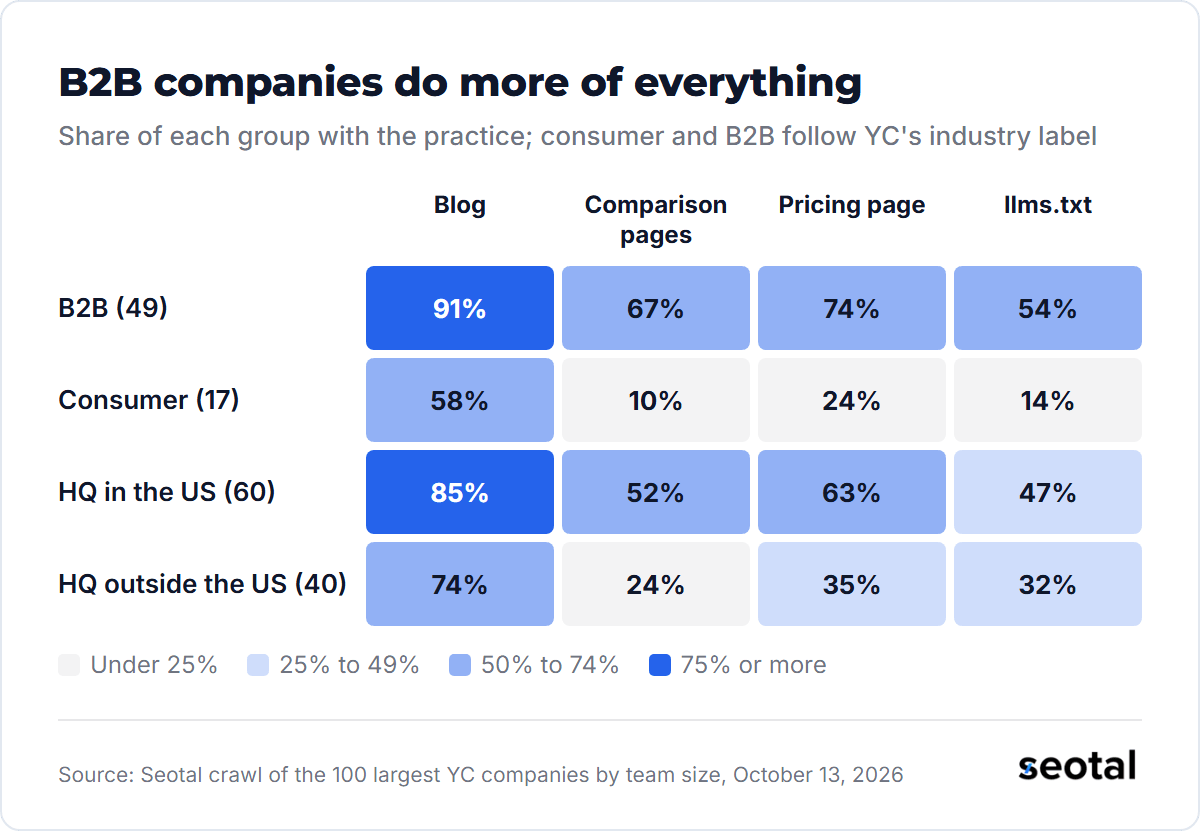
Headquarters matters too. 27 of 52 US-headquartered companies with a readable sitemap publish competitor pages, against 8 of 33 headquartered elsewhere. US companies also publish a pricing page more often: 38 of 60, against 14 of 40.
- Comparison pages: 30 of 45
- Pricing page: 36 of 49
- llms.txt: 25 of 46
- Comparison pages: 1 of 10
- Pricing page: 4 of 17
- llms.txt: 2 of 14
Do YC startups block AI crawlers?
Three of 91 do. We parsed 91 robots.txt files under RFC 9309 rules and checked nine AI user agent tokens, including GPTBot, OAI-SearchBot, ClaudeBot, PerplexityBot, Google-Extended and CCBot.
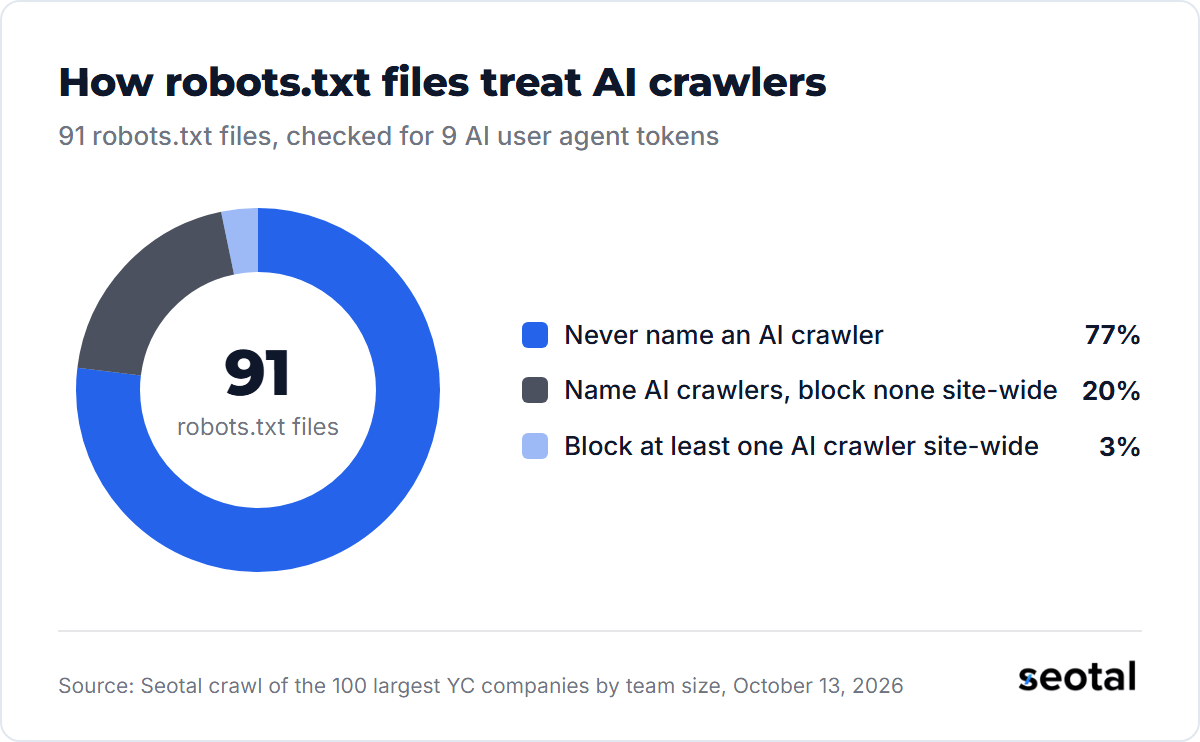
70 of the 91 files never mention an AI crawler, so those bots follow the same rules as every other crawler. 21 name at least one AI bot, and only three block one from the whole site:
- Rappi blocks GPTBot, OpenAI's training crawler, and nothing else.
- Scribd blocks ClaudeBot and CCBot by name.
- Instacart blocks every crawler by default, then lets in Googlebot, OAI-SearchBot and ChatGPT-User. It blocks PerplexityBot by name.
Several companies name AI bots to welcome them. Apollo.io, Zapier, TRM Labs and Submittable list the major AI user agents with no blocking rules. OpenAI's crawler documentation separates GPTBot, which collects training data, from OAI-SearchBot, which powers ChatGPT search, so a site can opt out of one and stay in the other, as Instacart does.
How many YC startups publish an llms.txt file?
38 of the 92 sites we could check serve a file at /llms.txt. The llms.txt proposal describes it as a markdown file that gives language models a short, LLM-friendly guide to a site. Stripe, Zapier, Rippling, Gusto, GitLab, Fivetran and Webflow all publish one.
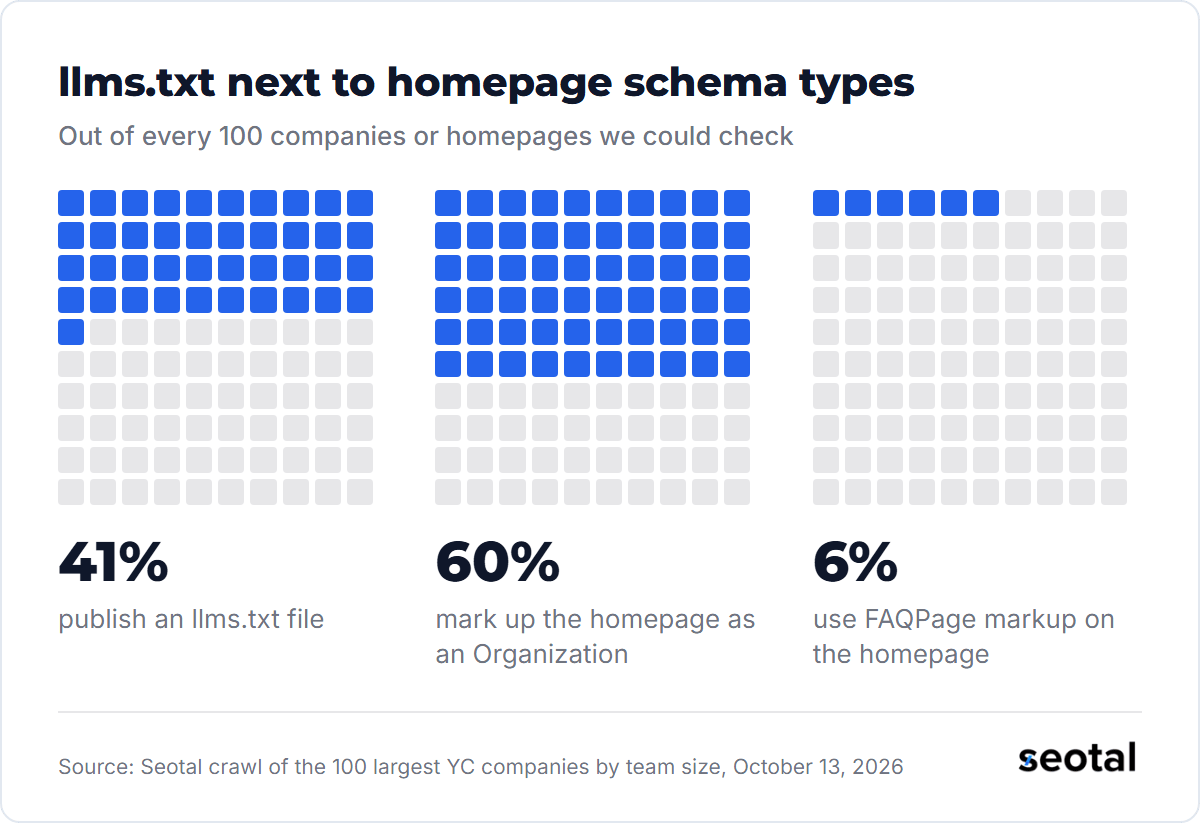
Adoption follows the same B2B pattern as comparison pages. 25 of 46 B2B companies publish llms.txt, against 2 of 14 consumer companies. No search engine has said it uses the file for ranking, so treat it as cheap insurance for AI answers rather than an SEO lever.
Homepage schema markup is more common but shallow. 67 of 93 homepages carry JSON-LD. Organization (56 homepages) and WebSite (43) dominate, while only 7 mark up a SoftwareApplication and 6 an FAQPage. Google's search documentation updates log notes that FAQ rich results are shown only for well-known, authoritative government and health websites, so FAQPage markup rarely earns a visible result for a startup.
A startup adds FAQPage schema to its pricing page. Will Google show the FAQ rich result?
How do YC homepages handle titles, descriptions and H1s?
Mostly by the book. The median homepage title runs 51 characters. Only 2 of 93 homepages send no title in the server HTML, and both add one with JavaScript.
The outliers sit at both ends:
- Too long: 15 titles run past 60 characters and are likely to be cut in results, such as Chaldal's at 112.
- Brand only: 10 titles are under 30 characters, often just the company name, as with Wave, Legora and Flock Safety.
- No description: 8 homepages have no meta description, including PagerDuty and Flock Safety, and 20 run past 160 characters.
Google's title link documentation asks for "descriptive and concise text" in the title element and warns against keyword stuffing. A brand-only title wastes the one line most searchers read.
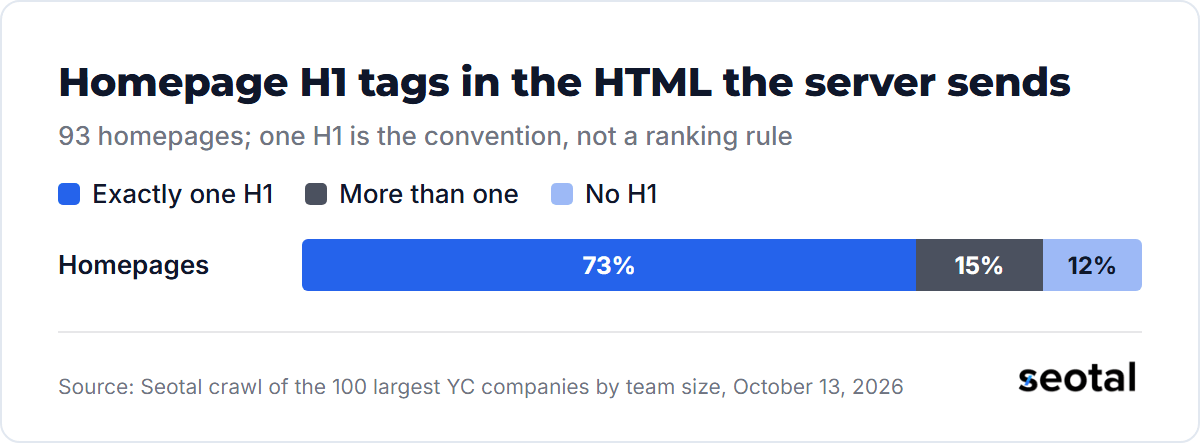
H1 usage is looser. 68 homepages send exactly one H1, 14 send more than one and 11 send none in the HTML the server returns. After JavaScript runs, 10 still have no H1, including Scale AI, Rappi and Tractian.
Do YC startup websites depend on JavaScript to show content?
Three of 93 do. We compared the words in the server HTML with the words visible after the page rendered in a headless browser. Only 3 of 93 homepages sent less than 30% of their visible text in the server HTML: Tractian, Odeko and Khatabook.
The median homepage sent 1,050 words of text in its raw HTML. Even companies whose product is a JavaScript app serve their marketing pages as ready HTML.
Google's JavaScript SEO basics explains that Googlebot renders JavaScript in a second step after crawling. Server HTML removes that step, for Google and for any other crawler that reads pages without rendering them. Our JavaScript frameworks for SEO test compares how much each framework ships.
What should a startup founder copy from the top YC companies?
Copy the commercial pages before the technical extras. The gap between the top companies and the rest of the sample is not sitemaps or schema, which almost everyone has. It is pages that meet buyers who are already comparing vendors.
- Publish a pricing page. 36 of 49 B2B companies have one. Even "contact us" pricing can explain the plans and what drives the price.
- Build comparison pages for your top three competitors. Lattice keeps them in
/compare/, and Ironclad in/alternative/. Write them fairly: a buyer reading "X vs Y" has usually tried both. - Keep the blog on a schedule you can hold. The median top company posted within the last week, but nine had stopped for more than 90 days.
- Leave AI crawlers in unless you have a reason. 88 of 91 robots.txt files let every AI bot crawl the main site.
- Fix the homepage basics. One H1, a descriptive title under 60 characters and a meta description cost an hour and are missing on 1 in 10 of these homepages.
Methodology
Sample. The 100 largest companies in YC's directory by listed team size, read from the yc-oss/api mirror updated October 13, 2026 at 04:38 UTC. We kept status Active or Public, dropped nonprofits, and broke ties at the 300-person cutoff by YC's Top Company badge, then by name. Team size is self-reported on YC's directory.
Crawl. On October 13, 2026 a Node.js crawler fetched each listed domain's homepage, robots.txt, llms.txt, up to 40 sitemap files, the blog index, up to 12 feed URLs and, when no pricing link turned up, /pricing, sending a desktop Chrome user agent with requests to each site at least one second apart.
Files the crawler could not read cleanly were fetched again with curl. Every homepage and blog index was also loaded in headless Brave to compare server HTML with the rendered page. We did not solve or bypass bot checks.
Definitions.
- Blog: a homepage link to a blog path or blog subdomain, or 5 or more blog post URLs in the sitemap.
- Blog freshness: the newest date in the RSS or Atom feed, else the newest date printed on the blog index. Sitemap lastmod dates were not used.
- Comparison page: a URL in a comparison directory, a slug naming the company next to vs, versus, alternative or competitor, or a short "X alternatives" slug in a content section, counted once across language versions.
- AI crawler block: a robots.txt verdict of disallowed for the whole site for one of 9 AI tokens, under RFC 9309 grouping and matching.
- JavaScript dependence: server HTML holding under 30% of the words visible after rendering, on homepages with at least 200 rendered words.
Limitations. We crawled from India. Eight homepages redirected us to a locale path such as stripe.com/in, and Airbnb sent us to airbnb.co.in, so a US visitor may see different pages. Comparison counts cover only the sitemap files we read (up to 40 per site), so large sites may have more. Pricing, docs and changelog checks rely on links and sitemap URLs and can miss pages that are not linked. Seven homepages could not be read, so shares use the number of companies we could check for each signal.
The per-company results are in yc-startups-seo.csv, and the totals are in the summary JSON. Both are free to reuse with credit.
Get startup SEO help through Seotal
The pages that separate these companies, comparison pages, pricing pages and a blog that keeps publishing, take steady writing and technical upkeep more than budget. Seotal runs SEO outsourcing for US startups and small businesses with vetted specialists, or you can hire an SEO expert or a content manager directly. Hourly work costs $15 to $30, and a part-time retainer costs $1,000 to $2,000 a month for 60 to 80 hours with a 3-month minimum (see pricing). For more of our own data, see Seotal Research, our AI crawler blocking study and what AI SEO costs a small business.
YC startup SEO: frequently asked questions
Does being a YC company help SEO?
Not directly. Search engines rank pages, not investors. A YC listing and launch coverage bring early links and brand searches, which help, but the companies in this study still built their traffic with blogs, comparison pages and product pages.
Can I reproduce these results?
Yes, with drift. The sample rule, scripts and CSV are published. Sites change weekly, and a crawl from the US would see different locale pages for at least nine of these companies.
 Which Southeast Asian Websites Block AI Crawlers? A robots.txt Study of Top Domains (2026)
 ![Freelance SEO Hourly Rates in the Philippines [Sep, 2026]](/assets/blog/philippines-freelance-seo-rates-cover.png) Freelance SEO Hourly Rates in the Philippines [Sep, 2026]
Freelance SEO Hourly Rates in the Philippines [Sep, 2026]  AI SEO Specialist Cost in 2026: GEO Rates, Scope and What You Get