
 Philippines
 Vietnam
 Bali, Indonesia
 Malaysia
 Dubai, UAE
 India
India
"Translate" was the most searched query on Google in Malaysia from July 2024 to June 2025, ahead of "google" itself. Four more translation queries made the top 20, including "english to malay" at 13th. In GWI's survey, 43.7% of internet users aged 16+ use an online translation tool each week.
How many people in Malaysia use the internet?
Two counts put Malaysian internet use at 98.0%, and they measure different people. DataReportal's Digital 2026: Malaysia counts 35.4 million users in October 2025 on Kepios analysis, up 409 thousand (+1.2%) in a year. That leaves 714 thousand people offline.
The Department of Statistics Malaysia (DOSM) runs a household survey. Its ICT Use and Access by Individuals and Households 2024 report found 98.0% of people aged 15 and over used the internet in 2024, up from 97.7%. Household internet access was 96.8%.
The Malaysian Communications and Multimedia Commission (MCMC) does not publish a headcount. Its Internet Users Survey 2024 surveyed 2,401 internet users by telephone, with fieldwork from October to December 2024, so its figures below are shares of people already online.
| Source | Type | Latest figure |
|---|---|---|
| Kepios via DataReportal | Estimate from ITU, GSMA, ad tools and national data | 35.4 million users, October 2025 |
| DOSM | Household survey, people aged 15+ | 98.0% used the internet in 2024 |
| MCMC | Phone survey of 2,401 internet users | 49.7% online more than 9 hours a day |
Screen time is where MCMC's survey shows movement. The share of users online for more than 9 hours a day rose from 38.5% in 2022 to 49.7% in 2024. Users in their 20s led, with 34.4% online for more than 13 hours a day.
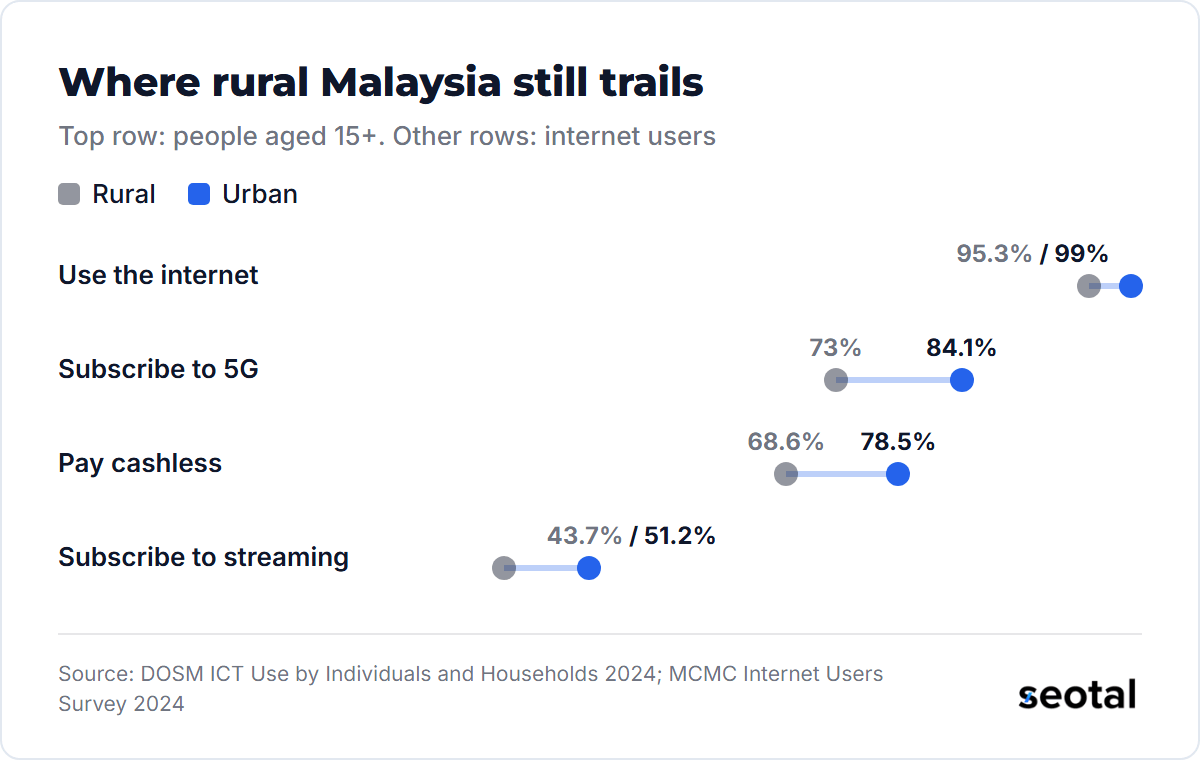
The rural gap survives in what people do online more than in whether they connect at all.
Ookla's median mobile download speed in Malaysia was 143.56 Mbps at the end of 2025, and fixed broadband reached 154.03 Mbps, per the DataReportal report.
Which languages do Malaysians search in?
No source in this set reports the language of Malaysian searches. The query list is the closest signal. Google Trends data in the DataReportal report puts "translate" at 1st, "google translate" at 7th and "translate to english" at 12th for July 2024 to June 2025.
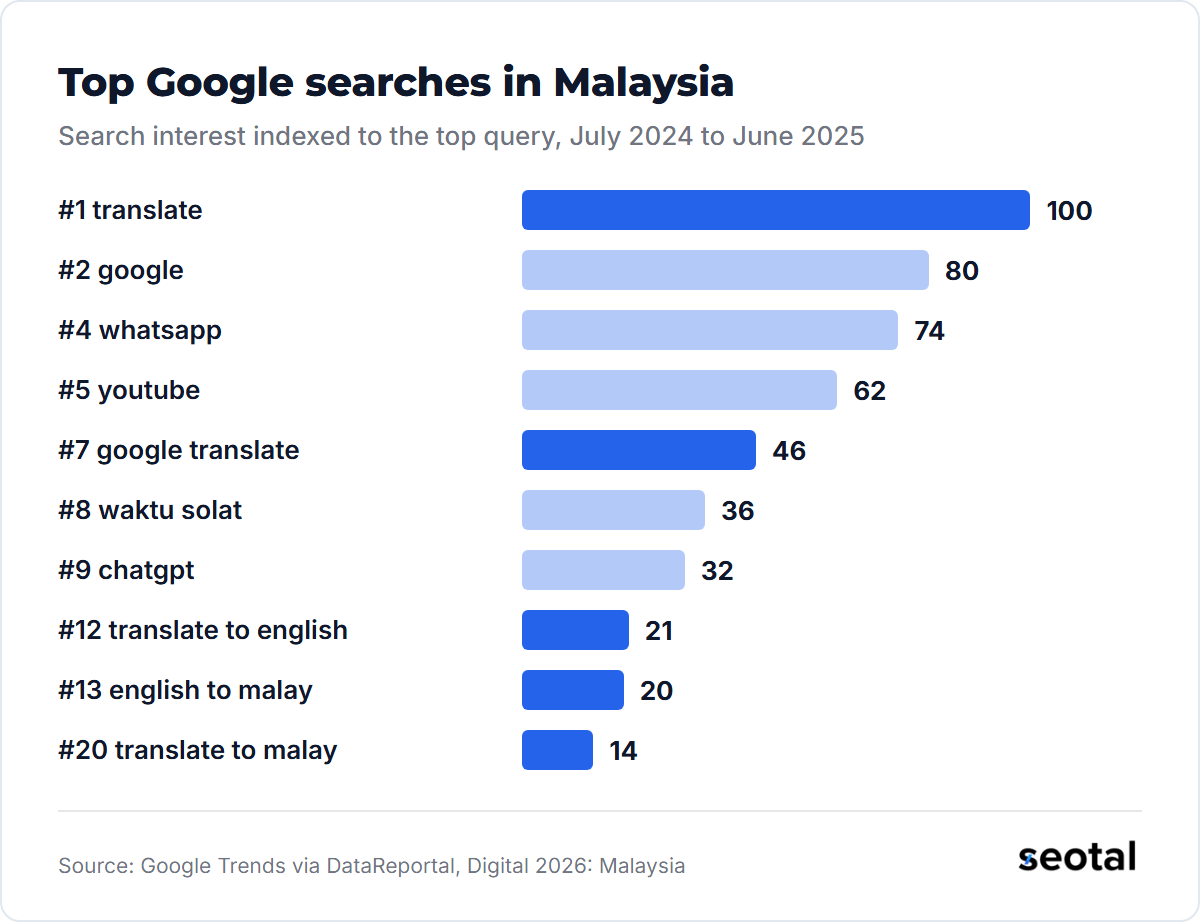
"Waktu solat", the Malay term for prayer times, ranked 8th. ChatGPT ranked 9th, ahead of "weather". Searches for "4d", a lottery game, came 11th.
Chinese-language apps hold a real audience too. GWI's Q2 2025 survey found:
- WeChat: used by 26.8% of internet users aged 16+ in the past month.
- Xiaohongshu (RedNote): used by 17.6%, and named the favourite platform by 5.1% of social media users, ahead of X at 2.8%.
- Translation tools: used weekly by 43.7%.
Shopping searches mix the same way. The top Google shopping query was "iphone", then "shopee" and "samsung", while "translate" still placed 7th in that list. Briefs for keyword work in Bahasa Malaysia, English and Chinese go to a Malaysian SEO specialist, and SEO freelancer rates by country compares what that costs.
Which search engines do Malaysians use?
Google handled 93.03% of Malaysian search traffic in August 2026, Bing 4.38%, Yahoo! 1.58% and Yandex 0.53%, on StatCounter's search engine data for Malaysia. Google's yearly share fell from 98.37% in 2019 to 93.62% in 2025.
Bing took most of that ground. Its yearly share rose each year from 2019 to 2026.
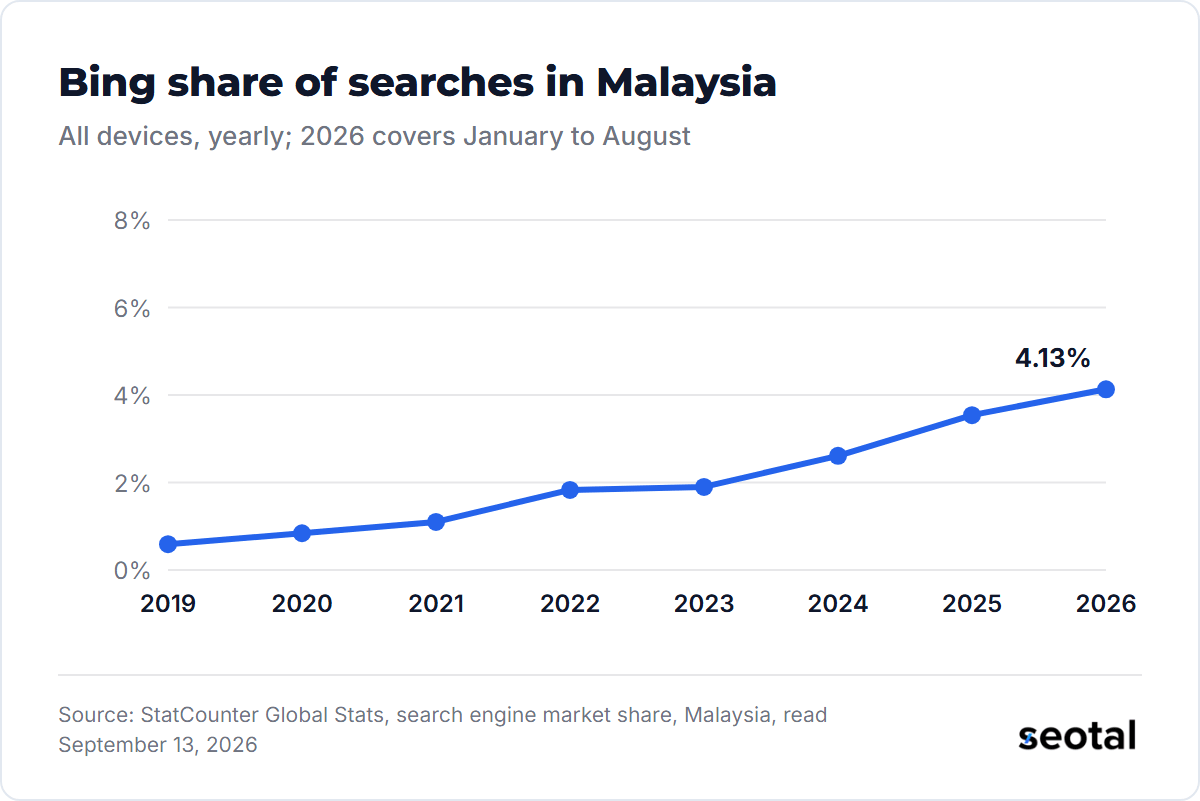
The device decides the runner-up:
- Desktop, August 2026: Google 89.54%, Bing 7.17%, Yahoo! 2.68%.
- Mobile, August 2026: Google 97.59%, Yandex 0.82%, Bing 0.73%.
Yandex is the odd one out. It held 0% of Malaysian searches in 2019 and 1.04% in 2025, before slipping to 0.66% in 2026 so far.
Social ads edge out search for brand discovery. GWI found 39.7% of internet users aged 16+ discover brands through social media ads and 37.3% through search engines, while 91.6% use a search engine each month. Semrush counted 918 million visits to google.com in August 2025.
How many Malaysians can TikTok, YouTube and Meta ads reach?
TikTok's ad tools reach 30.7 million adults in Malaysia, equal to 114.8% of the population aged 18 and over. A share above 100% marks an ad audience estimate, not a count of people. YouTube reaches 23.6 million, Facebook 23.0 million and Instagram 16.1 million, per each platform's ad tools as compiled by DataReportal.
Ad reach moved in opposite directions over the year to October 2025:
- LinkedIn: 10.0 million members, up 13.6%. LinkedIn counts registered members, not monthly users.
- Reddit: 4.30 million, up 219%, a jump DataReportal flags as unusual.
- Messenger: 9.60 million, down 11.1%. X: 4.81 million, down 9.6%.
- YouTube: down 6.0% over the same year.
Reach and attention do not rank platforms the same way.
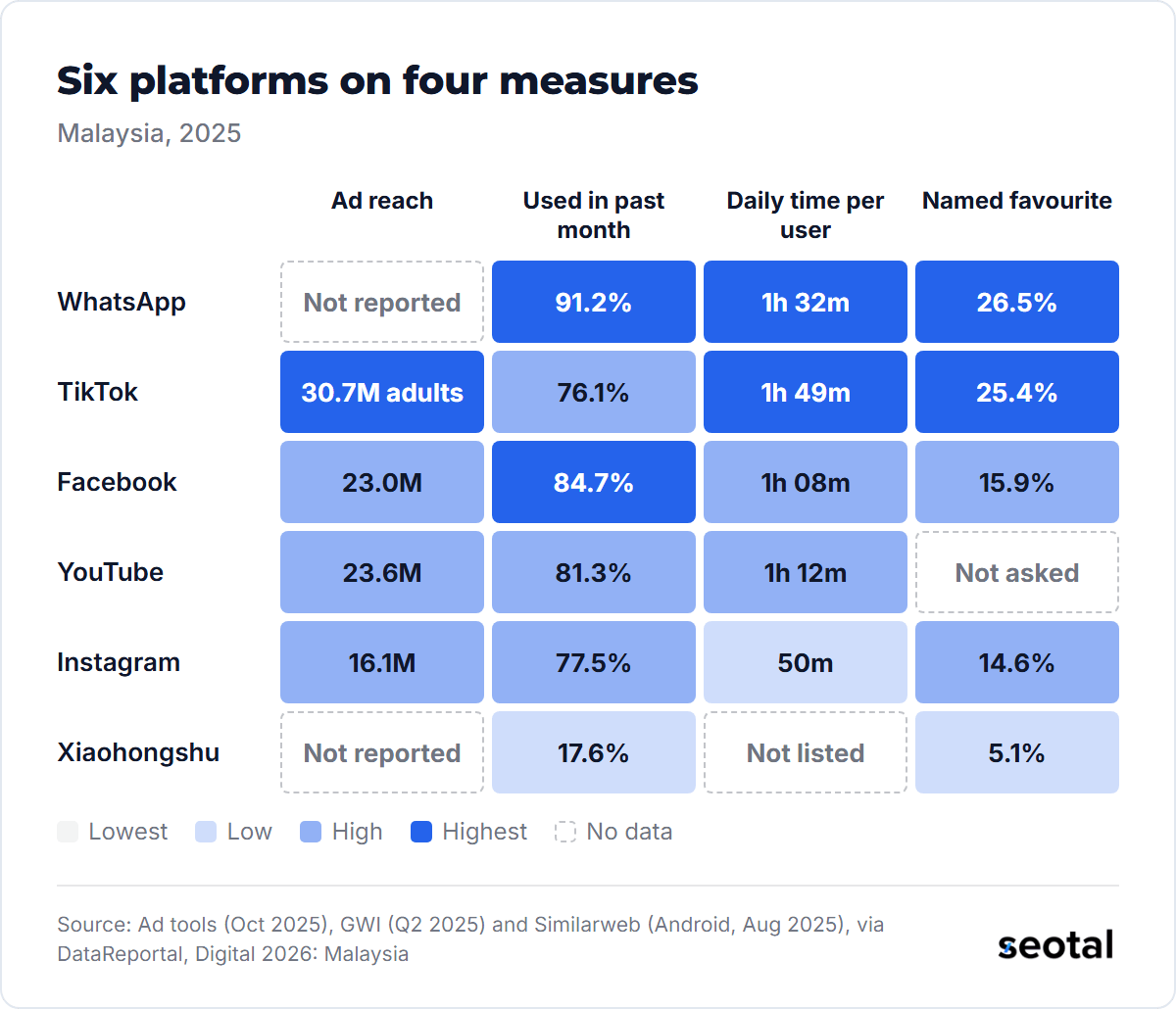
Similarweb's Android data for August 2025 shows active users spending 1 hour 49 minutes a day on TikTok and 1 hour 32 minutes on WhatsApp. Imo, a video calling app, drew 54 minutes a day, more than Instagram's 50. The Malaysian social media manager page lists pay bands for the people who run these accounts.
Which platform do the most Malaysian social media users call their favourite?
How much do brands spend on digital advertising in Malaysia?
Social media ads were the largest digital format in Malaysia in 2025 at an estimated $470 million, up 14.0%, according to Statista Market Insights data in the DataReportal report. Total ad spend across all channels reached $1.94 billion, up 5.9%, and digital grew faster at 8.3%.
Statista's format estimates overlap, so they do not add up to the digital total:
- Programmatic: $885 million, up 9.9%, 68% of digital spend.
- Online banner ads: $415 million.
- Search ads: $348 million, up 10.9%, 26.9% of digital spend.
- In-app ads: $324 million, up 8.4%, 25% of digital spend.
- Online retail platform ads: $279 million, up 14.9%, 21.6% of digital spend.
- Influencer ads: $77.0 million, up 13.5%, 6.0% of digital spend.
DataReportal divides Statista's digital total by internet users to get $36.56 of ad spend per user.
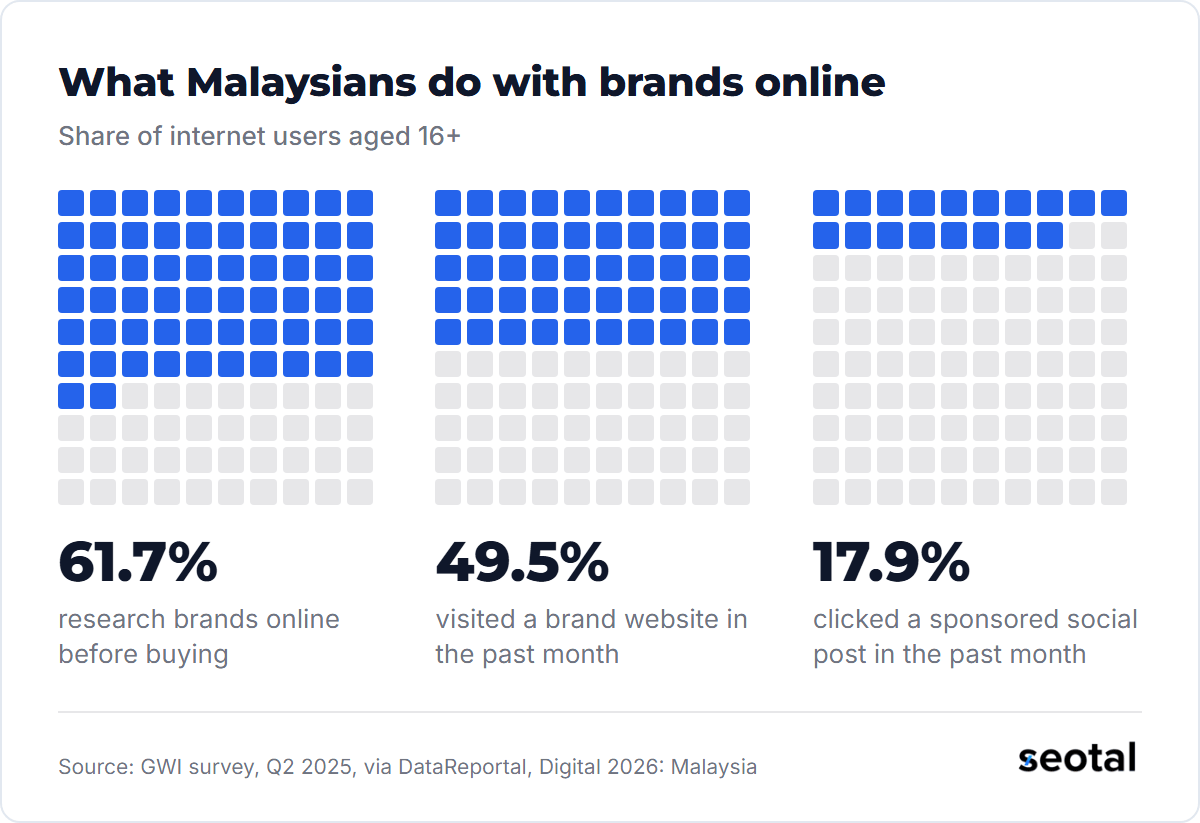
GWI's survey shows what the spend buys. Only 12.0% of internet users feel represented in the ads they see, and 16.4% clicked a banner ad in the past month. Yet 64.5% visit social media to learn about brands. The Malaysian performance marketer page lists monthly pay bands for paid media hires.
How big is ecommerce in Malaysia?
Three sources size Malaysian ecommerce, and their numbers do not line up, because each counts something different.
| Source | What it counts | Latest value |
|---|---|---|
| DOSM, Usage of ICT and E-Commerce by Establishment 2025 | E-commerce income of firms, B2B included, 2024 | RM1,288.1 billion, up 8.8% |
| Same DOSM survey | Business-to-consumer income only, 2024 | RM374.7 billion, up 11.3% |
| Google, Temasek and Bain, e-Conomy SEA 2025 | Ecommerce GMV, 2025 estimate | $20 billion, up 21% |
| Statista Market Insights, via DataReportal | B2C consumer goods only, 2025 | $8.79 billion, up 13.1% |
DOSM's establishment survey, released on June 30, 2026, shows B2B transactions made up RM879.6 billion of the total. Its quarterly figures run later: e-commerce income grew 2.9% to RM338 billion in the second quarter of 2026, Bernama reported.
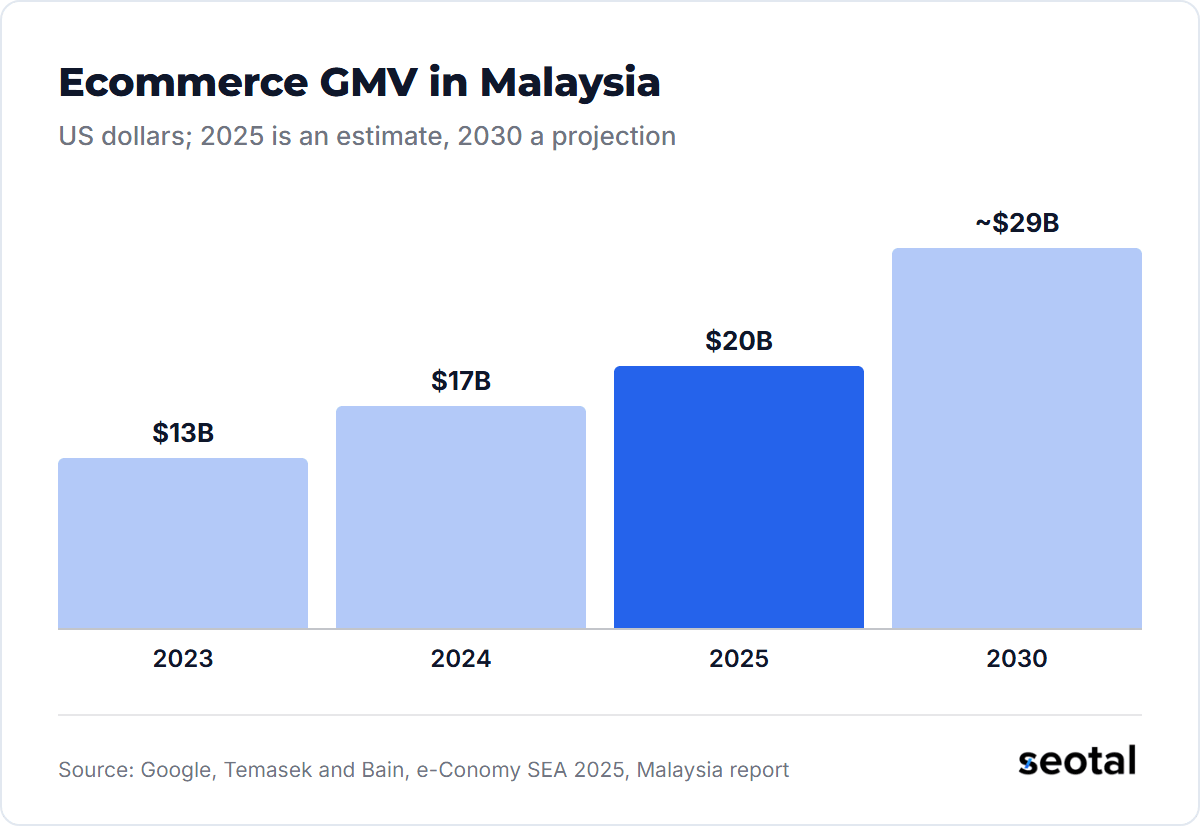
The e-Conomy SEA 2025 Malaysia report values the whole digital economy at $39 billion in 2025, up 19%. Online travel added $10 billion.
Platforms grew faster still. Momentum Works' Ecommerce in Southeast Asia 2026 report puts Malaysia's 2025 platform GMV growth at 47.6%, behind only Thailand's 51.8%. It ranks Shopee first in all six markets it covers.
GWI found 61.0% of internet users aged 16+ buy something online each week. In MCMC's survey, 81.0% of users reported making online purchases with cashless payments, and clothing was the top online category at 74.8%.
Phones carry most of the spend. Statista's consumer goods figures show 59.8% of 2025 online consumer goods spend went through mobile phones. It counts 16.0 million online buyers of consumer goods, and online sales made up 10.3% of all consumer goods retail.
Which products sell through video commerce in Malaysia?
Malaysia's video commerce market has about 350,000 sellers and stores, up 40% in a year, handling 700 million transactions, up 10%. The e-Conomy SEA 2025 report cites Cube data for both, and adds that the top 10 sellers in each category drive 25% of that category's transactions.
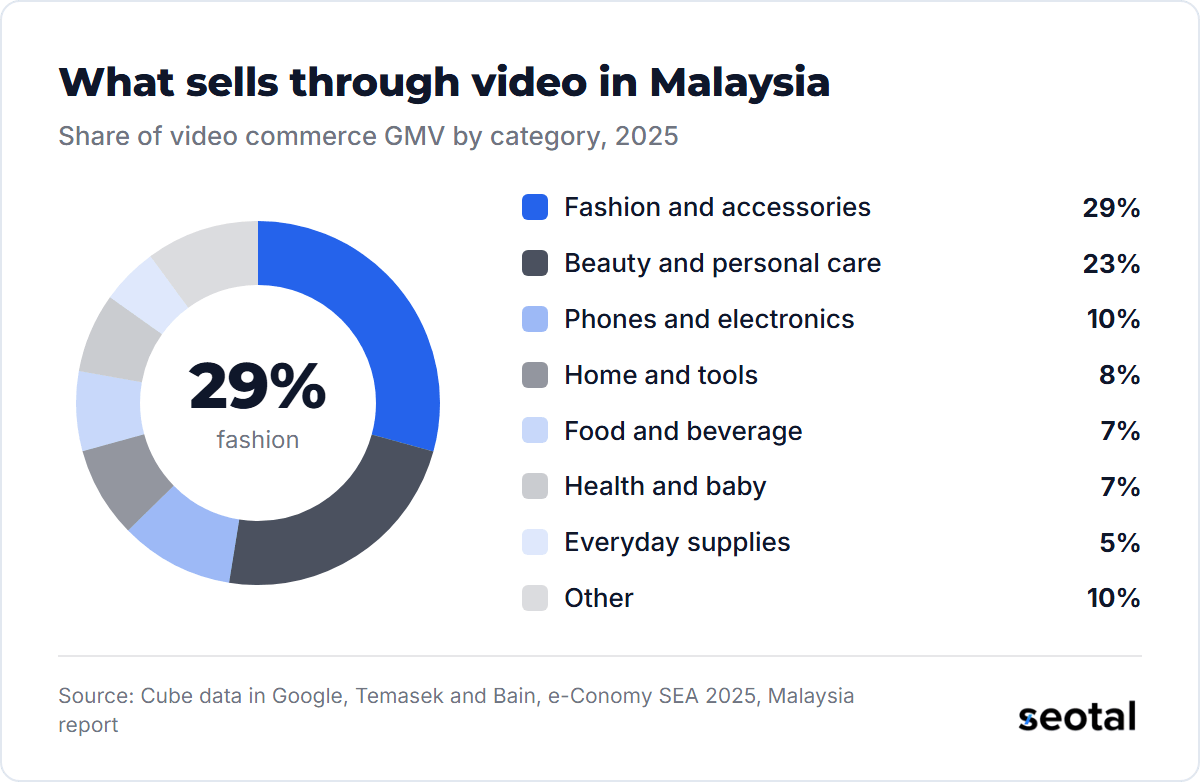
The report describes Malaysian video shopping as higher value with less seller competition than the rest of the region. Its chart places Malaysia's average order value above the Southeast Asian range of $8 to $10, without printing the Malaysian figure.
How do Malaysians pay online?
Bank transfers lead the online checkout. Worldpay's Global Payments Report 2025, cited by DataReportal, found account-to-account payments took 37% of 2024 B2C ecommerce value. Bank Negara Malaysia's Annual Report 2025 notes that FPX and DuitNow Online Banking/Wallets, both paid from bank or e-money accounts, are in common use for ecommerce purchases.
- Account-to-account transfers 37%
- Debit and credit cards 26%
- Mobile and digital wallets 25%
- Other methods 8%
- Buy now, pay later 4%
The same report gives the national picture for all e-payments:
The central bank counts almost three million registered DuitNow QR touchpoints at the end of 2025, most of them small businesses. The average e-money transaction rose to RM43 from RM33. Payments Network Malaysia (PayNet), which runs DuitNow, processed 8.44 billion transactions in 2025, and cross-border QR payments grew 2.5 times to 29.7 million.
MCMC's survey shows the same habits from the user side. Among internet users, 75.6% had used a cashless method, and 55.2% of users said they pay cashless at least once a day.
QR codes were the most used method at 69.1%, ahead of debit cards (50.6%), e-wallets (45.9%), online banking or FPX (43.1%) and credit cards (25.7%). Touch 'n Go eWallet led e-wallets with an 86.3% usage rate.
Two estimates of payment value disagree by a wide margin. Statista puts 2025 consumer digital payments at $74.6 billion, counting mobile point-of-sale payments and B2C digital commerce only. The e-Conomy SEA report puts digital payments gross transaction value at $213 billion, counting all card, account-to-account and e-wallet transactions.
How many Malaysians use ChatGPT and other AI tools?
ChatGPT reached 48.4% of Malaysian internet users aged 16+ in the past month, in GWI's Q2 2025 survey. Semrush ranked chatgpt.com the 4th most visited website in Malaysia in August 2025, with 59.6 million visits, ahead of whatsapp.com and shopee.com.my.
The e-Conomy SEA 2025 report's consumer survey, run by Google and Milieu in September 2025 with 7,200 people across ten ASEAN countries, found:
- 74% of Malaysian respondents say they interact with AI tools and features daily.
- 68% have conversations with AI chatbots.
- 60% worry about privacy and data security with AI agents, against a 50% ASEAN average.
Malaysia also drew $759 million of private AI funding from H2 2024 to H1 2025, 32% of the ASEAN total, per the same report.
Microsoft measures something narrower. Its AI Diffusion Report Q1 2026 counts 21.8% of Malaysians aged 15 to 64 as generative AI users, up from 18.3% in H1 2025. Its base includes people who are offline, and it estimates use of generative AI products from Microsoft telemetry, so the figure sits far below GWI's survey of internet users.
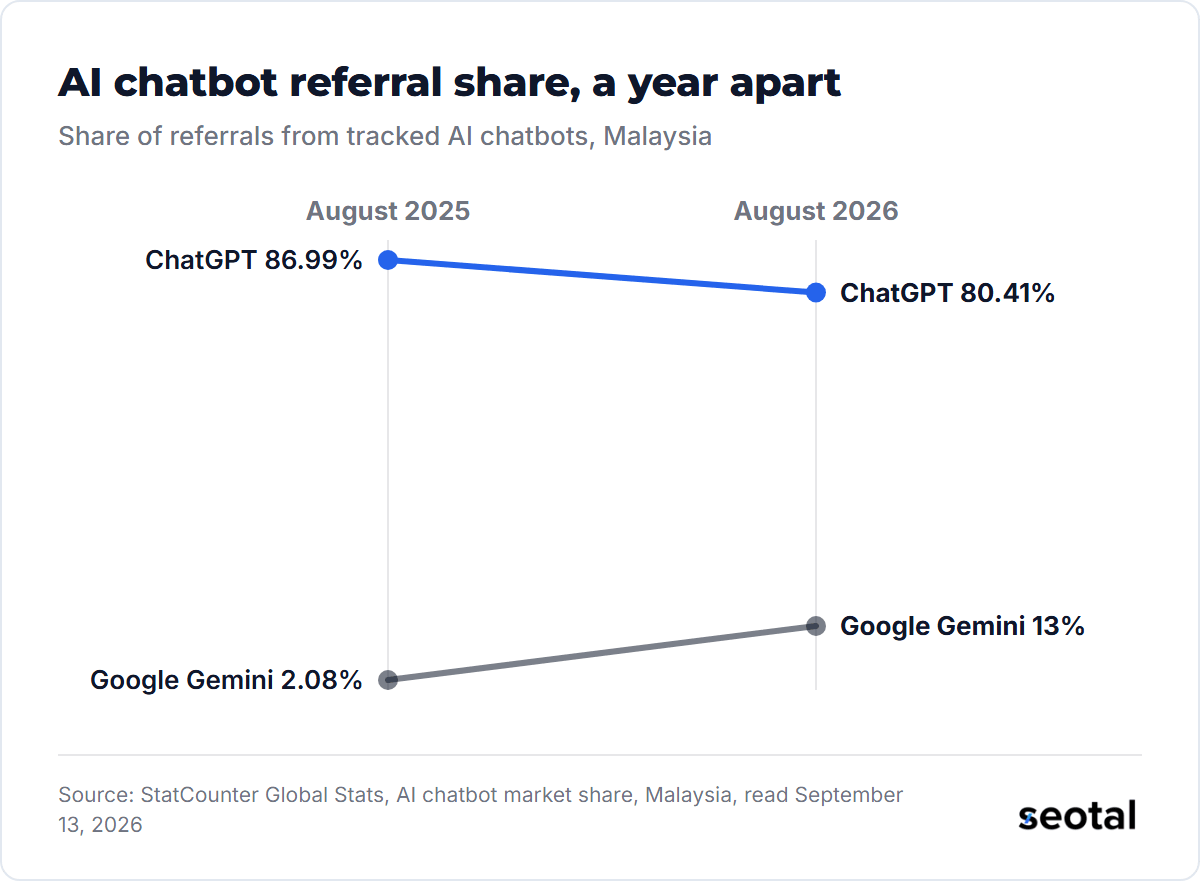
Gemini is the fastest mover as a traffic source. StatCounter's AI chatbot share for Malaysia gave it 15.36% of referrals in April 2026, its peak, and 13.00% in August. Perplexity fell from 5.75% to 2.74% over the year. The regional comparison sits in AI search use in Southeast Asia.
Hire Malaysian marketing talent through Seotal
I lead growth marketing at Seotal. We match businesses with vetted freelance marketers in Malaysia, where our country page lists 290+ vetted freelancers, from SEO specialists writing in English, Malay and Mandarin to performance marketers.
Our pricing page lists Malaysian hourly rates of $12 to $45. Mid-level monthly rates run $1,800 to $3,500 for an SEO expert or a performance marketer, and $1,400 to $2,800 for a social media manager. Send a brief and we share 3 to 5 vetted profiles within 72 hours. To start with search, hire a freelance SEO expert.
Malaysia digital marketing statistics: frequently asked questions
What is the population of Malaysia in 2026?
Malaysia had 36.1 million people in October 2025, according to United Nations data in DataReportal's report. The median age was 31.0, and 79.8% of people lived in urban areas.
How many mobile connections are there in Malaysia?
GSMA Intelligence counts 44.0 million cellular connections, equal to 122% of the population, and classes 99.3% of them as 3G, 4G or 5G. Many people carry more than one connection.
Where can I find the same data for other Southeast Asian markets?
Our Indonesia digital marketing statistics, Philippines digital marketing statistics and Vietnam digital marketing statistics posts cover those markets, and Southeast Asia SEO statistics compares search across the region.

 Indonesia Digital Marketing Statistics 2026
  Philippines Digital Marketing Statistics 2026
  Vietnam Digital Marketing Statistics 2026