
 Philippines
 Vietnam
 Indonesia
 Malaysia
 Cambodia
 India
India
If you run a local business, you have probably noticed something on Google: for more and more searches, an AI-written summary now sits at the very top, answering the question before any blue link. For "best family dentist in Austin" or "electrician open now near me," that summary names a few businesses and moves on. This is Google's AI Overview, and for local search it has quietly rewritten the rules of visibility.
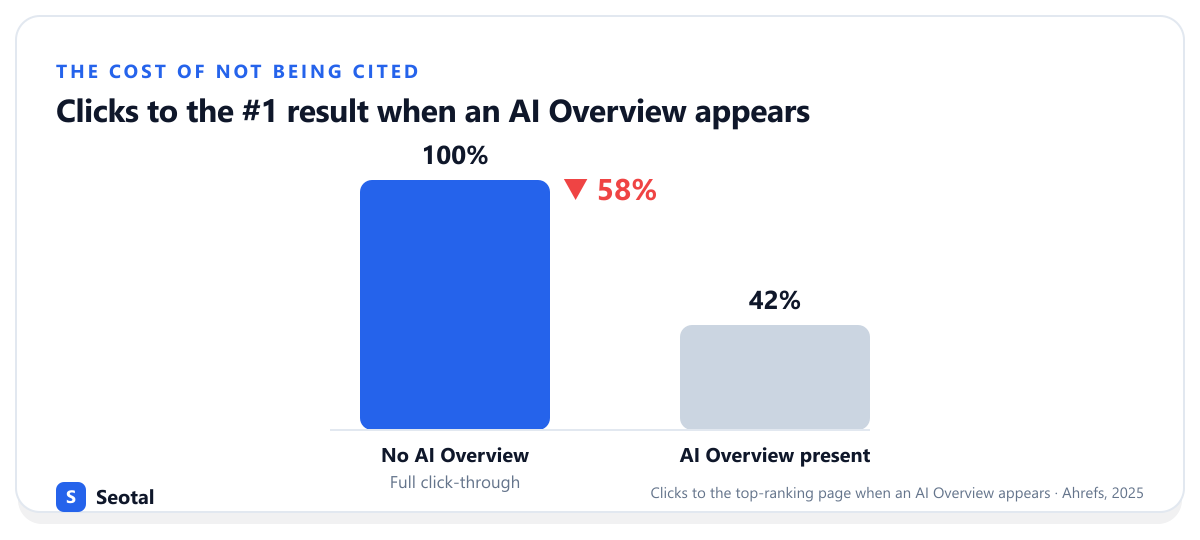
The stakes are concrete. When an AI Overview appears, the top-ranking page below it loses around 58% of its clicks, according to Ahrefs' 2025 analysis — and lower-ranked results lose a smaller but still real share. If you are not in the overview, you are competing for a much thinner slice of attention.
The good news: getting cited is a solvable engineering problem, not a lottery. Below are the five levers that decide it. If you would rather delegate, our team can handle your local SEO end to end, and our overview of how AI search finds local businesses sets the wider context.
What changed: AI Overviews came for local search
AI Overviews began on informational queries — "how to unclog a drain." Through 2025 and into 2026 they expanded to commercial and local intent, the exact queries that used to send customers straight to the map pack. Now the same "near me" search that once showed three map listings and ten links often opens with an AI paragraph recommending specific businesses.
Critically, the citation source has shifted. Google's AI does not simply echo the number-one result. It extracts passages — self-contained, well-structured chunks of text — from pages it trusts, and it cross-checks business facts against Google Business Profiles and structured data. That means a page ranked fifth with a crisp, quotable answer can be cited over a page ranked first that buries its answer in fluff.
Not every local query triggers an AI Overview
It is worth knowing where AI Overviews show up, because it tells you which pages to prioritize. They appear most often on research-style and comparison queries — "best family dentist in Austin," "how much does gutter cleaning cost," "emergency plumber vs handyman" — where the searcher wants guidance before choosing. They appear less often on purely navigational queries ("Rivertown Plumbing phone number"), where the customer already knows who they want. The practical implication: your highest-value optimization targets are the "best," "how much," and "near me" question queries in your category, because those are exactly the searches where an AI Overview will decide who gets named — and where being left out costs you the most.
What being cited looks like in practice
Consider the query "family dentist in Austin that takes new patients." Google's AI Overview drafts a two-sentence answer and needs to name a practice or two. To do that it looks for a business whose page states, in plain language, "We are accepting new patients" and "We treat families and children," whose Google Business Profile category is precisely Dentist (not the vaguer Doctor), and whose recent reviews mention family visits. A practice that has all three is easy to name with confidence. A practice that buries "new patients welcome" in a PDF, uses a generic category, and has no recent reviews gives the AI nothing clean to quote — so it is skipped, even if it ranks well organically. Being cited is less about being the biggest name and more about being the clearest, most verifiable match for the exact question.
The five things you need to be cited
Google's local AI answers reward a specific, stackable set of signals. Miss one and you weaken the whole case.
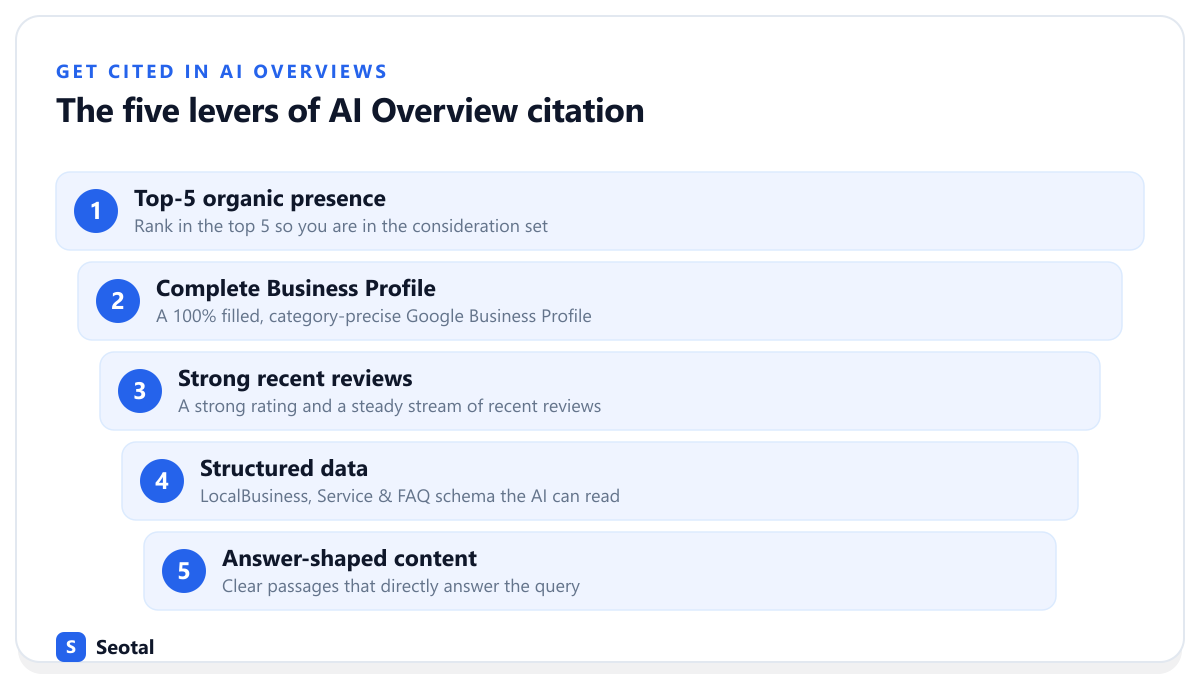
Think of these as a chain. The first gets you into the room; the middle three establish trust; the last makes your content the most quotable option. Let us take the ones that trip businesses up most.
Rank in the top 5 — but optimize the passage, not just the page
You still need organic visibility: Google generally extracts AI Overview passages from pages already ranking well for the query. But how you write matters as much as whether you rank. A page that answers "how much does an emergency plumber cost in Chicago?" in a single clear paragraph — with a number, a range, and a reason — is far more extractable than one that makes the reader hunt.
Practical moves that raise extractability:
- Put a direct, one-paragraph answer immediately under each question-style heading.
- Use headings that mirror how customers actually ask ("Do you offer same-day service?").
- Keep answer passages self-contained — no "as mentioned above," which breaks when quoted alone.
- Lead with specifics: prices, timeframes, service areas, and qualifications.
Our guide to SEO and AEO principles for front-end developers goes deeper on structuring pages so machines can lift the right passage.
Your Google Business Profile is the primary source
For local queries, Google's AI leans on the Business Profile as its source of truth for facts — hours, categories, services, location. An incomplete profile is the most common reason a qualified business gets skipped.
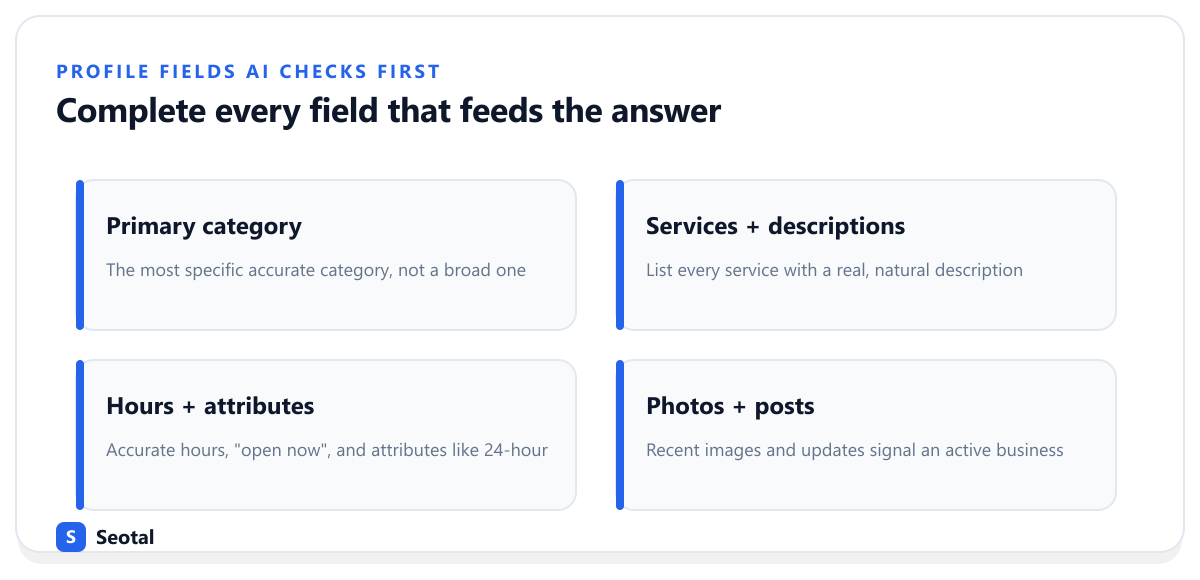
Completeness is not vanity — the data backs it. Google reports that customers are 2.7x more likely to consider a business reputable when its profile is complete, and 70% more likely to visit. The same completeness that persuades a human is what lets the AI cite you with confidence. If you are unsure where you stand, our local SEO outsourcing service starts with a full profile audit.
Reviews: quality, volume, and why recency wins
Reviews do double duty: they are around the second-largest local pack ranking factor — roughly 20% of the weighting (BrightLocal's 2026 study) and they are a signal the AI weighs when deciding which business to name. Google publishes no magic review-count threshold, so ignore the "you need exactly N reviews" advice you will see on agency blogs. What is well established is that volume, recency, and velocity all matter, and that most buyers filter hard on rating — 68% will only consider businesses rated 4.0★ or higher.
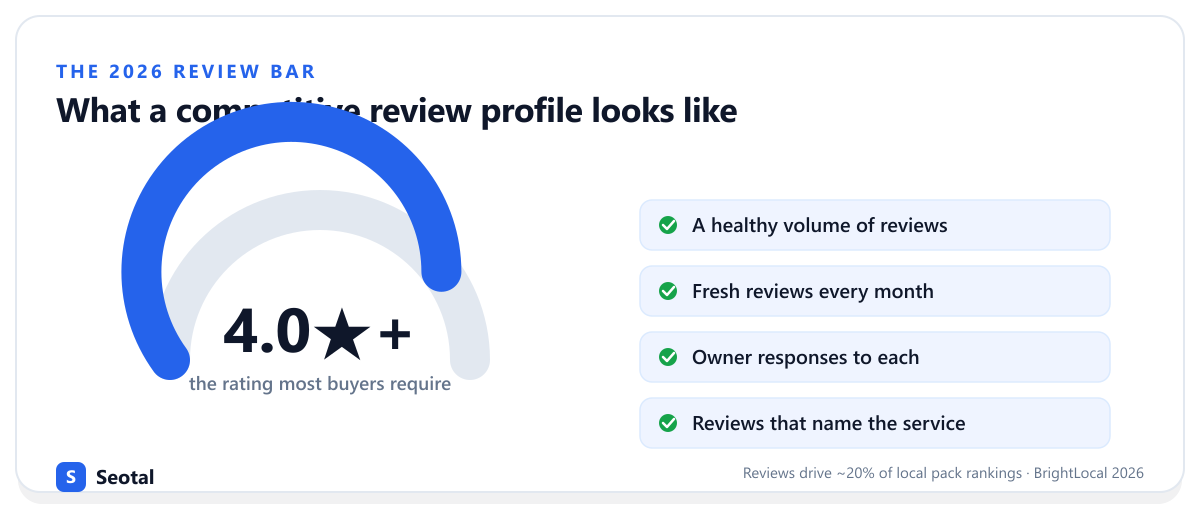
Two nuances matter. Recency: a steady trickle of fresh reviews beats a big burst two years ago, because it signals a business that is still active and still good. Specificity: reviews that name a service ("great same-day boiler repair") help the AI associate you with that service for the matching query. Ask happy customers to mention what you did, not just that they were happy — the compounding is real, with roughly a 2.8% lift in conversions for every ten new reviews (SOCi).
Structured data that Google's AI reads
Structured data (schema markup) hands Google's systems your facts in a format they do not have to guess at. Google's own guidance is that pages with valid schema are eligible for rich results and are easier for its systems to understand, and that consistency between your markup and your Business Profile builds trust. Three types matter for local.
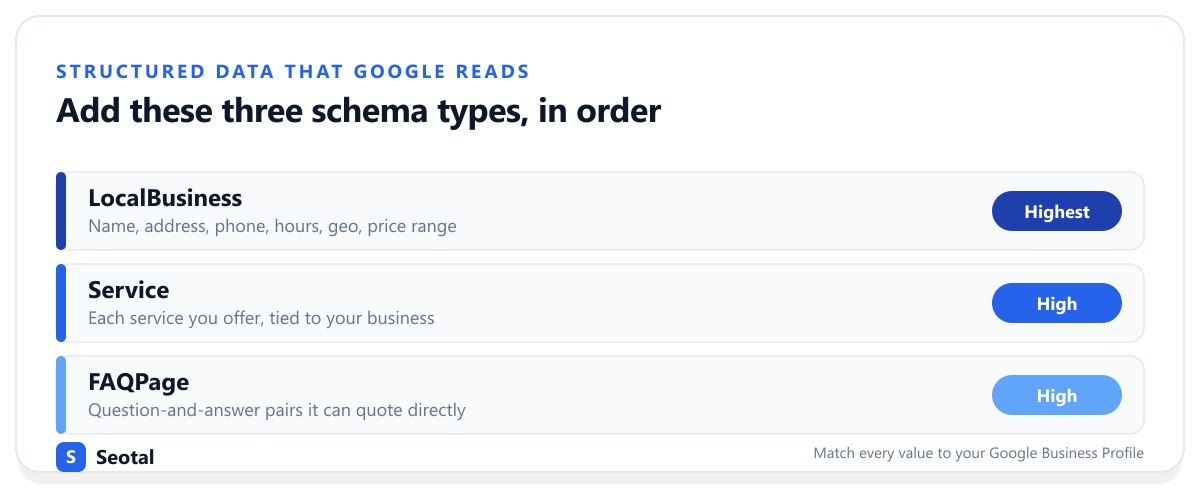
Use the most specific LocalBusiness subtype that fits — Plumber, Dentist, Attorney — rather than the generic parent, and make sure every fact in the markup matches your profile exactly. We cover implementation in the companion guide on AI-ready local SEO data signals; for the underlying spec, see Google's LocalBusiness documentation and schema.org/LocalBusiness.
Measure it: are you actually in the AI answer?
You cannot improve what you do not check. Build a short list of your ten most valuable "near me" and "best [service] in [city]" queries, and run them monthly:
- Search each query on Google and note whether an AI Overview appears.
- Record whether your business is named, and if not, which competitors are.
- Check the same queries in ChatGPT and Perplexity for cross-channel coverage.
- For every query where a rival is cited and you are not, compare profiles and pages — the gap is usually reviews, a missing category, or a buried answer.
For queries that recur across many cities or services, this monitoring gets tedious fast — the kind of repeatable checking our AI SEO tooling roundup helps automate.
Where to focus first
If your business is starting from behind, the highest-leverage order is: complete the Business Profile, then build a steady stream of recent reviews, then add LocalBusiness and FAQ schema, then rewrite your key service pages as clear answers. That sequence front-loads the signals Google's AI weighs most.
It is steady, detail-heavy work — exactly what a dedicated specialist is for. You can outsource local SEO to our vetted Asia-based team, hire a local SEO expert directly, or book a call to get a read on where you stand in AI Overviews today.
Frequently asked questions
What is a Google AI Overview for a local search?
It is the AI-written summary Google places at the top of the results for many queries, including local ones. For a "near me" search it can name specific businesses and describe why they fit, appearing above the map pack and organic links.
Does ranking number one guarantee I appear in the AI Overview?
No. AI Overviews extract passages from trusted, well-structured pages and cross-check business facts against profiles and schema. A page ranked fifth with a clearer answer and cleaner data can be cited over the number-one result.
How many reviews do I need to compete in local AI results in 2026?
There is no official number — Google publishes no threshold. What matters is a strong rating (most buyers require 4.0★ or higher), a healthy volume relative to your local competitors, and a steady flow of recent reviews. Recency and specificity matter as much as the raw count.
Do AI Overviews reduce my website traffic?
They can. When an overview appears, click-through on the results below drops considerably. That is precisely why being cited inside the overview, rather than only ranking beneath it, is now the goal.
What structured data should a local business add first?
Start with LocalBusiness schema using the most specific subtype for your industry, then add Service and FAQPage markup. Ensure every fact matches your Google Business Profile, because consistency between the two is what earns AI trust.

 How AI Search Finds Local Businesses (and How to Get Recommended)
  Local SEO Schema: Make AI Recommend Your Local Business (2026)
 ![SEO Freelancer Rates by Country in 2026 [Hourly Rates & Prices Worldwide]](/assets/blog/seo-freelancer-rates-cover.png) SEO Freelancer Rates by Country in 2026 [Hourly Rates & Prices Worldwide]
SEO Freelancer Rates by Country in 2026 [Hourly Rates & Prices Worldwide]