
 Philippines
 Vietnam
 Bali, Indonesia
 Malaysia
 Dubai, UAE
 India
India
There is a comforting myth that winning at local search is about clever marketing. In the AI era it is closer to the opposite: it is about being boringly, verifiably consistent. When ChatGPT, Perplexity, or Google's AI Overview decides which plumber or dentist to recommend, it is not moved by your tagline. It scores the structured, cross-checkable facts that exist about you online and recommends whichever business is easiest to trust.
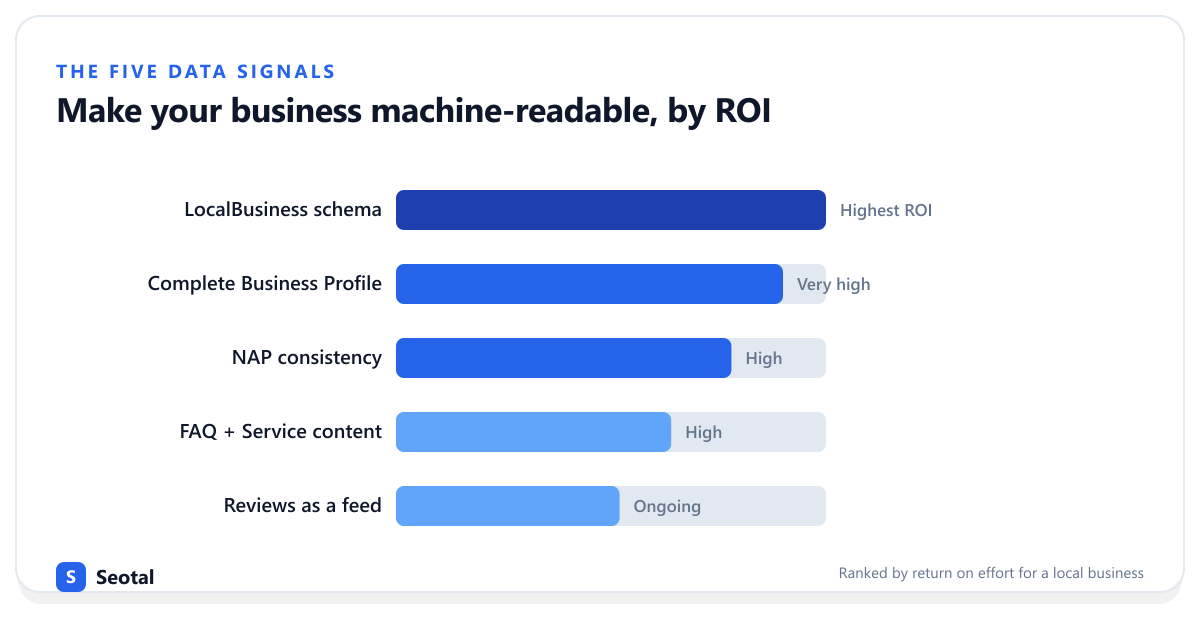
This guide is the technical checklist behind that outcome — the five data signals that make your business machine-readable and AI-ready.
It pairs with our overviews on how AI search finds local businesses and how to show up in Google AI Overviews; here we get concrete about implementation. None of it requires a huge budget — but it does require precision, which is why many teams choose to outsource local SEO rather than let details slip.
Why "machine-readable" is the new local SEO
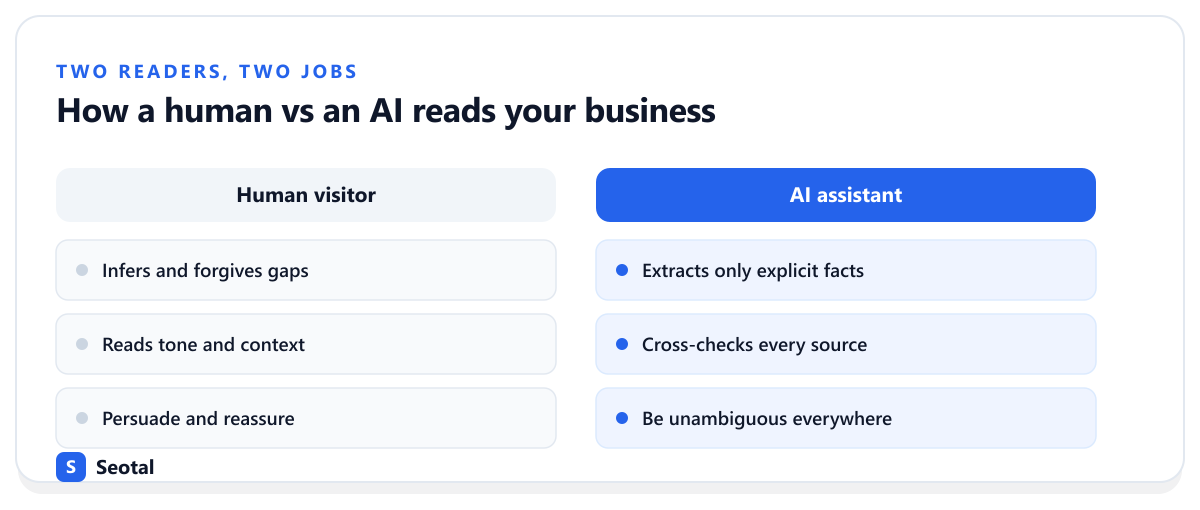
A human visitor forgives a messy site — they can infer your hours from context, guess your service area, and read between the lines. A language model cannot. It works from explicit, structured signals, and when those are missing or contradictory it either guesses (risky for you) or picks a competitor whose data is cleaner (worse for you).
The five signals below are ranked by return on effort. Work top to bottom and you fix the highest-impact gaps first.
Signal 1: LocalBusiness schema, the highest-ROI markup
Structured data is code you add to your site that states your facts in a format machines parse without guessing. For a local business, LocalBusiness schema is the single highest-ROI markup you can implement — it is the foundational type Google and AI systems use to identify and verify you.
Two rules make it work:
- Use the most specific subtype. Do not settle for the generic
LocalBusinessif a precise child type exists —Plumber,Dentist,Attorney,Restaurant,HVACBusiness. Specificity helps the AI associate you with the right queries. - Match your profile exactly. Every value — name, address, phone, hours, price range — must be identical to your Google Business Profile. A mismatch is a trust penalty, not a rounding error.
A minimal, correct block looks like this:
{
  "@context": "https://schema.org",
  "@type": "Plumber",
  "name": "Rivertown Plumbing",
  "address": {
    "@type": "PostalAddress",
    "streetAddress": "18 Canal Street",
    "addressLocality": "Austin",
    "addressRegion": "TX",
    "postalCode": "78701"
  },
  "telephone": "+1-512-555-0142",
  "openingHours": "Mo-Sa 07:00-19:00",
  "priceRange": "$$",
  "areaServed": "Austin, TX"
}
Add Service schema for each service and FAQPage schema for your question-and-answer content. For the full field list, use Google's LocalBusiness documentation and validate every page with the Rich Results Test. If you build on a modern framework, our SEO and AEO principles for front-end developers shows how to inject this cleanly.
Signal 2: A complete, category-precise Business Profile
Your Google Business Profile is the record AI trusts first for local facts. "Complete" is not a suggestion — every empty field is a fact the AI has to source elsewhere or do without. Set the most specific primary category, list every service with a real description, fill your hours and attributes, keep posting recent photos, and populate the Q&A section yourself so the answers are correct and quotable.
The payoff is measurable: Google reports that a complete profile makes customers 2.7x more likely to consider you reputable and 70% more likely to visit — and the same completeness is what lets an AI cite you without hedging. We break the profile fields down further in the Google AI Overviews guide.
Signal 3: NAP consistency across the web
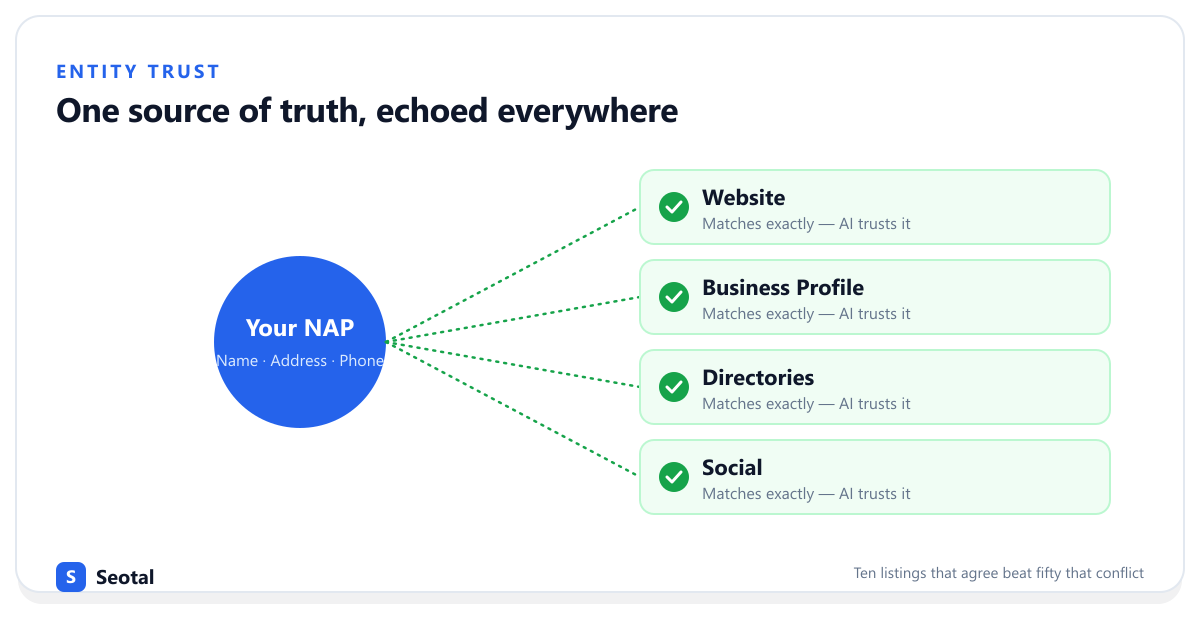
NAP stands for Name, Address, Phone — and consistency of these three across every place your business appears is one of the strongest entity-trust signals there is. When an AI finds your phone number listed three different ways across old directories, it cannot be sure which is right, so it trusts you less.
A practical citation audit:
- Search your business name plus city and list every directory, map, and aggregator you appear on.
- Check the name, address, and phone on each against a single source of truth (usually your Business Profile).
- Fix or claim every listing that disagrees — even small differences like "St." vs "Street" or an old suite number.
- Prioritize the big aggregators and industry-specific directories that feed many others.
This is unglamorous, repetitive work, and it is exactly the kind of task worth automating or delegating — see our roundup of Python scripts for SEO automation for the DIY route, or hire a local SEO specialist to run it for you.
Signal 4: FAQ and Service content that answers real questions
AI Overviews and assistants quote passages — self-contained chunks that answer a question directly. Content built as clear questions and answers is far more extractable than prose that buries the answer.
For each core service, publish a page that states plainly: what it is, what it costs (a range is fine), your service area, how fast you deliver, and answers to the questions customers actually ask. Then mark the Q&A up with FAQPage schema so it is doubly readable.
The test is simple: could an AI lift a single paragraph from your page and hand it to a customer as a complete, accurate answer? If yes, you are citable.
Signal 5: Reviews as a data feed
Treat reviews not as decoration but as a structured, recency-weighted feed the AI scores. There is no official review-count target — Google publishes none — so what counts is a strong rating (most buyers require 4.0★ or higher), a healthy volume relative to your local rivals, and, most importantly, a steady stream of recent ones. Reviews are the second-largest local pack factor, worth roughly 20% of the weighting (BrightLocal, 2026).
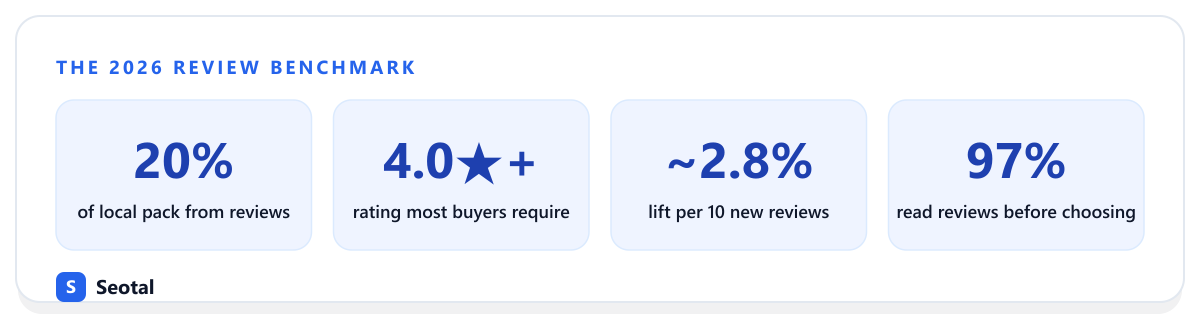
Build a simple habit: ask every satisfied customer for a review, make it one tap via a short link, and encourage them to name the specific service they used — those service mentions help the AI associate you with the matching query. The compounding is real: roughly a 2.8% conversion lift for every ten new reviews (SOCi). Always respond, positive and negative alike; response activity is itself a signal that the business is real and engaged.
Putting it together: an AI-readiness audit
Run this quarterly. It maps directly to the five signals and surfaces the gaps that keep you out of AI answers.
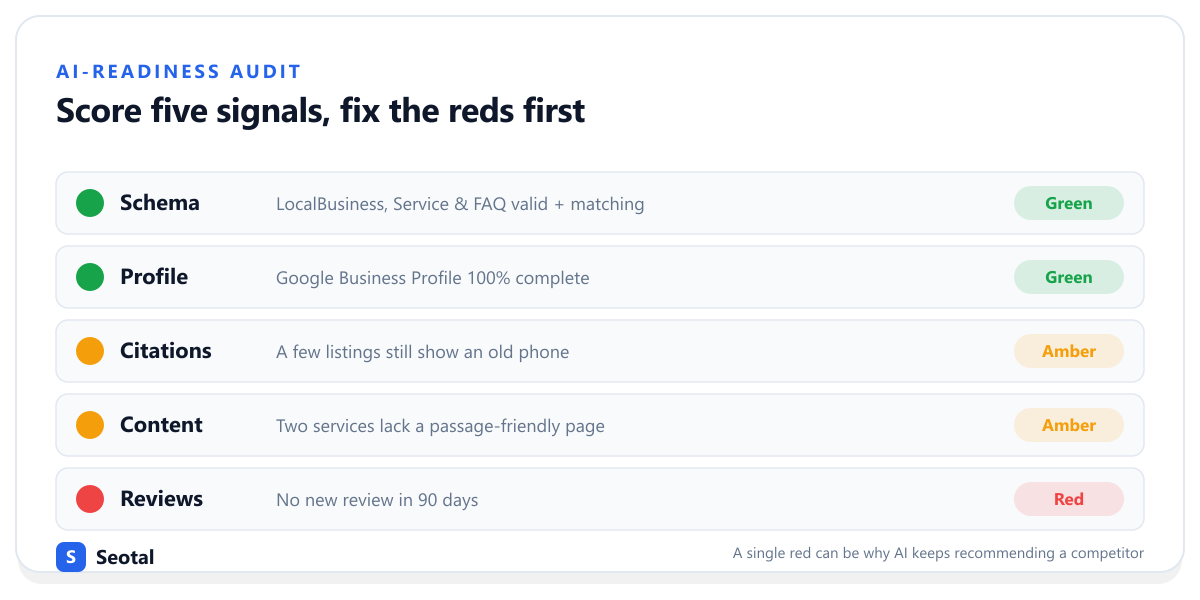
- Schema — validate LocalBusiness, Service, and FAQ markup on every key page; confirm it matches your profile.
- Profile — score your Business Profile out of 100% and close every gap.
- Citations — audit NAP across your top listings and fix every conflict.
- Content — confirm each service has a passage-friendly page with FAQ schema.
- Reviews — check count, rating, recency, and response rate against the 2026 benchmark.
Common mistakes that keep you invisible to AI
Most businesses that fail to get recommended are not doing anything dramatically wrong — they are losing on small, fixable inconsistencies. The usual culprits:
- A phone number that changed but was never updated on an old directory, so your NAP now conflicts across the web.
- The generic category. Choosing Contractor instead of Electrician, or Store instead of Florist, leaves the AI unsure which queries you belong to.
- Schema that does not match the profile — a different suite number or an outdated set of hours in your markup versus your Business Profile.
- Marketing copy where facts should be. "Trusted, reliable, affordable" tells a model nothing; it cannot be quoted as an answer.
- A review profile frozen in time. Great reviews from three years ago read as a business that may no longer be active.
None of these require a redesign or a big budget. They require someone to notice them and fix them — which is exactly the discipline an AI-readiness audit enforces.
The bottom line
AI-ready local SEO is not a growth hack; it is disciplined data hygiene, maintained over time. The businesses that win are the ones whose facts are complete, identical everywhere, and easy for a machine to quote — quarter after quarter.
That discipline is hard to sustain alone while running a business. If you would rather have it handled, our vetted Asia-based specialists do exactly this work at a fraction of agency cost. Compare pricing, hire a local SEO expert, hire an AI SEO specialist, or book a call — and start with our companion guides on how AI search finds local businesses and showing up in Google AI Overviews.
Frequently asked questions
What does "AI-ready local SEO" actually mean?
It means your business data is complete, structured, and consistent enough for AI systems to read and confidently recommend you. In practice that is five signals: schema markup, a complete Google Business Profile, NAP consistency, answer-shaped content, and a healthy review feed.
Is LocalBusiness schema really necessary for a small business?
Yes. It is the highest-ROI markup for local businesses because it hands AI and Google your core facts in a format they do not have to guess at. Businesses whose schema matches their profile are easier for AI to cite in answers.
How do I keep my NAP consistent across directories?
Pick one source of truth — usually your Google Business Profile — then audit every listing against it and fix conflicts, including small ones like abbreviations or old suite numbers. Re-check quarterly, since listings drift over time.
Do I need a developer to add schema markup?
Not necessarily. Many site platforms and plugins generate LocalBusiness schema, and you can validate it with Google's Rich Results Test. For custom sites, a front-end developer or an SEO specialist can add it in an afternoon.
How often should I run an AI-readiness audit?
Quarterly is a good rhythm for most local businesses. Schema and profile fixes hold up well, but citations drift and review recency needs constant attention, so a quarterly pass keeps all five signals green.
 How to Show Up in Google AI Overviews for Local Searches (2026)
  How AI Search Finds Local Businesses (and How to Get Recommended)
  Structured Data on Southeast Asia's Top Websites: A Schema Markup Study (2026)