
 Philippines
 Vietnam
 Bali, Indonesia
 Malaysia
 Dubai, UAE
 India

Only 35% of small businesses have a Google Business Profile, according to BrightLocal, yet 71% of US consumers use Google to read reviews of local businesses. Most local SEO work closes that gap: a correct profile, a steady flow of reviews and pages Google can match to "near me" searches. None of it needs a full-time hire.
How much does it cost to outsource local SEO?
Outsourced local SEO costs $499 to $1,999 a month at the published prices of two specialist firms, and about $1,557 on average across SEO providers with local clients. Ahrefs surveyed 439 SEO providers for its August 2024 pricing study. Agencies charged local clients $1,819 a month on average and freelancers about $1,150. General SEO work cost more, at $2,917.
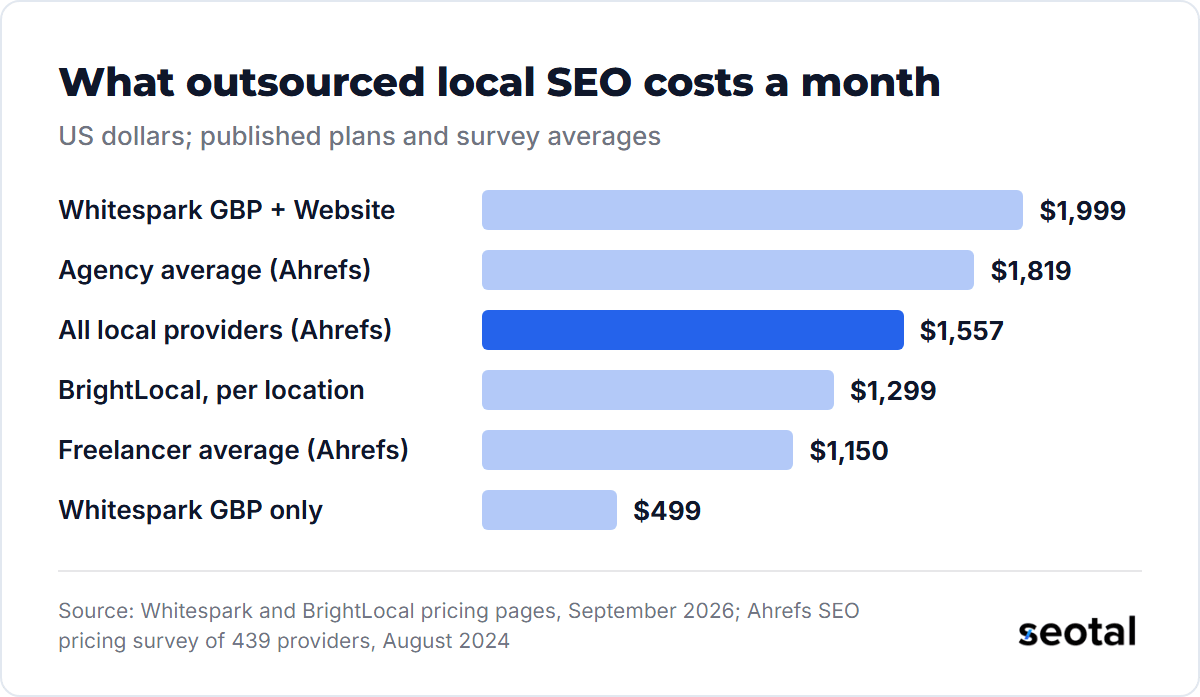
The price depends on how many locations you have and whether the website is in scope. BrightLocal's managed service charges $1,299 per location, so a three-location dentist pays three times that. Profile-only plans are the cheap end. Plans that also rewrite location pages and build links sit near $2,000.
Hourly work suits one-off jobs such as a profile cleanup or a citation audit. The most common hourly rate for local SEO in the Ahrefs survey is $75 to $100.
What does a local SEO package include?
A local SEO package covers four jobs: the Google Business Profile, reviews, citations and the location pages on your website. Plans differ in how much of the last two they include. The table lists three published offers, read from the vendors' own pages in September 2026:
| Package | Monthly price | Business Profile | Reviews | Citations and links | Website work | Term |
|---|---|---|---|---|---|---|
| Whitespark GBP | $499 | Optimization, weekly posts | Strategy, replies to all reviews | Not listed | Not included | No contract |
| Whitespark GBP + Website | $1,999 | Same as above | Same as above | Not listed | Audit, content, conversion work | No contract |
| BrightLocal managed | $1,299 per location | Daily posts, monthly photos | Replies, spam fighting | 25 citations in month 1, then 10 a month, plus links | 10+ pages optimized and 10+ city pages a month | 12 months in its help center |
The volume in the BrightLocal plan is large for a single shop: over 14,000 words of content and six YouTube videos per campaign. A plumber in one town may not need ten new city pages a month. Ask what each deliverable is for before you pay for it.
Is outsourcing cheaper than hiring an in-house local SEO?
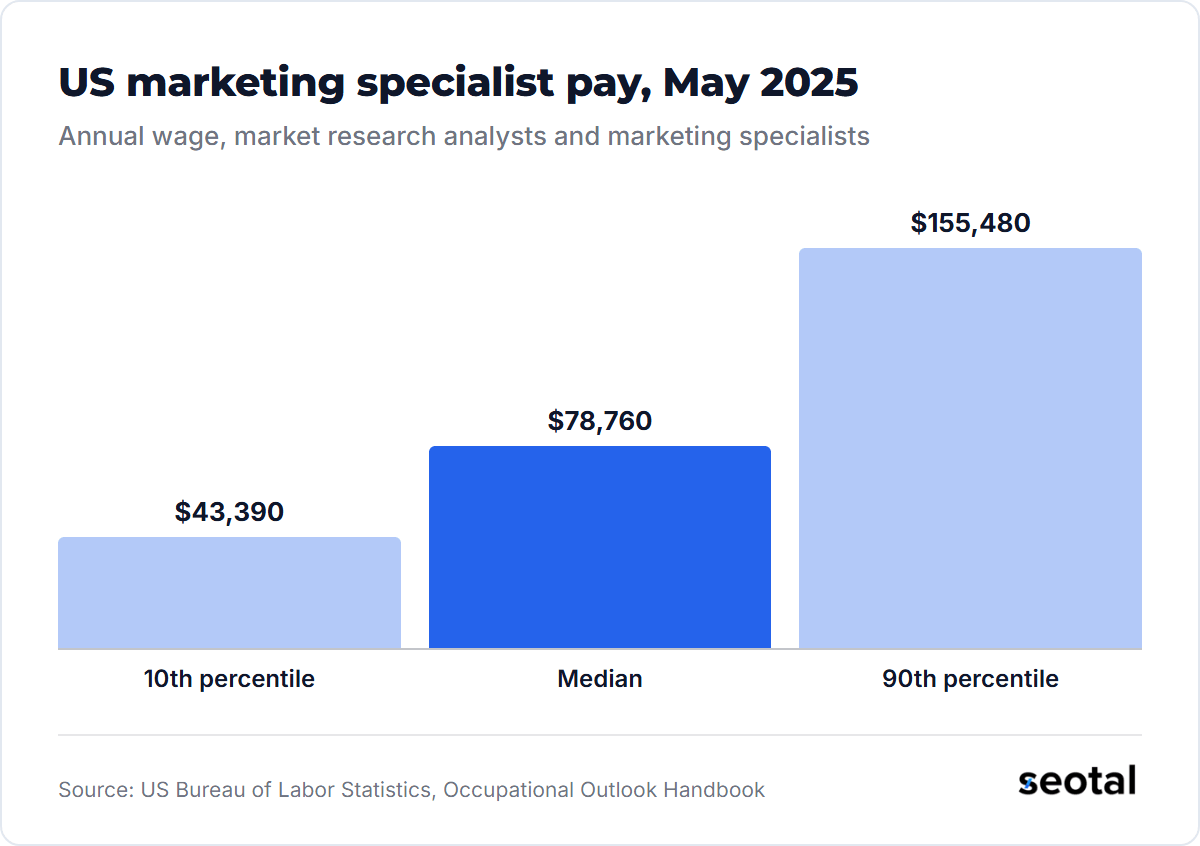
Yes, for a single business. The median US market research analyst and marketing specialist earned $78,760 in May 2025, or about $6,563 a month, per the Bureau of Labor Statistics. That is more than four times the average local SEO retainer in the Ahrefs survey.
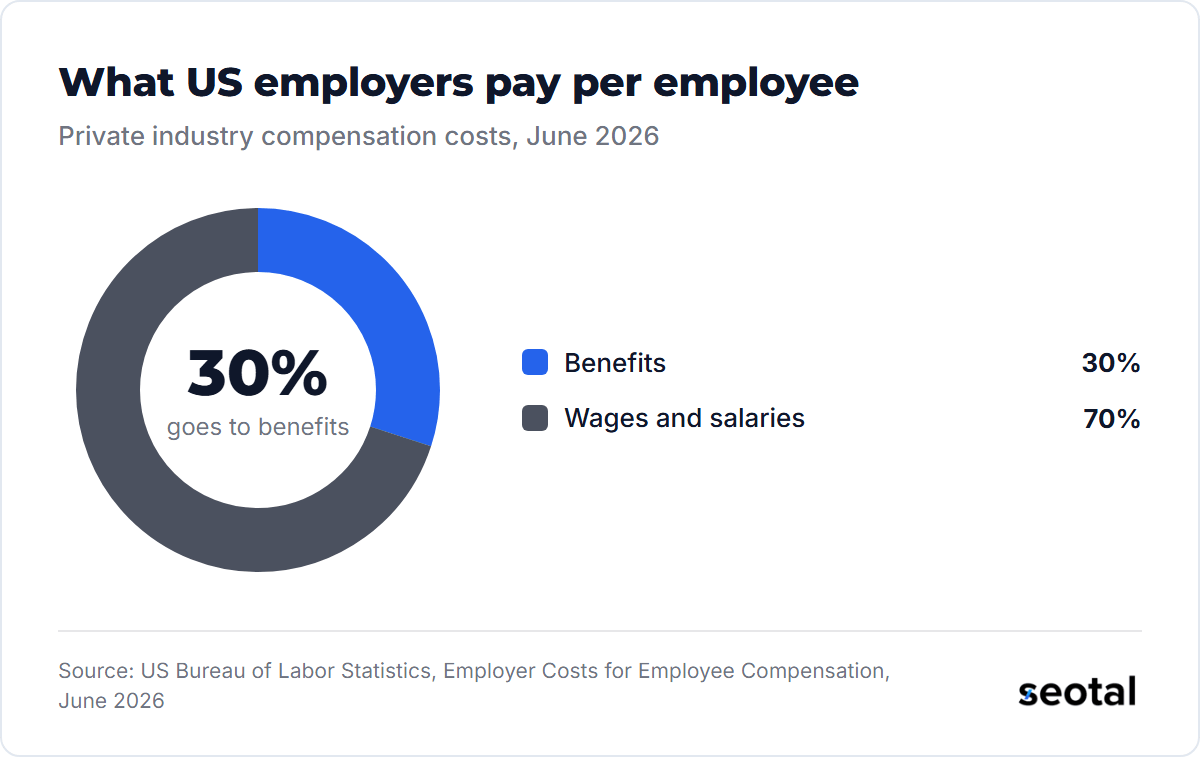
Salary is only part of what an employee costs. In June 2026, benefits made up 30.0% of what private US employers spent on compensation, per the BLS Employer Costs for Employee Compensation release. Paid leave, insurance and retirement plans come on top of the wage.
A full-time hire makes sense for a chain with dozens of locations, where profile edits, review replies and store pages fill a week. For one location, the recurring work after setup is review replies, profile posts and listing fixes, which fits a part-time plan.
- Median wage $78,760 a year
- Benefits add 30% of compensation cost
- One person's skills
- Fixed at 40 hours a week
- Average retainer $1,557 a month
- Benefits are the provider's cost
- Tools and process come with the plan
- Hours set by the plan
What can an outsourced specialist change in your rankings?
Google names three things it uses to rank local results: relevance, distance and prominence. Its local ranking help page defines distance as "how far each business is from the customer who's searching". Distance is the one factor a provider can't move. Google also states that "there's no way to request or pay for a better local ranking".
That leaves relevance and prominence, and most of the top factors sit there. In Whitespark's 2026 Local Search Ranking Factors survey, the primary Business Profile category scored highest for the map pack, at 227. A side by side of the 2023 and 2026 reports by GMBapi shows all seven factors that appear in both top tens gaining weight.
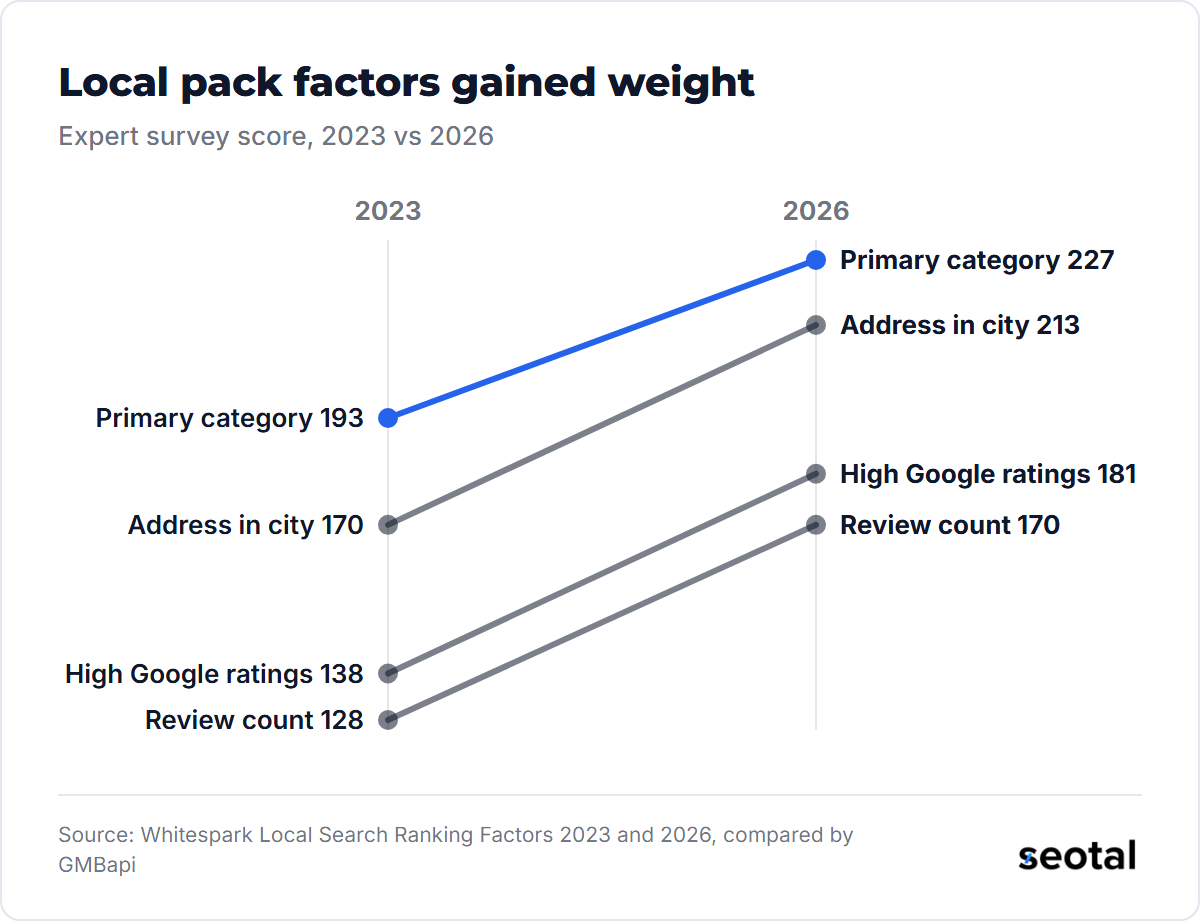
Proximity to the searcher and a physical address in the city searched ranked second and fourth. You can't outsource those. An outside specialist can fix the rest of the top ten:
- Primary and extra categories: choosing the category that matches what people search for.
- Opening hours: "open at the time of search" entered the 2026 top ten at 189.
- Map pin placement: a new top ten entry, scored 165.
- Ratings and review count: a review program, covered below.
Why reviews are the work most worth paying for
Reviews move both rankings and customers. Review recency jumped from 93rd to 11th place between the two Whitespark surveys. On the customer side, BrightLocal's Local Consumer Review Survey 2026, a panel of 1,002 US adults, found that 97% read reviews for local businesses.
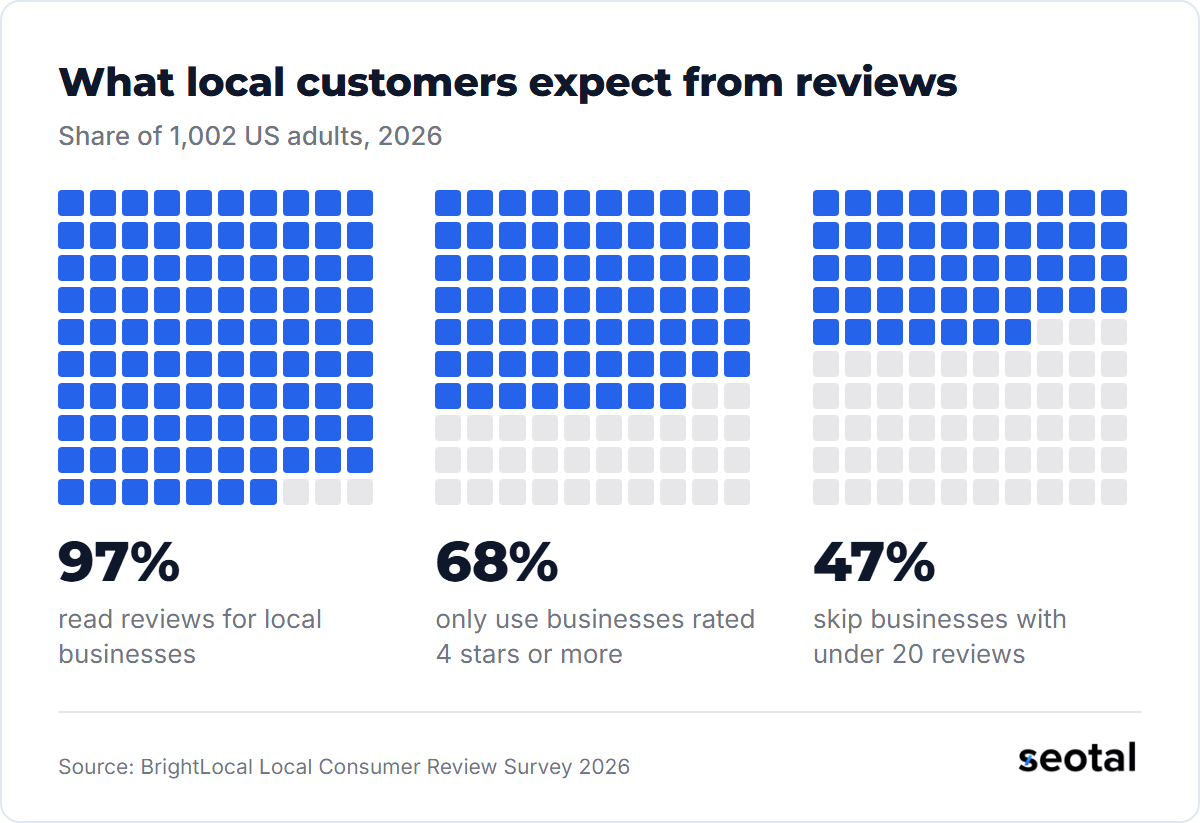
Consumers now want fresh reviews: 74% only care about reviews from the last three months. They also expect replies. 89% expect owners to respond, 81% within a week, and templated responses put off 50%. That is steady weekly work, which suits an outside specialist.
Businesses asked 78% of consumers for a review in the past year, and 83% of those asked left one. Reviews also send people to your site: 54% visit a business's website after reading positive reviews, yet BrightLocal says only 40% of local businesses have one.
When does outsourced local SEO pay for itself?
Outsourced local SEO pays for itself in the month the extra jobs it brings in cover the fee. Work that out from your gross profit per job, not from revenue. BrightLocal's help center says it expects "meaningful growth in results (clicks, calls, leads) within 4-6 months".
Vendors publish their own client averages. Whitespark reports an 87% average increase in phone calls and a 567% average increase in Google reviews for its service clients. These are vendor figures without a published method, so treat them as a ceiling, not a forecast.
Track results in the Business Profile performance report, which shows calls, direction requests and website clicks from the profile. Ask for those numbers each month, next to rankings.
- 1Ask for past workGoogle's own advice lists examples and success stories as the first question to ask any SEO.
- 2Ask what changes they will makeGoogle warns against firms that are secretive about their methods.
- 3Reject ranking guaranteesGoogle says no one can guarantee a #1 ranking.
- 4Check the term and exit noticeCompare the contract with the sales page.
- 5Ask how reviews are requestedIncentives tied to positive reviews break the FTC rule.
The first three come from Google's page Do you need an SEO?, updated in June 2026. It also warns against SEO firms that email you out of the blue.
The same work now feeds AI answers. Whitespark's 2026 report added AI search visibility for the first time, and its top signals overlap with local SEO: "best of" lists, mentions on news and local sites, and review strength. Our guide to how AI search finds local businesses covers those signals.
Outsourcing is not worth it when the business can't take more work. A contractor booked out for two months gains little from more calls. The same goes for a business with no reviews that won't ask customers for them: no provider can fix that for you.
Outsource local SEO with Seotal
Seotal is not an agency: it matches you with a vetted freelance SEO specialist from Asia who works on your account. You can hire hourly at $15 to $30 with no minimum, or on a part-time retainer of $1,000 to $2,000 a month for 60 to 80 hours, with a 3-month minimum. There are no platform fees. Our local SEO outsourcing page covers typical scopes, and pricing lists every plan.
I would start with the profile, categories and a review routine, then add location pages once reviews are flowing. The how it works page shows the matching steps, and our guide to SEO outsourcing costs covers the wider budget.
Frequently asked questions
Can I do local SEO myself instead of outsourcing it?
You can: the Google Business Profile is free, and so is asking customers for reviews. Outsourcing makes sense when nobody on your team keeps up the weekly work of review replies, posts and listing fixes.
Does outsourced local SEO work for businesses without a storefront?
It does, with one limit. Service-area businesses such as plumbers hide their address, and "address shows on the profile" scored 176 in Whitespark's 2026 survey. A provider can still fix categories, hours, reviews and the local SEO schema on your site.
 How Much Does SEO Outsourcing Cost in 2026?
 SEO Agency Pricing: What US SEO Companies Cost in 2026
 Top 10 Technical SEO Experts to Hire in 2026